"
Skip to content
Logo for College of Western Idaho Pressbooks

Primary Navigation

  • Home
  • Read
  • Sign in

Want to create or adapt books like this? Learn more about how Pressbooks supports open publishing practices.

Book Contents Navigation

Contents
  1. Introduction

  2. Learning to Look
    1. Learning to Look: elements, principles and describing what you see

    2. How art can help you analyze

    3. Introduction to Art and Art History

    4. Artistic Techniques

  3. The Ancient World
    1. Chapter 1: Prehistoric Art

      1. Introduction to Prehistoric Art
      2. The Paleolithic Period
      3. The Neolithic Period
      4. FURTHER RESOURCES
    2. Introduction and Timeline: The Ancient Near East and Ancient Egypt

    3. Chapter 2: Ancient Near East

      1. The Ancient Near East – an introduction
      2. SUMER c. 3500-2340 BCE
      3. AKKAD  2340-2180 BCE
      4. NEO-SUMERIA/UR III  2150 -2030 BCE
      5. HITTITES, an introduction
      6. BABYLON (the city 2016-1595) BCE and NEO-BABYLONIA (612-539 BCE)
      7. PERSIA – 559-31 BCE
    4. Chapter 3: Ancient Egypt

      1. Introduction to Ancient Egypt
      2. PREDYNASTIC AND EARLY DYNASTIC EGYPT
      3. OLD KINGDOM AND FIRST INTERMEDIATE PERIOD
      4. MIDDLE KINGDOM (c. 2030–1640 B.C.E.)
      5. NEW KINGDOM and THIRD INTERMEDIATE PERIOD
      6. LATE, PTOLEMAIC, and ROMAN PERIODS
      7. ANCIENT NUBIA and the KINGDOM OF KUSH
    5. Chapter 4: The Ancient Aegean

      1. The Ancient Aegean – an introduction
      2. CYCLADIC ART
      3. MINOAN ART
      4. MYCENAE
      5. Conclusion
  4. The Classical World
    1. Chapter 5: Ancient Greece

      1. Chapter Contents      
      2. Chronological Periods
      3. ARCHAIC PERIOD
      4. EARLY CLASSICAL PERIOD
      5. LATE CLASSICAL PERIOD
      6. HELLENISTIC PERIOD
    2. Chapter 6: The Etruscans and Ancient Romans

      1. THE ETRUSCANS
      2. ROME
      3. Introduction – architecture, cities, tombs and wall painting
      4. ROMAN REPUBLIC c. 509-27 B.C.E.
      5. MIDDLE EMPIRE 117-235 C.E.
    3. Chapter 7: Jewish and Early Christian Art

      1. INTRODUCTION
      2. Part 1:  Introduction to Jewish and Early Christian Art and Architecture
      3. Part 2:  Early Christian Art and Architecture after Constantine
  5. The Medieval World
    1. Chapter 8: The Byzantine World

      1. Part 1: A Beginner’s Guide
      2. Part 2: The Early Byzantine – Constantine and Justinian
      3. Part 3: Middle Byzantine c. 843-1204
      4. Part 4:  Byzantium and its neighbors
      5. Part 5:  The Fourth Crusade and the Latin Empire
      6. Part 6:  Late Byzantine – 1261-1453
    2. Chapter 9: The Islamic World

      1. Introduction to Islamic Arts:   History, Art and Architecture
      2. Contents 
    3. Chapter 10: Early Medieval Art in Western Europe

      1. This chapter contains the following:
      2. Introduction: The Early Medieval Period in Western Europe
      3. The Vikings
      4. The Anglo-Saxons
      5. Carolingian Period
      6. Ottonian Period
    4. Chapter 11: The Romanesque Period

      1. BEGINNER’S GUIDE
      2. FRANCE
      3. ITALY
      4. ENGLAND (c. 1000-1200 C.E.)
      5. SPAIN
      6. The Morgan Beatus
    5. Chapter 12: The Gothic Period

      1. A Beginner’s Guide to the Gothic
      2. France
      3. ENGLAND
      4. Italy, Germany, and the Czech Republic
      5. Spain and Portugal
      6. THE LATE GOTHIC
      7. THE CRUSADES
  6. Glossary Terms

    1. Glossary

ARTS 101: Art and Architecture from the Prehistoric World through the Medieval World

Learning to Look: elements, principles and describing what you see

Learning to Look – an introduction:

This section of your book is a guide to looking at and describing art and an introduction to the study of Art History.  You’ll probably want to return to this section over the course of the semester to revisit terminology and ideas as your knowledge and experience grows.

Why Art Matters

Elements of Art and Architecture

Principles of Composition

Describing What You See – Art History and Visual Analysis


Why Art Matters (why look at art?)

URL: https://youtu.be/0OloYD_kSbU

Source: Dr. Steven Zucker and Dr. Beth Harris, “Why art matters (why look at art?),” in Smarthistory, November 25, 2015, accessed November 8, 2024, https://smarthistory.org/why-look-at-art/.


Key terminology covered in this section

Contour line

Hatching

Shading

Organic lines and shapes

Geometric (or inorganic) lines and shapes

Implied lines

Form

Colors: primary, secondary, and tertiary

Hue

Complementary and analogous colors

Value (tint and shade)

Saturation

Contrast

Space – real or represented

Linear perspective – horizon line, vanishing point, orthogonals

Atmospheric perspective

Texture

Plan

Elevation

Section

Elements of Art and Architecture

Line, Shape and Form, Color, Space, Texture, Surface and Depth, Architectural Plans.

Line

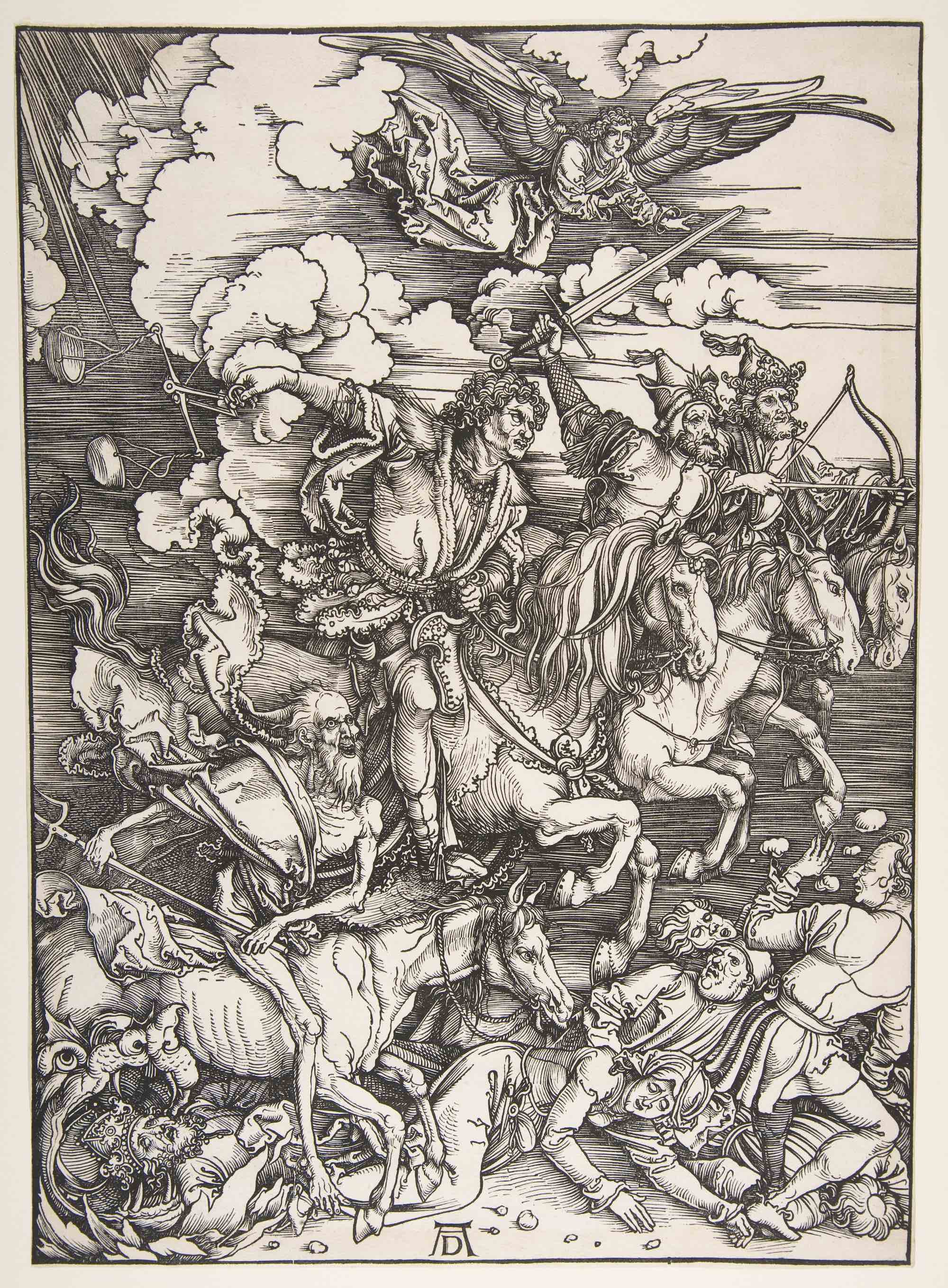
Albrecht Dürer, The Four Horsemen, from The Apocalypse,1498, woodcut, 38.7 x 27.9 cm (The Metropolitan Museum of Art)
Albrecht Dürer, The Four Horsemen, from The Apocalypse, 1498, woodcut, 38.7 x 27.9 cm (The Metropolitan Museum of Art)

Line is the most basic visual element. Lines can be used to define shapes and figures, but also to indicate motion, emotion, and other elements

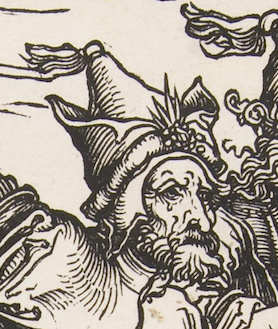
Detail, Albrecht Dürer, The Four Horsemen, from The Apocalypse,1498, woodcut, 38.7 x 27.9 cm (The Metropolitan Museum of Art)
Detail, Albrecht Dürer, The Four Horsemen, from The Apocalypse,1498, woodcut, 38.7 x 27.9 cm (The Metropolitan Museum of Art)

Contour lines and hatching

In a woodblock print of the Four Horsemen of the Apocalypse by Albrecht Dürer, contour lines — lines that define shapes — are used to mark the outside of all of the elements of the image.

The outline of the hat on one of the horsemen, for example, is clearly made by a few black contour lines. This simple device is so effective that it is hard to remember that there is no hat here, only a few black marks on a white page.

Note, though, that lines are also used to show shading – the shadows caused when light hits one side of an object, leaving the other in shadow. On the hat, for example, the closely spaced lines, called hatching, show that the left side of his hat is in a shadow. This also helps the hat to look more three-dimensional, giving it a sense of form.


Roy Lichtenstein, In the Car, 1963, oil and magna on canvas, 172.00 x 203.50 cm (National Galleries, Scotland, © Estate of Roy Lichtenstein/DACS 2018)
Roy Lichtenstein, In the Car, 1963, oil and magna on canvas, 172.00 x 203.50 cm (National Galleries, Scotland, © Estate of Roy Lichtenstein/DACS 2018)

Contour lines outline all the figures and forms in the image, creating the illusion of shading and form. In addition, there are horizontal lines in the background. While these create shading, they also help create the sense that the riders are moving rapidly from left to right. Motion lines may be familiar to you from comic strips, but they appear in all sorts of work.

Organic and inorganic (geometric) lines

In the Dürer print, we can also divide the lines into organic and inorganic (or geometric) lines (see the section on shape for more on organic and inorganic). Organic lines are loose, curving lines like those found in nature. In the Dürer print, the lines of the horses’ manes and tails, the figures’ hair, and the ruffled clouds are all organic. Inorganic lines are generally straight or perfectly curving lines, like those found in geometry. In this image, most of the lines are organic, but the horizontal lines in the background are inorganic.

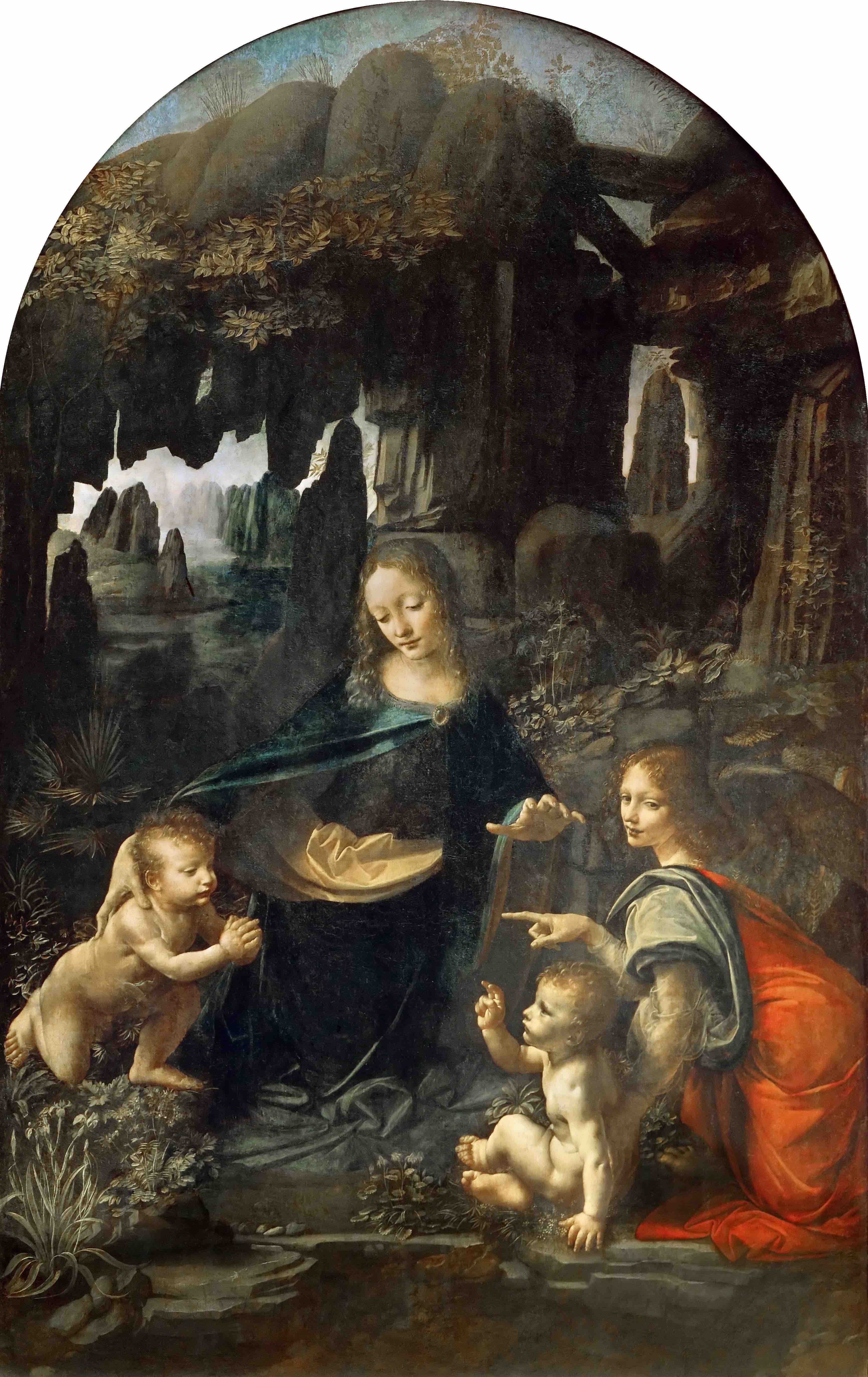
Leonardo da Vinci, The Virgin of the Rocks, c. 1483-86, oil on panel, 199 x 122 cm (Louvre, Paris)
Leonardo da Vinci, The Virgin of the Rocks, c. 1483-86, oil on panel, 199 x 122 cm (Louvre, Paris)

Implied lines

We can also look for implied lines. These are not actually drawn, but we can connect the dots (literally or figuratively) to create the lines in our minds. Leonardo da Vinci’s Virgin of the Rocks contains wonderful examples of implied lines.

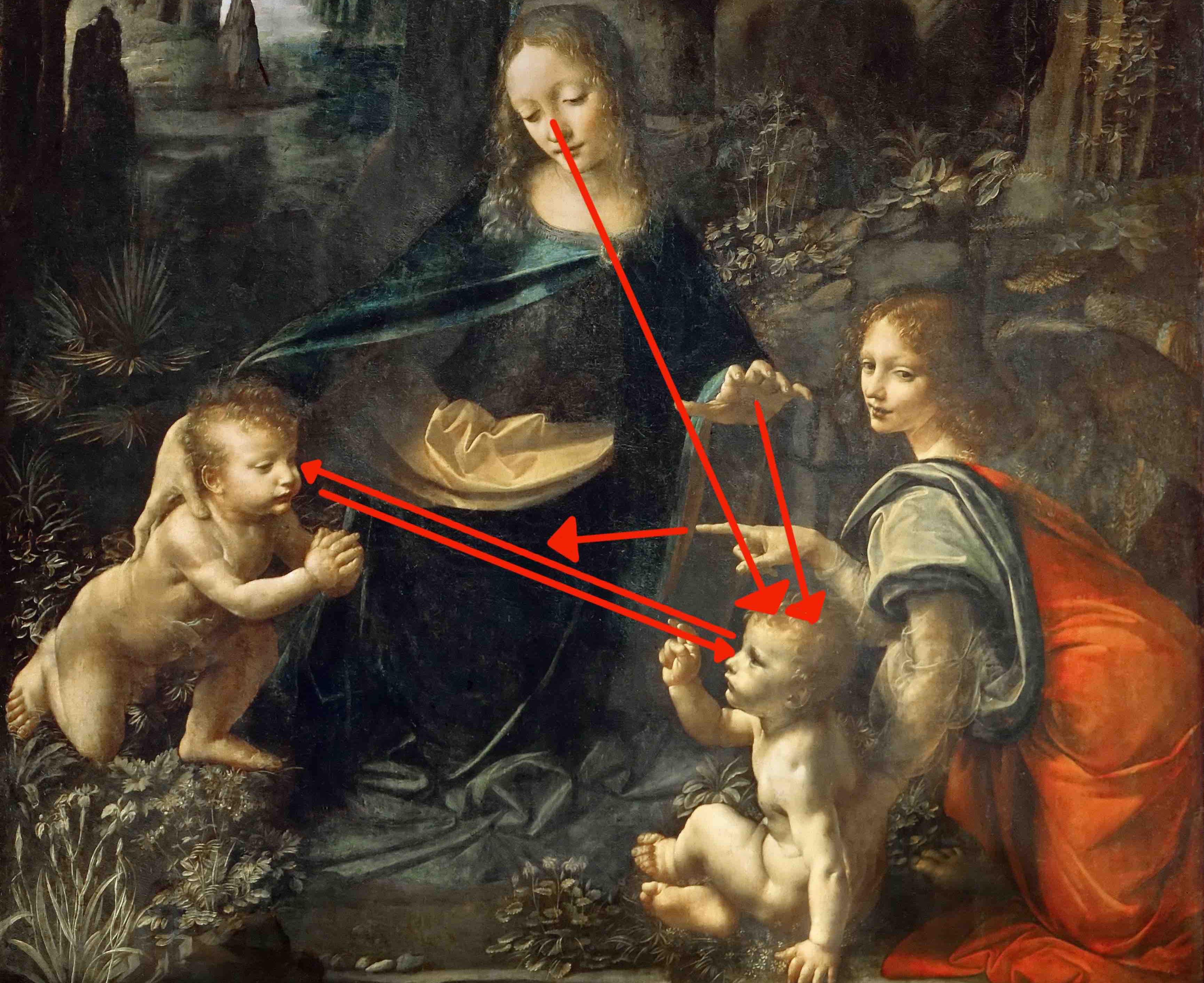
Here, the implied lines are sight lines, which guide us throughout the image. These help us know where to look, and show us what is important in the painting. Follow the gazes of the figures as they look and point at one another. The angel in the red cape to the right looks out at us, and then points at the infant John the Baptist, at the left. He looks at the infant Jesus, who in turn looks back again at him. Above, Mary looks down at Jesus, and also gestures toward him with her hand.

Detail with implied lines, Leonardo da Vinci, The Virgin of the Rocks, c. 1483-86, oil on panel, 199 x 122 cm (Louvre, Paris)

Basically, once we make it into the space of the painting by meeting the gaze of the angel, we become locked in a cycle of movement between the holy figures, guided by their sight lines.

Shape and Form

Shape builds on line and color, as it has to be made of one or both of these. Shape is the property of a two-dimensional form, usually defined by a line around it or by a change in color.  There are two main types of shapes, geometric and organic. While most works of art contain both geometric and organic shapes, looking at those that are more completely divided can serve to clarify these qualities.

Geometric shapes

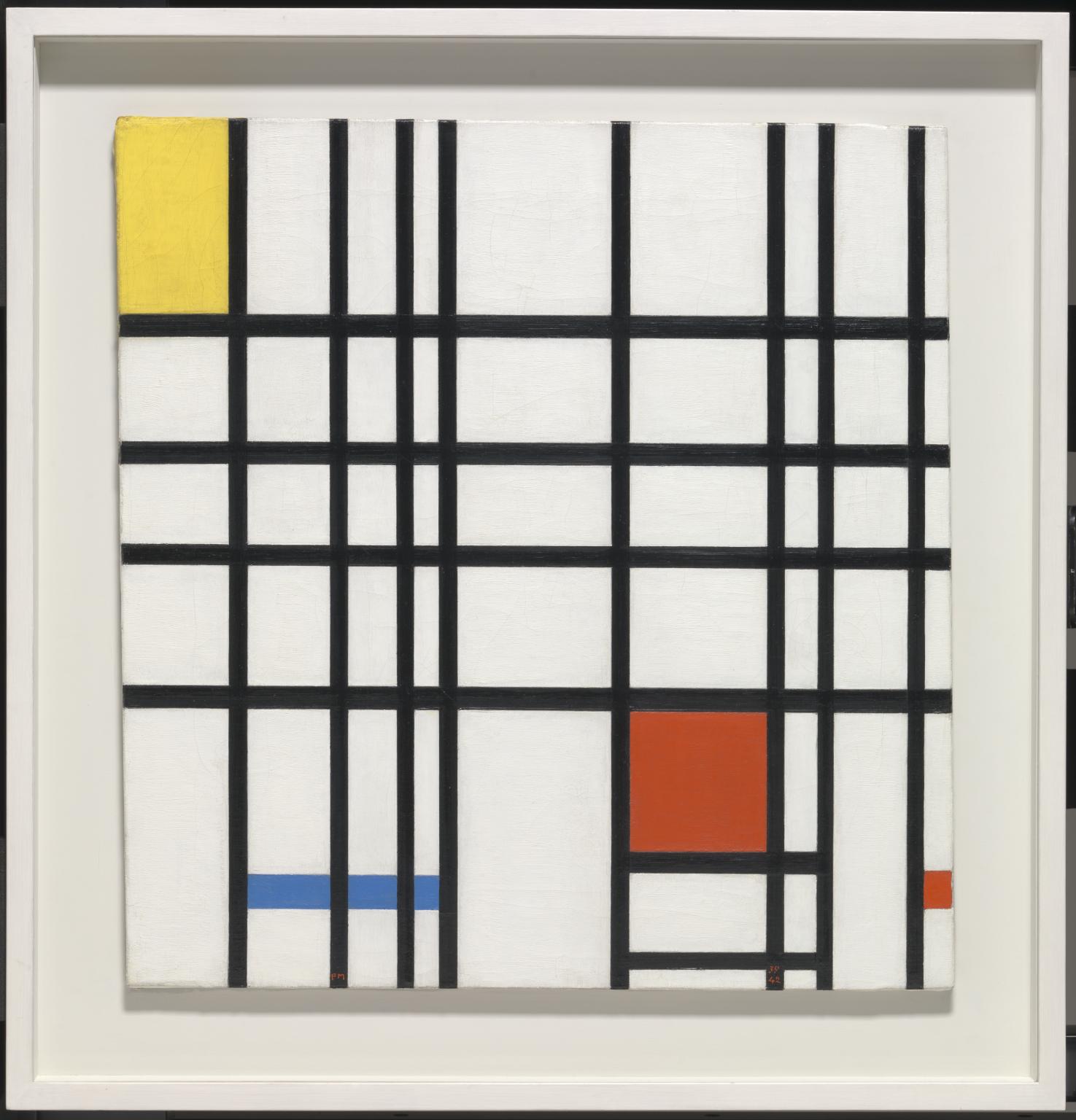
Piet Mondrian is an excellent example of an artist who used geometric shapes almost exclusively. In his Composition with Yellow, Blue and Red (1937-42), Mondrian, uses straight vertical and horizontal black lines to divide his canvas into rectangles of primary colors.

Piet Mondrian, Composition with Yellow, Blue and Red, 1937–42, oil on canvas, 72.7 x 69.2 cm (Tate)
Piet Mondrian, Composition with Yellow, Blue and Red, 1937–42, oil on canvas, 72.7 x 69.2 cm (Tate, CC-BY-NC-ND 3.0)

Nothing here gives the impression of the natural world.

Organic Shapes

On the other hand, Maori facial tattooing, known as moko, uses primarily organic shapes. They are still, like Mondrian’s shapes, generally abstract — they do not depict any clear images — but the shapes are like those found in nature, curving, twisting, and spiraling across their wearers’ faces. The edges of the lines and shapes are crisp, but the forms are curving and sensuous.

Moko(photo: James Heremaia, license information)
Moko (photo: James Heremaia, license information)

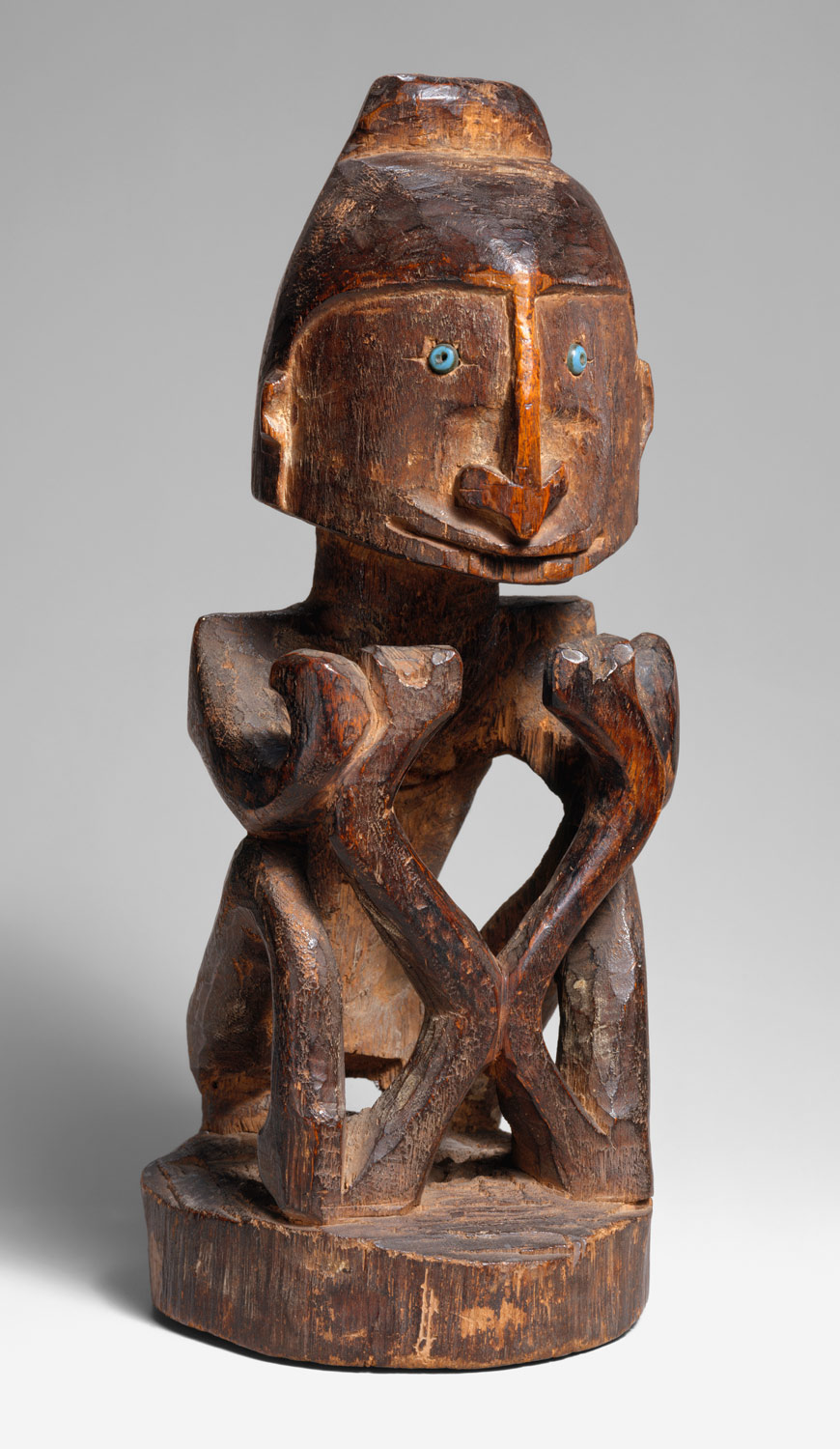
"Ancestor
Korwar), late 19th–early 20th century, Indonesia, Papua Province (Irian Jaya), Cenderawasih Bay region, in northwest New Guinea, wood and glass beads, 26 cm high (The Metropolitan Museum of Art)

Form

Form is actual, three-dimensional shape, though it is often used to describe the illusion of three-dimensionality, as well. Like shape, form can be geometric or organic.

A small korwar — a representation of an ancestor — from Irian Jaya, New Guinea, mixes these form types well. While the figure is predominantly geometric, with the head shaped like a cube and the nose an arrow pointing downward, the curving organic lines around the eyes soften this effect a bit.

Color

Hue
Colours of the visible light spectrum
Colors of the visible light spectrum (image: Meganbeckett27, CC BY-SA 3.0)

Artists can use colors for many reasons other than to simply duplicate reality including setting moods and highlighting importance.

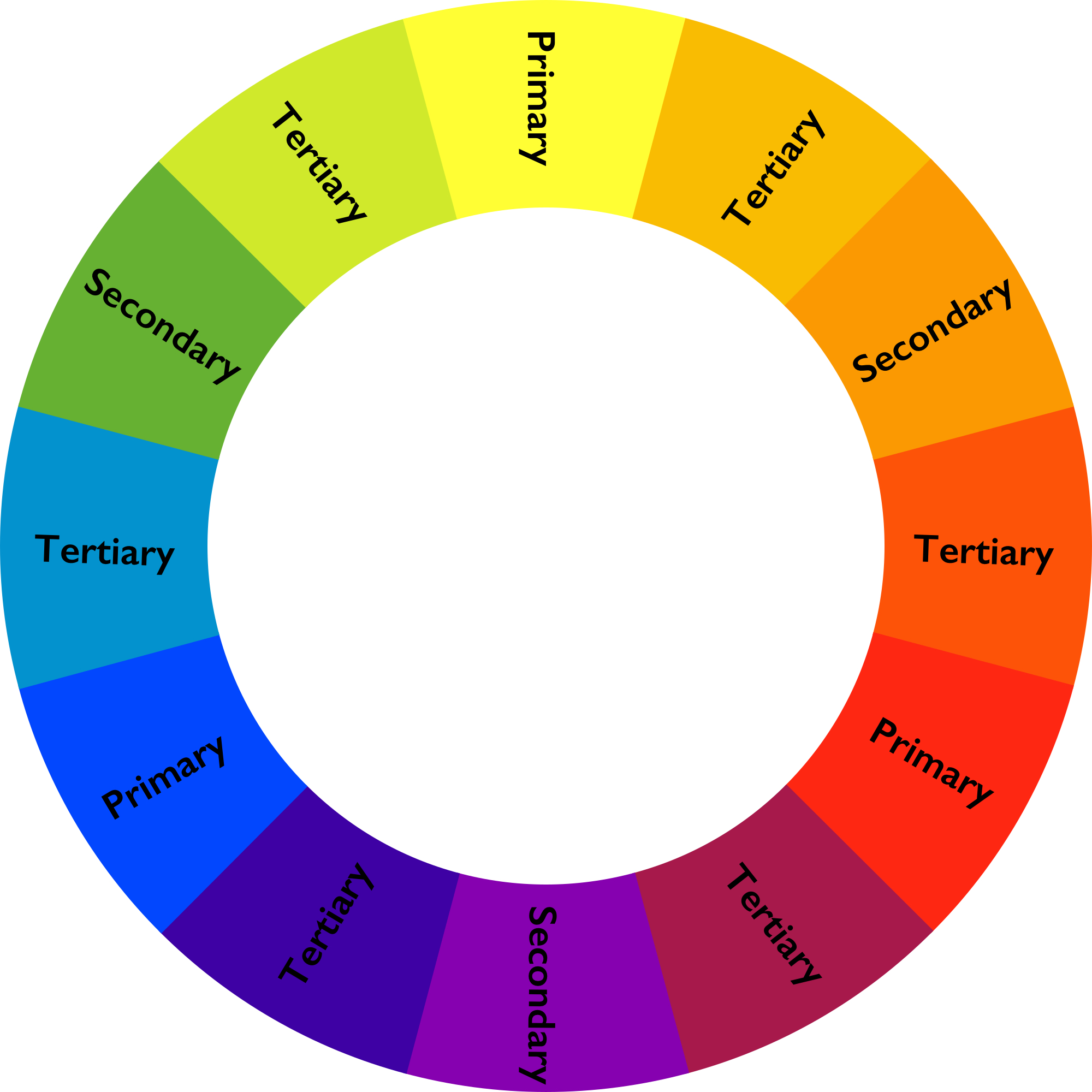
The colors of the world can be divided in different ways. When we use the term “color” casually, what we usually mean is hue. Hues appear on the visible spectrum. On the spectrum, we see the pure hues. These can be divided into primary, secondary and tertiary colors, as on this color wheel.

Color wheel (image: public domain)

Primary, secondary and tertiary colors

Primary colors are, for most art media, red, yellow and blue (the exception is the additive color system, which is used in computer screens, theater lighting and the like, and has red, green, and blue as its primary colors). All the rest of the colors can be made from these.

Secondary colors are made by mixing two primary colors: Red and yellow make orange, and so on.

Tertiary colors are made by mixing a primary color with a secondary color.

Complementary and analogous colors

The colors opposite one another (like red and green or blue and orange) are complementary colors, which tend to stand out boldly next to one another. These are therefore often used for university colors and sport team logos. Colors next to one another (like red and orange or blue and green) are analogous colors, and these tend to blend together more smoothly.

Warm and cool colors

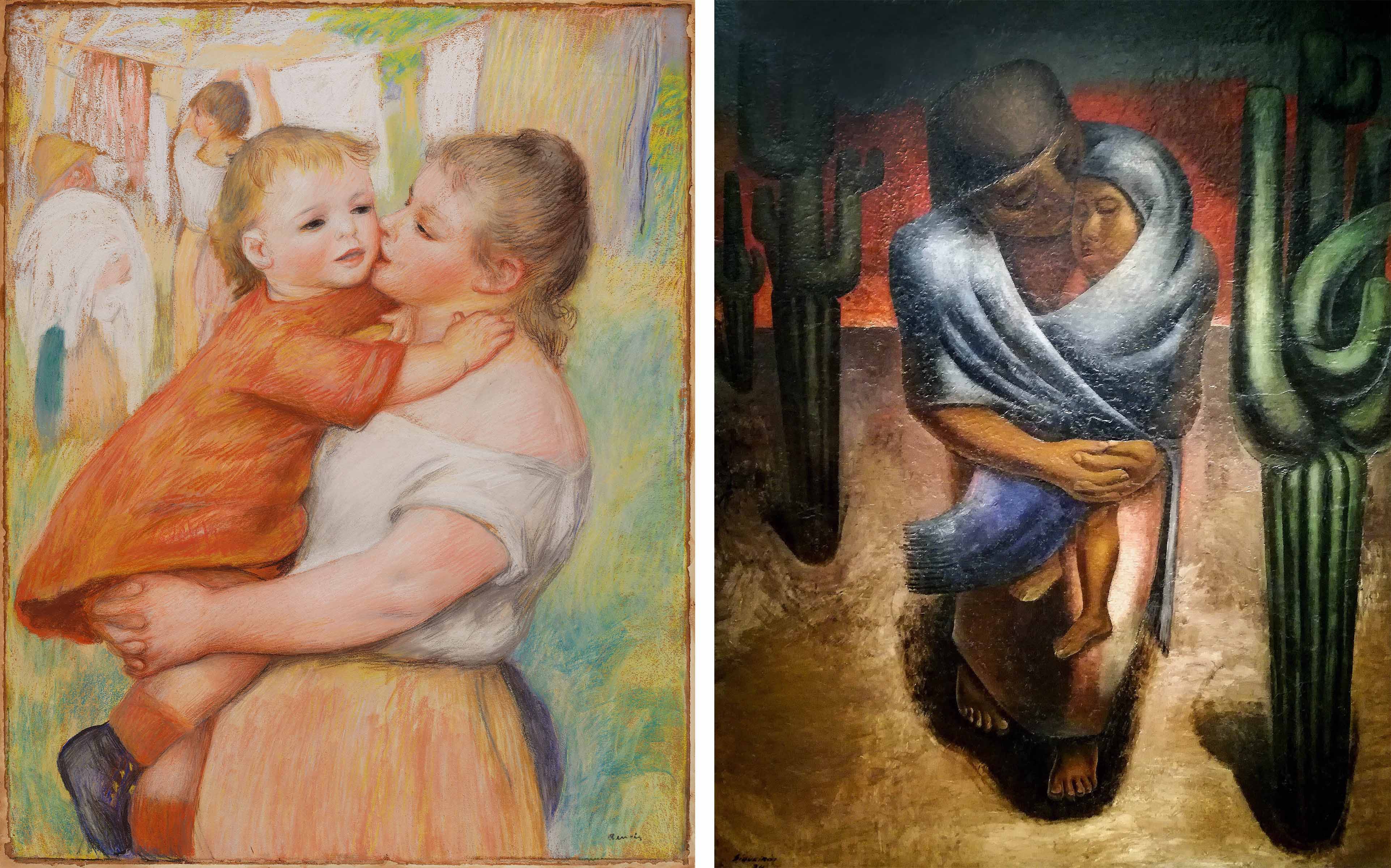
The colors on the left of this wheel are called cool colors and those to the right are warm colors. Using cool or warm colors in an image can create moods. Pierre Auguste Renoir used warm colors for his Mother and Child, 1886, creating a warm, cheerful, inviting scene. The oranges, pinks and yellows dominate the image.

Left: Pierre-Auguste Renoir, Mother and Child, 1886 right: David Alfaro Siqueiros, Peasant Mother, 1962
Left: Pierre-Auguste Renoir, Mother and Child, 1886, pastel, 79.1 x 63.5 cm, (Cleveland Museum of Art); right: David Alfaro Siqueiros, Peasant Mother, 1962, oil on burlap, 249 x 180 cm (Museum of Modern Art, Mexico City) © David Alfaro Siqueiros

Diego Alfaro Siqueiros presents a similar subject in his Peasant Mother (1929), but through the use of cool colors, instead creates a sad, cold scene dominated by figures of blues and greens. Neither of these artists was worried about portraying the world as it really looked. Instead, they used color to inspire feelings in the viewer.

Value (tint and shade)

Color can also be considered in terms of value, which is the degree of lightness or darkness of a color. If we add white to a hue, we get a tint. If we add black, we get a shade. As we might expect, tints tend to be more cheerful — pastel colors are all tints. Shades tend to be gloomier. Indeed, our terms for moods are based on these properties, so that we say that we are lighthearted, or in a dark temper. There are many tints in the Renoir’s Mother and Child, and many shades in Siqueiros’ Peasant Mother.

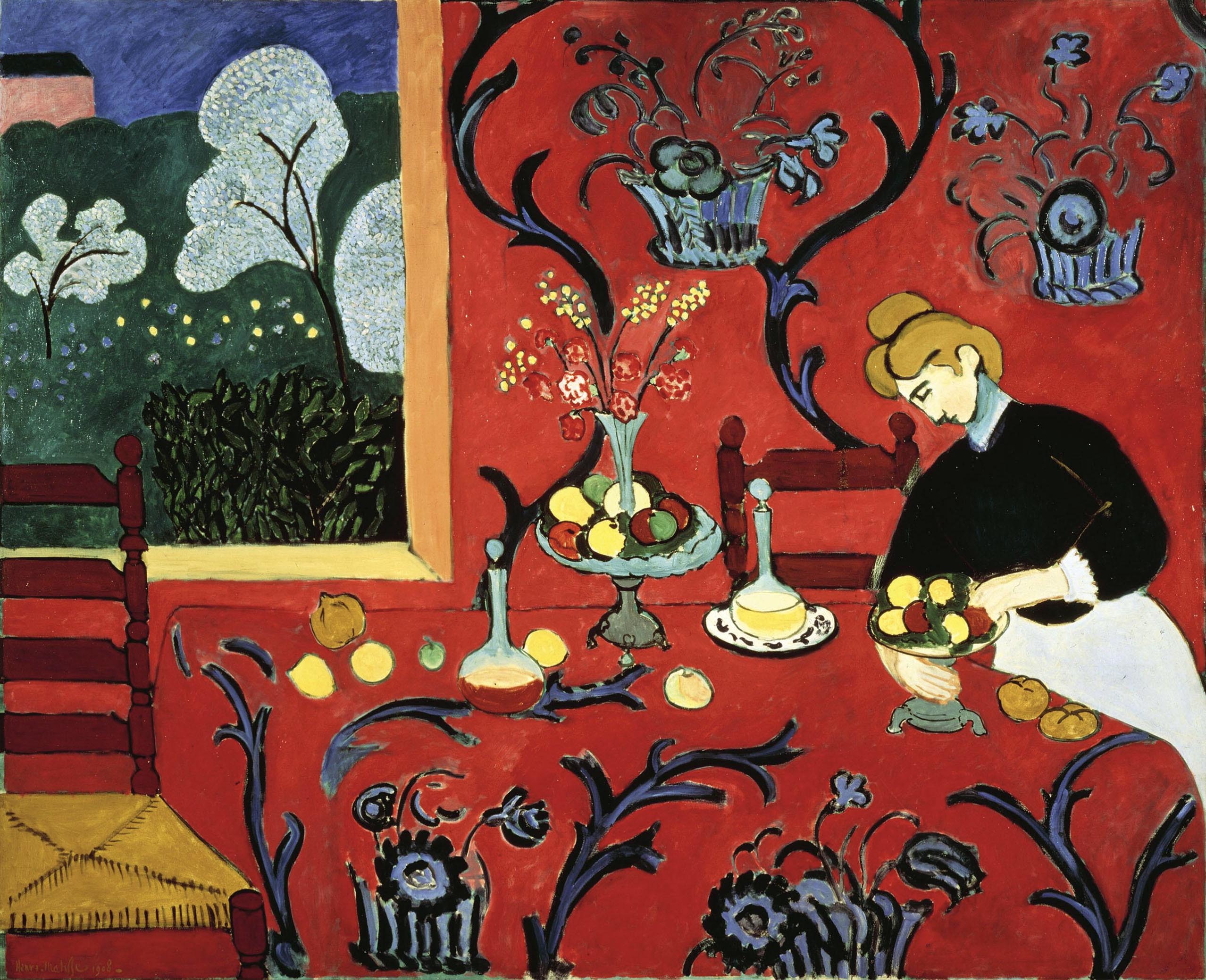
Henri Matisse, Red Room (Harmony in Red), 1908, oil on canvas, 180.5 x 221 cm (The State Hermitage Museum)

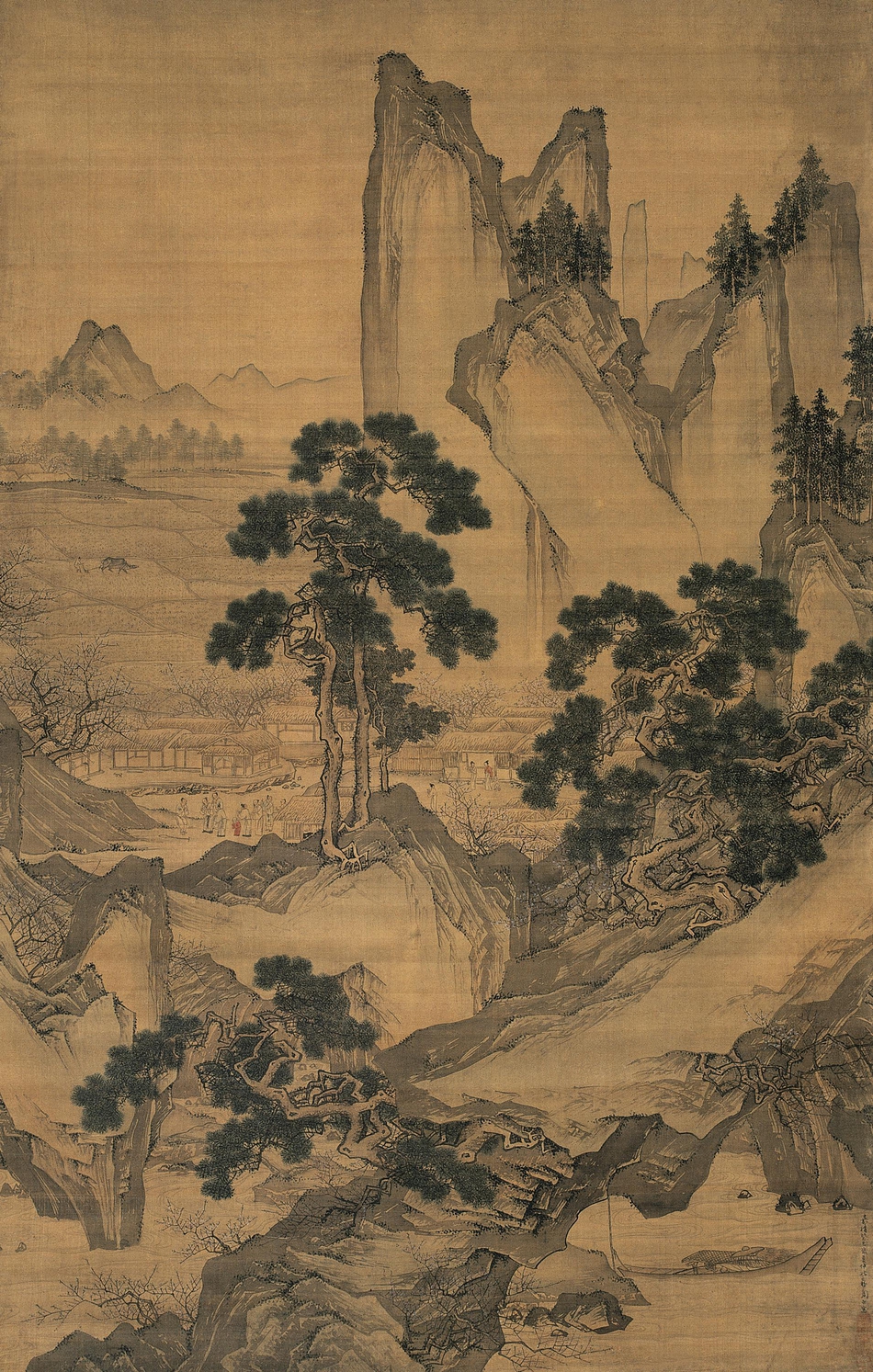
Zhou Chen. Peach Blossom Spring, 102.5 X 161.5 cm (Suzhou Museum)
Zhou Chen, Peach Blossom Spring, 102.5 X 161.5 cm (Suzhou Museum)

Saturation

Finally, intensity or saturation is how bright or dull a color is. Henri Matisse tended to use very saturated colors, as in Red Room (Harmony in Red) (1908), whereas in Peach Blossom Spring (1533), Zhou Chen relied on a much more muted palette with very little saturation of colors.

The landscape is almost entirely in shades of brown and beige. The grey-green of the trees is low in saturation, leaving the single splash of red on the child’s clothes the only moment of high saturation in the image. Therefore, we notice this tiny detail within this large painting. The Matisse painting, on the other hand, is a blaze of colors. The vibrant red of the wall and tablecloth dominates the image, in sharp contrast with the green grass showing through the window and the blues and purples curving throughout the image.

Contrast

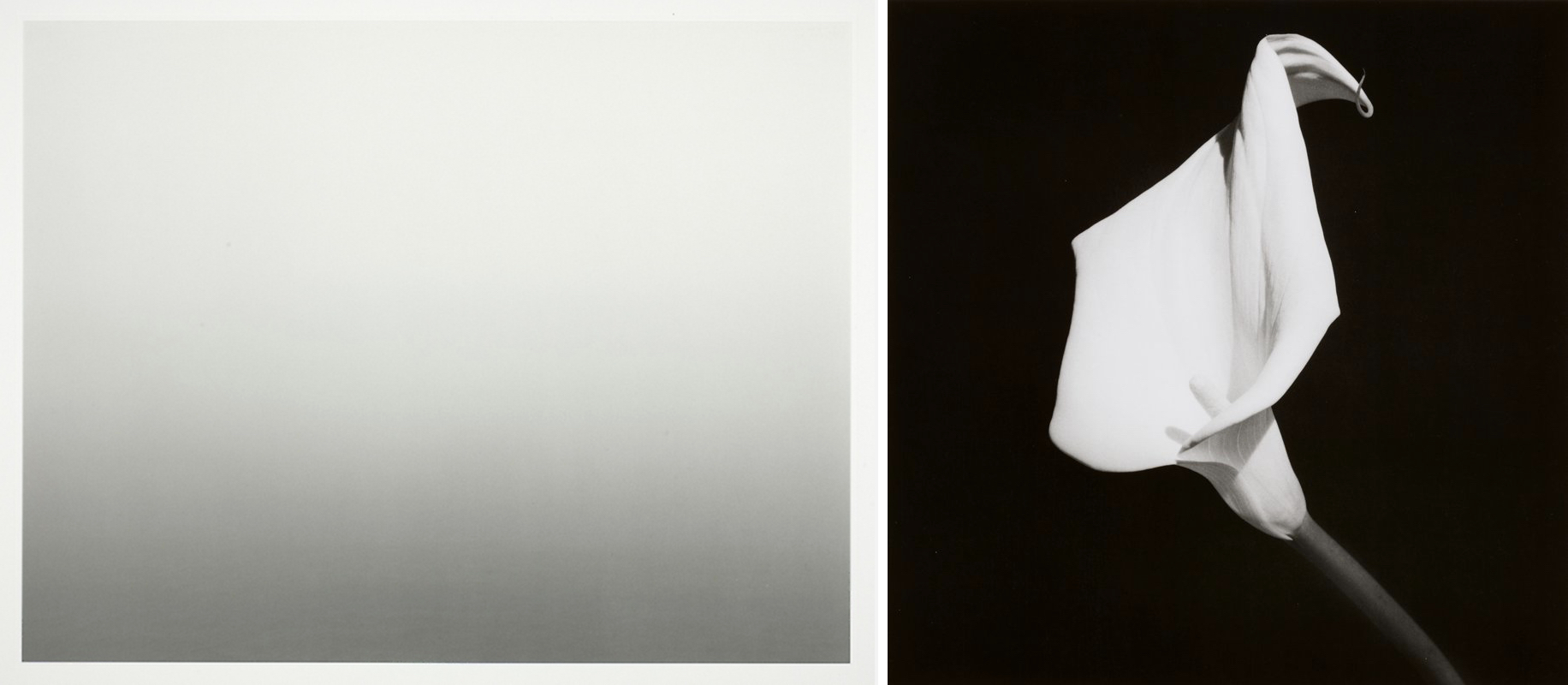
Contrast is the amount of variation between the highest and lowest values in a work. This is perhaps most commonly used to talk about photography, but can be applied to any work. Hiroshi Sugimoto’s Cliffs of Moher (1989) has very low contrast. There are no dark blacks, no stark whites; everything is in very similar shades of gray.

Left: Hiroshi Sugimoto, Atlantic Ocean, Cliffs of Moher, 1989 right: Robert Mapplethorpe, Calla Lily, 1987
Left: Hiroshi Sugimoto, Atlantic Ocean, Cliffs of Moher, 1989, offset lithograph, 24 x 31 cm (Art Institute of Chicago) © Hiroshi Sugimoto; right: Robert Mapplethorpe, Calla Lily, 1987, gelatin silver print, 17.94 × 17.78 cm (Minneapolis Institute of Art) © Robert Mapplethorpe / The Robert Mapplethorpe Foundation

The low contrast conveys the soft and gentle feeling of a heavy mist over quiet water. On the other hand, Robert Mapplethorpe photograph, Calla Lily (1987) has much higher contrast, meaning that the difference in the whites and blacks is much greater. The effect is much sharper and crisper, making this simple flower appear grand and impressive.

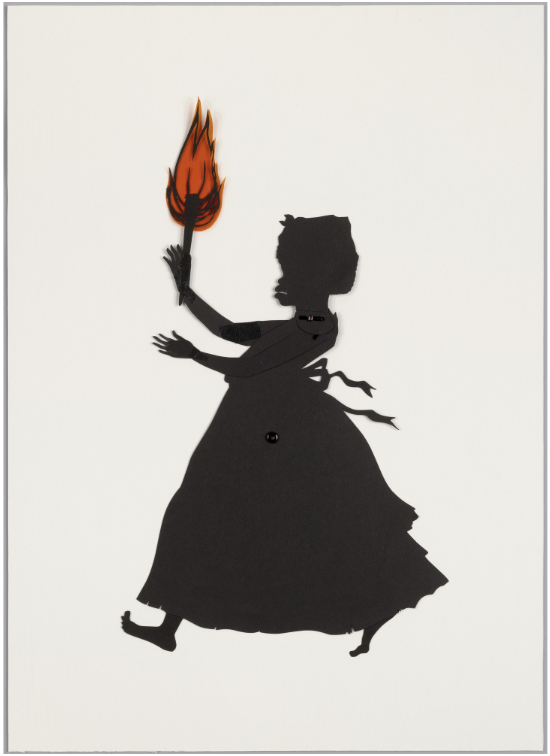
Moving yet further, in Kara Walker’s silhouette image, Untitled (from Testimony), the contrast is absolute. We see only black and white (and here, some red).

In this case, the artist is using the power of this contrast to draw the viewer’s attention to some of the problems in American race relations, and their origins in the institution of chattel slavery. Therefore, while visual elements produce visual effects, their implications can extend well beyond the purely visual.

Kara Walker, Untitled (from Testimony), 2004
Kara Walker, Untitled (from Testimony), 2004, cut black paper with pencil, pressure-sensitive tape, metal fasteners, and synthetic polymer film on paperboard, 52.7 x 38.1 cm (The Museum of Modern Art)

Additional resources:

Art terms in action: tint, shade and tone (video from MoMA)

Making purple: the science of art (video from The National Gallery)

Making Green: Tempera versus Oil (video from The National Gallery)

Space

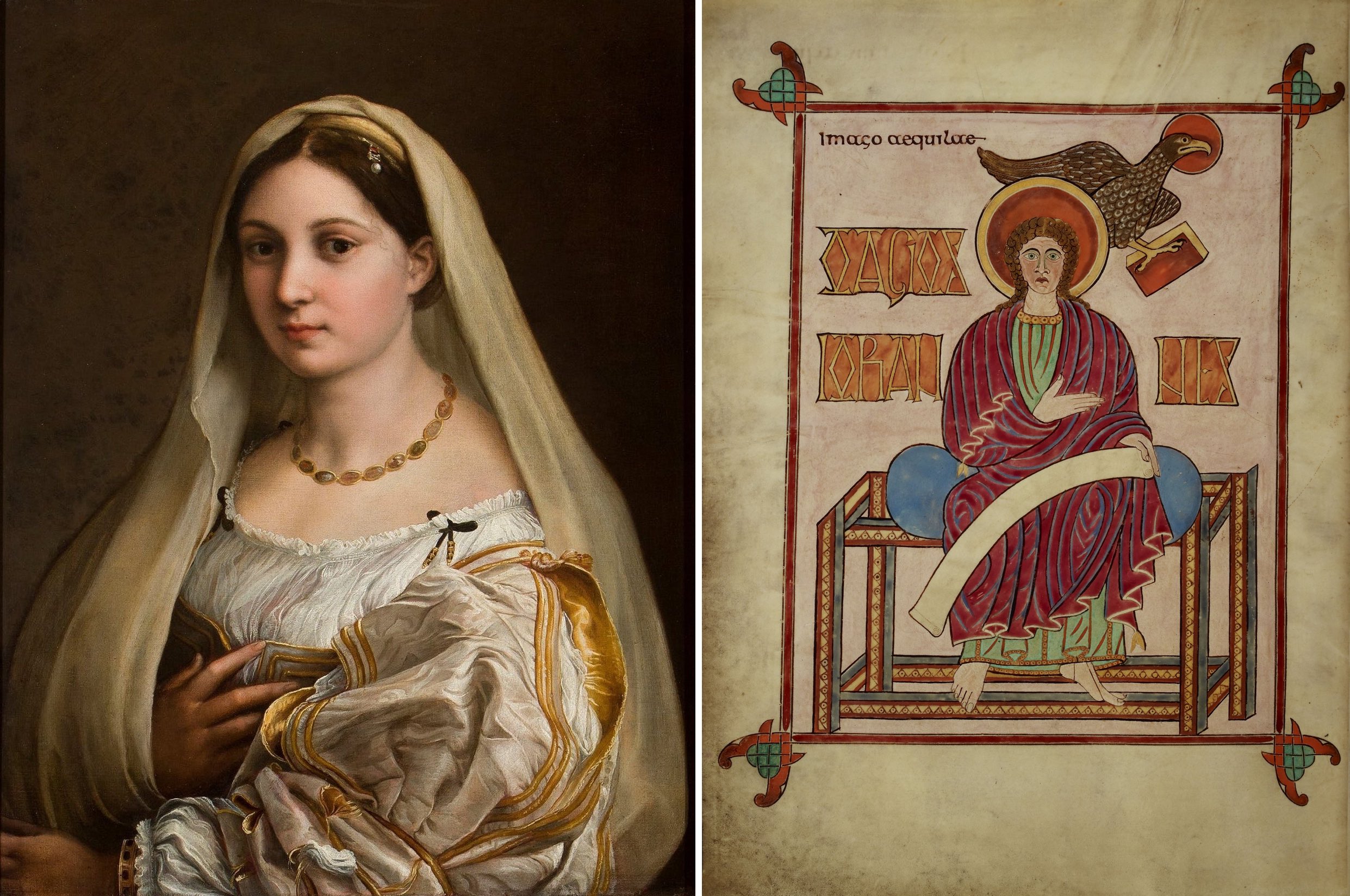
Left: Raphael, La Donna velata, 1514-15 right: St John the Evangelist in the Lindisfarne Gospels
Left: Raphael, La Donna Velata, 1514-15, oil on canvas, 82 x 60.5 cm (Palazzi Pitti, Florence); right: St John the Evangelist in the Lindisfarne Gospels (London, British Library, MS Cotton Nero D IV, f. 209v).

A convincing illusion of space

Space is used to refer both to depth—real or represented—and also to the general surface area within a work of art. Some periods of art history show a great deal of interest in creating convincing illusions of three-dimensional space in two-dimensional media. Perhaps the most iconic (though certainly not the only) example of this is the Italian Renaissance (c. 1400-1600), when artists very deliberately worked to created convincing illusions of depth.

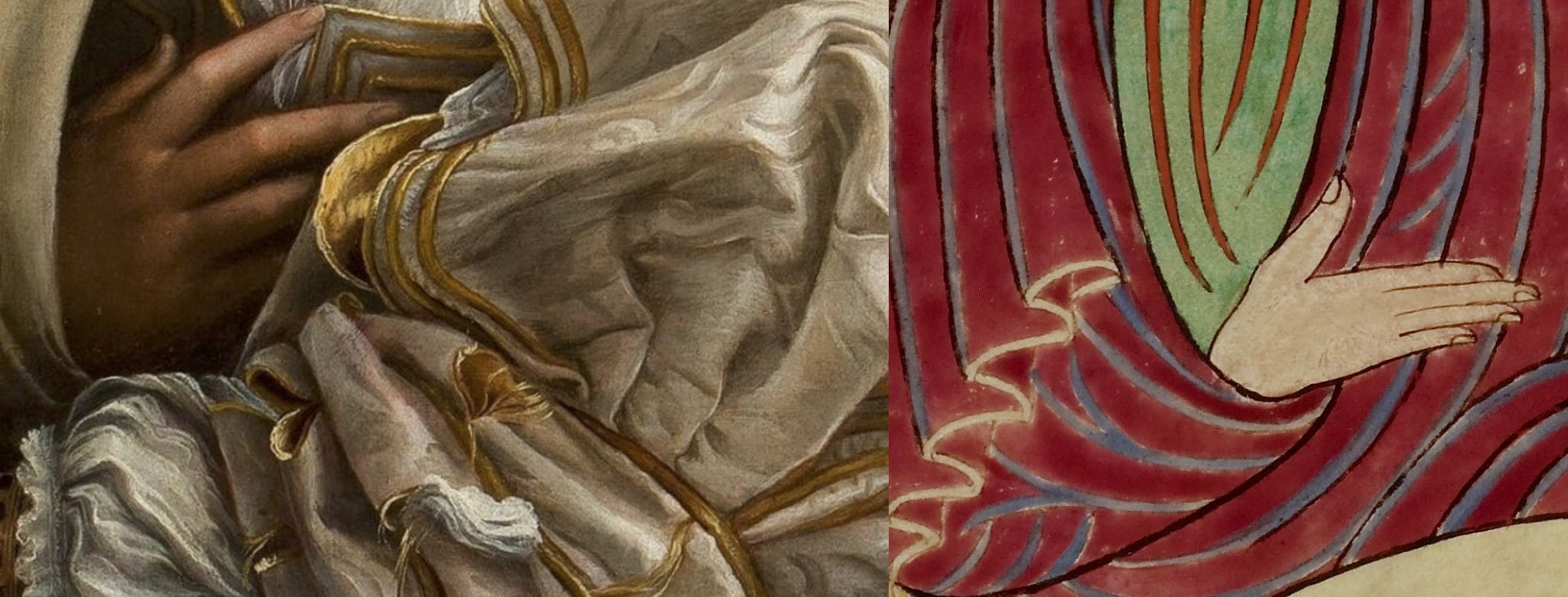
Look at how Raphael creates an illusion of three-dimensional form in La Donna Velata. Through careful variations in value, particularly in shading — the use of darker colors to create the illusion of shadows — Raphael convinces us that the woman in the painting is really there in three dimensions.

Light seems to strike her from her left, casting her right side in shadow. The folds of her voluminous sleeve are a particularly splendid example of the illusion of space. Even examining a small detail of it, it is hard to believe that there is no depth, at all, just thin layers of paint on flat canvas.

Details of the sleeve. left: Raphael, La Donna velata, 1514-15 right: St John the Evangelist in the Lindisfarne Gospels
Details of the sleeve, left: Raphael, La Donna velata, 1514-15, oil on canvas, 82 x 60.5 cm (Palazzi Pitti, Florence); right: St John the Evangelist in the Lindisfarne Gospels (London, British Library, MS Cotton Nero D IV, f. 209v).

For sharp contrast, we can examine a detail of a page of the Lindisfarne Gospels. Both images show a person in voluminous robes, looking out at us, but here, the similarities end. Raphael’s figure is lit softly, creating highlights and shadows that create a sense of roundness and weight to her body and clothes. The figure of John the Evangelist from the Lindisfarne Gospels, on the other hand, is almost totally flat. There is virtually no shading to his body and the folds on his clothes are purely schematic patterns.

If we isolate a small detail of John’s sleeve, as we did with La Donna Velata’s, it is difficult to even recall that this series of lines and colors is intended to be seen as a three-dimensional form, at all.

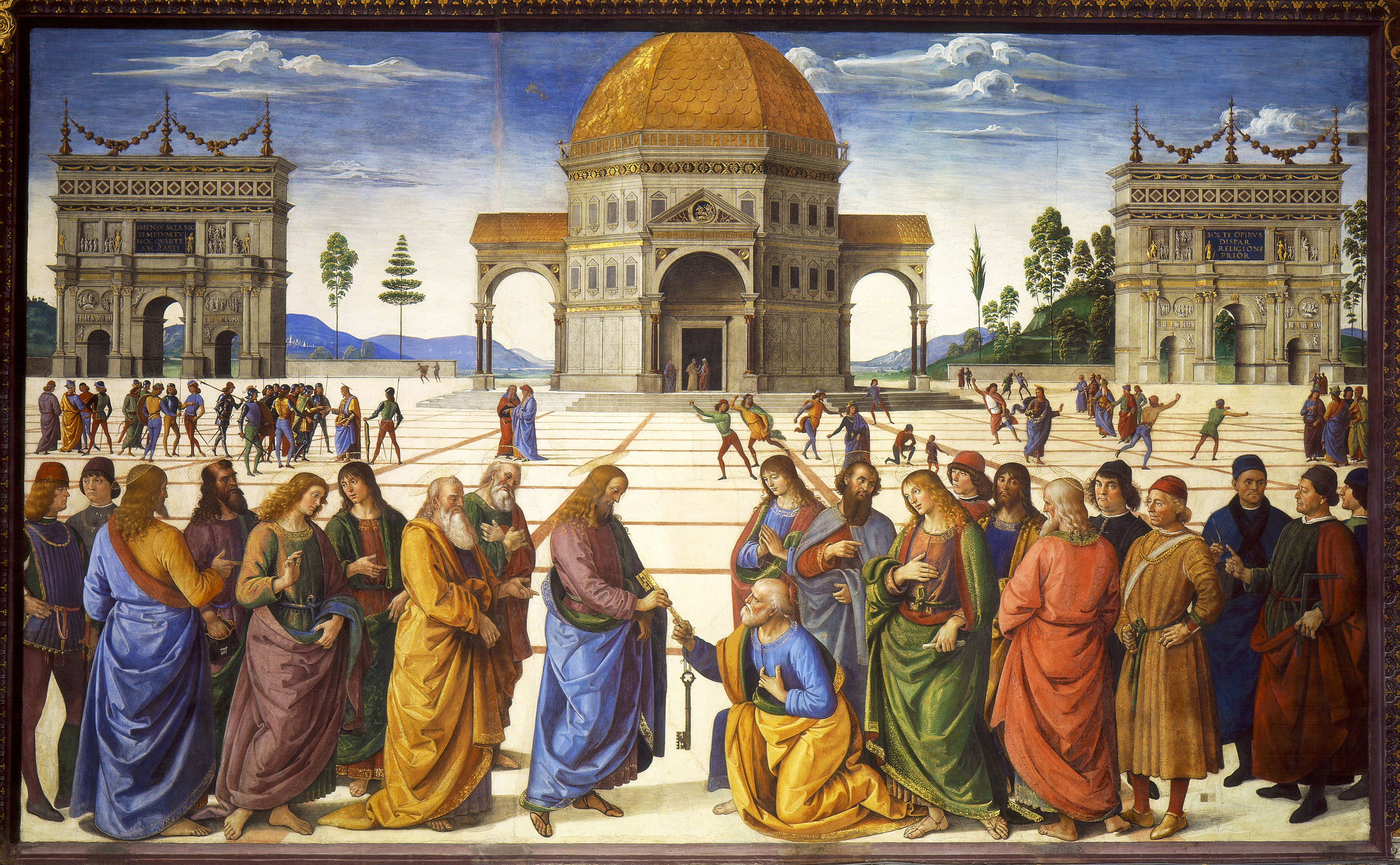
Perugino, Christ Giving the Keys of the Kingdom to St. Peter, Sistine Chapel, 1481-83, fresco, 10 feet 10 inches x 18 feet (Vatican, Rome)
Perugino, Christ Giving the Keys of the Kingdom to St. Peter, Sistine Chapel, 1481-83, fresco, 10 feet 10 inches x 18 feet (Vatican, Rome)
Wolf Vostell, No: Life as a Picture—A Picture as Life series, photograph, 1963

Linear and atmospheric perspective

There are various methods used by artists to create the illusion that their figures exist in three-dimensional space. Among the more effective are linear and atmospheric perspective. Another work from the Italian Renaissance will serve to demonstrate both. Pietro Perugino’s Christ Handing the Keys to St. Peter, uses both linear and atmospheric perspective to create a very convincing illusion of depth.

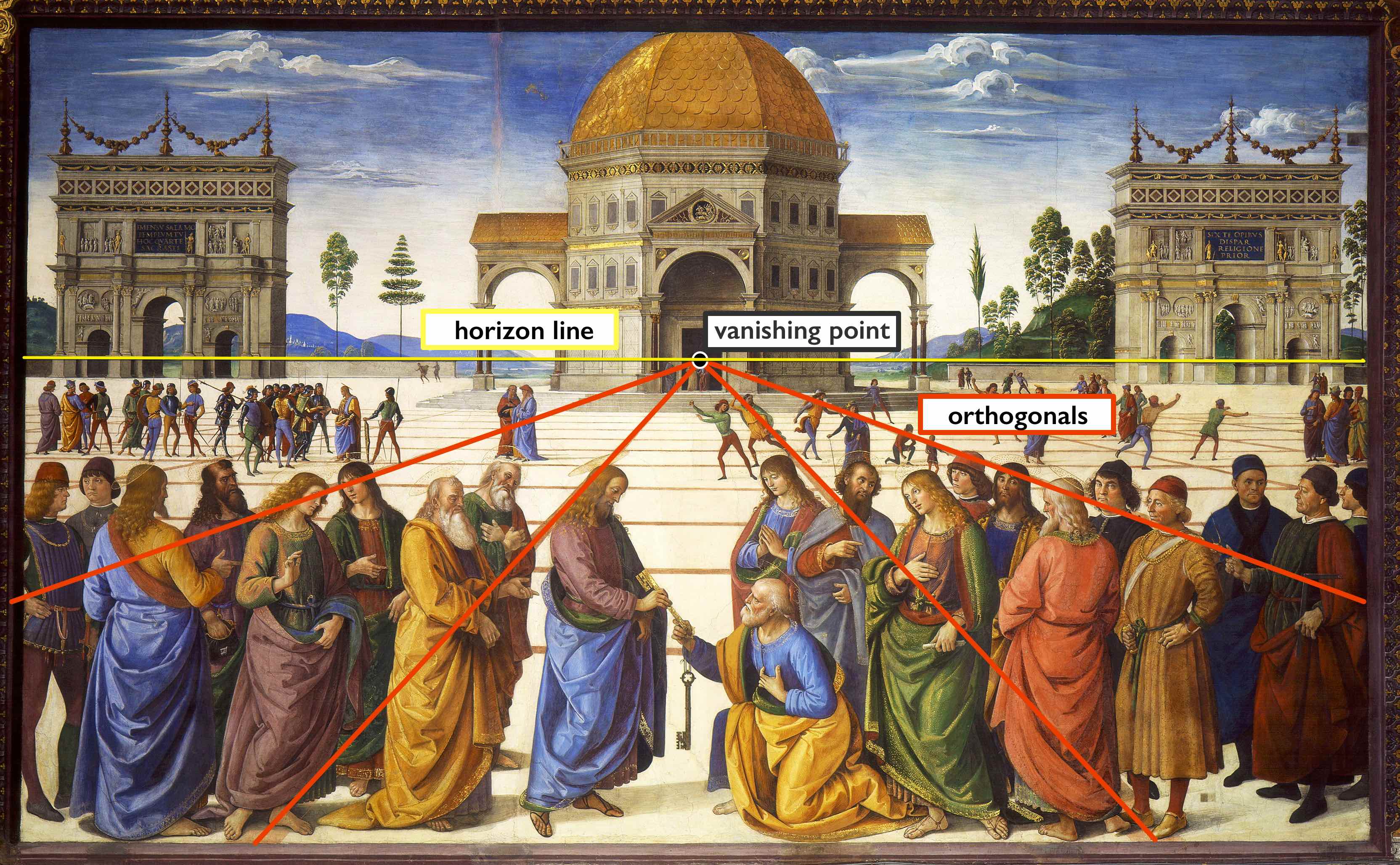
Linear perspective is based on the optical illusion that parallel lines seem to converge as they recede into the distance. Railroad tracks are the classic example, as in, Wolf Vostell’s photograph from his No: Life as a Picture—A Picture as Life series from 1963. If we overlay the lines used on Perugino’s painting, we can see how he used this effect. The lines are called orthogonal lines or orthogonals and they meet on the horizon line, at the vanishing point. Note that as all the orthogonals converge, the forms also get smaller.

Perspective diagram, Perugino, Christ Giving the Keys of the Kingdom to St. Peter, Sistine Chapel, 1481-83, fresco, 10 feet 10 inches x 18 feet (Vatican, Rome)
Perspective diagram, Perugino, Christ Giving the Keys of the Kingdom to St. Peter, Sistine Chapel, 1481-83, fresco, 10 feet 10 inches x 18 feet (Vatican, Rome)

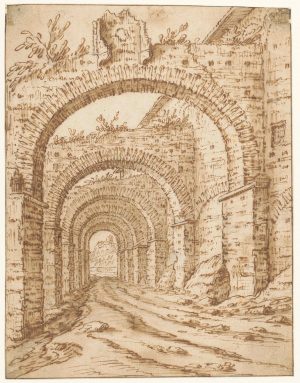
Tobias Verhaecht, The Clivus Scauri in Rome, chalk, graphite and ink on paper, 22 x 17.1 cm (Rijksmuseum)
Tobias Verhaecht, The Clivus Scauri in Rome, chalk, graphite and ink on paper, 22 x 17.1 cm (Rijksmuseum)

The tool of one-point linear perspective is very simple, and artists can use it to create a convincing illusion of depth with only a few pencil strokes and without the careful measuring and use of a straightedge, as in Tobias Verhaecht’s sketch of a Roman ruin. Two- and three-point linear perspective are slightly more complicated, but operate on the same general principles and produce similar results.

Perugino also uses Atmospheric perspective. This is based on the optical effect that makes objects in the distance appear paler, bluer, and less detailed that objects that are close to us. Returning to Perugino’s painting, we can see that he has replicated this effect, carefully making the figures in the foreground (the portion of the image that appears to be closest to the viewer) bolder in color, the smaller figures in the middle ground paler, and the hills in the background (the portion of the image that appears to be in the far distance) fading off into pale blues.

An important note

It is important to note, though, that the use of various techniques to create a convincing illusion of depth does not make Raphael or Perugino “better” artists than the anonymous medieval monk who painted the page of the Lindisfarne Gospels, nor does it make their works any “better” or more sophisticated. The illusion of depth is one of the many tools in the artist’s toolbox, and it is serves some purposes very well, but it is not always the most powerful or effective way to convey an idea and, indeed, can sometimes be in direct conflict with the intentions of an artist.

Additional resources:

Drawing techniques from the V&A

Texture

Texture is the feeling of a surface, real or represented. This might refer to the roughness or smoothness of actual objects and art media, or to the illusion of these properties.
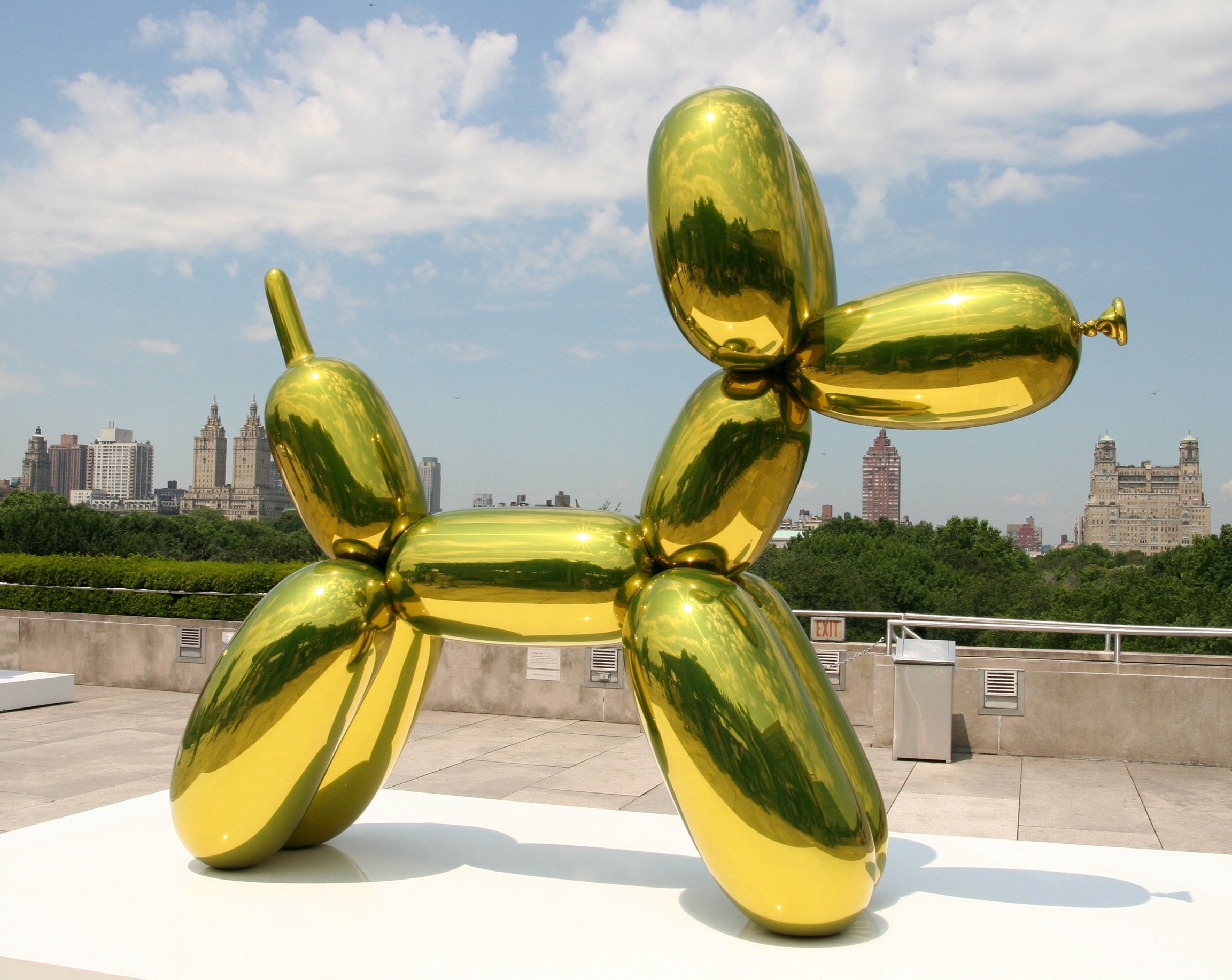
Jeff Koons, Balloon Dog: installation view with silver balloon, 1994-2001, transparent color coating, stainless steel, 320 x 380 x 120 cm (photo: Kim, © Jeff Koons)
Jeff Koons, Balloon Dog, 1994-2001, transparent color coating, stainless steel, 320 x 380 x 120 cm (photo: Kim, © Jeff Koons)

Surface texture

Jeff Koons’ Balloon Dog has a perfectly smooth, mirrored surface it is difficult to resist touching (though we must). It is this surface texture that turns these replicas of commonplace, short-lived and disposable items (balloon animals) into precious objects.

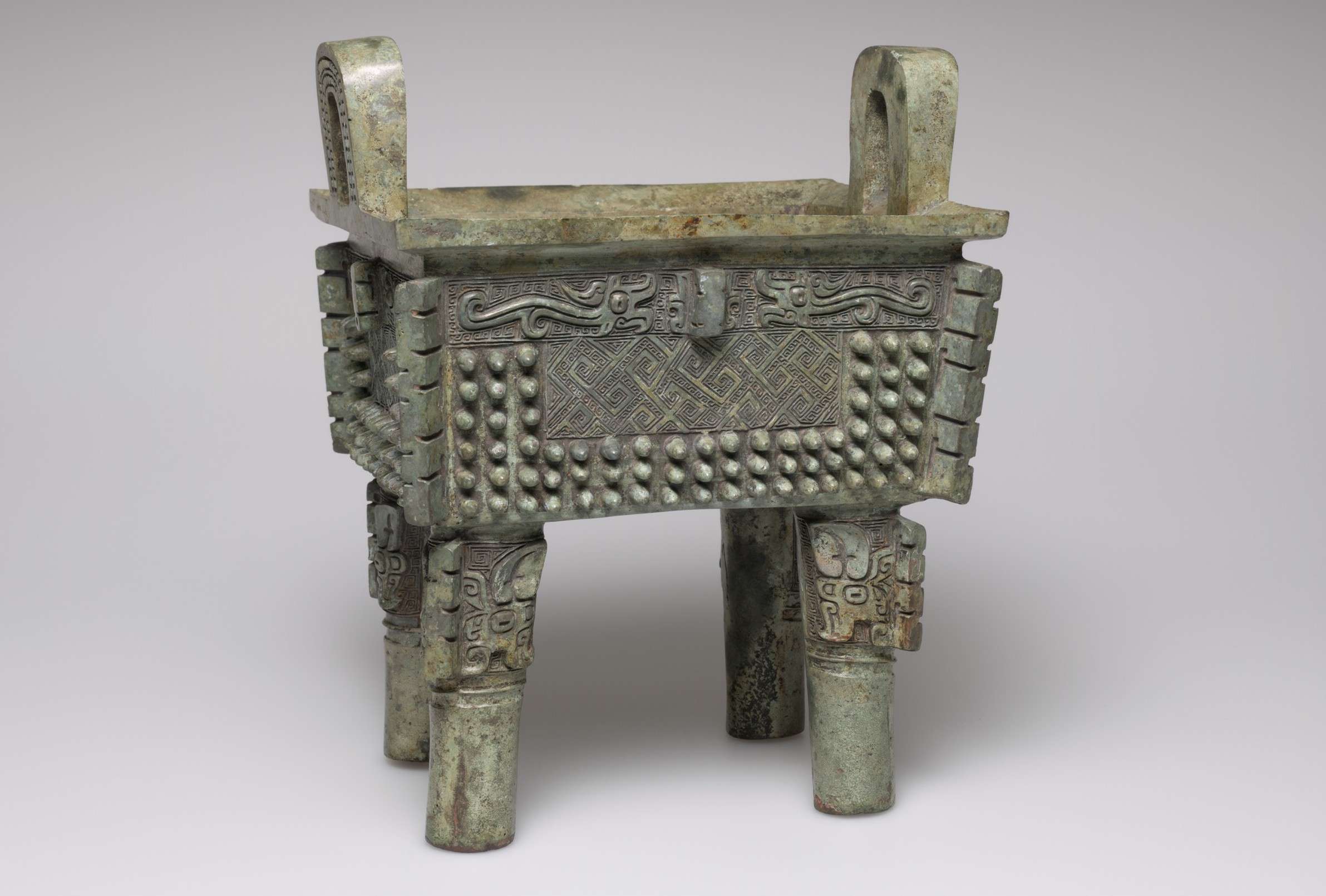
In contrast, the coarse, bristly surface of an ancient Shang Dynasty Fang-Ding — a ritual vessel used in worshipping dead ancestors — grants the work a vibrant energy, but does not invite our touch.

'Fangding' Ritual Food Vessel with Abstract Decor, 14th-11th century B.C.E., China, Shang dynasty, cast bronze, 21.7 x 17.1 x 15.2 cm (Harvard Art Museums)
Fangding Ritual Food Vessel with Abstract Decor, 14th-11th century B.C.E., China, Shang dynasty, cast bronze, 21.7 x 17.1 x 15.2 cm (Harvard Art Museums)

The illusion of texture

The illusion of texture is no less important to our experience of works of art.

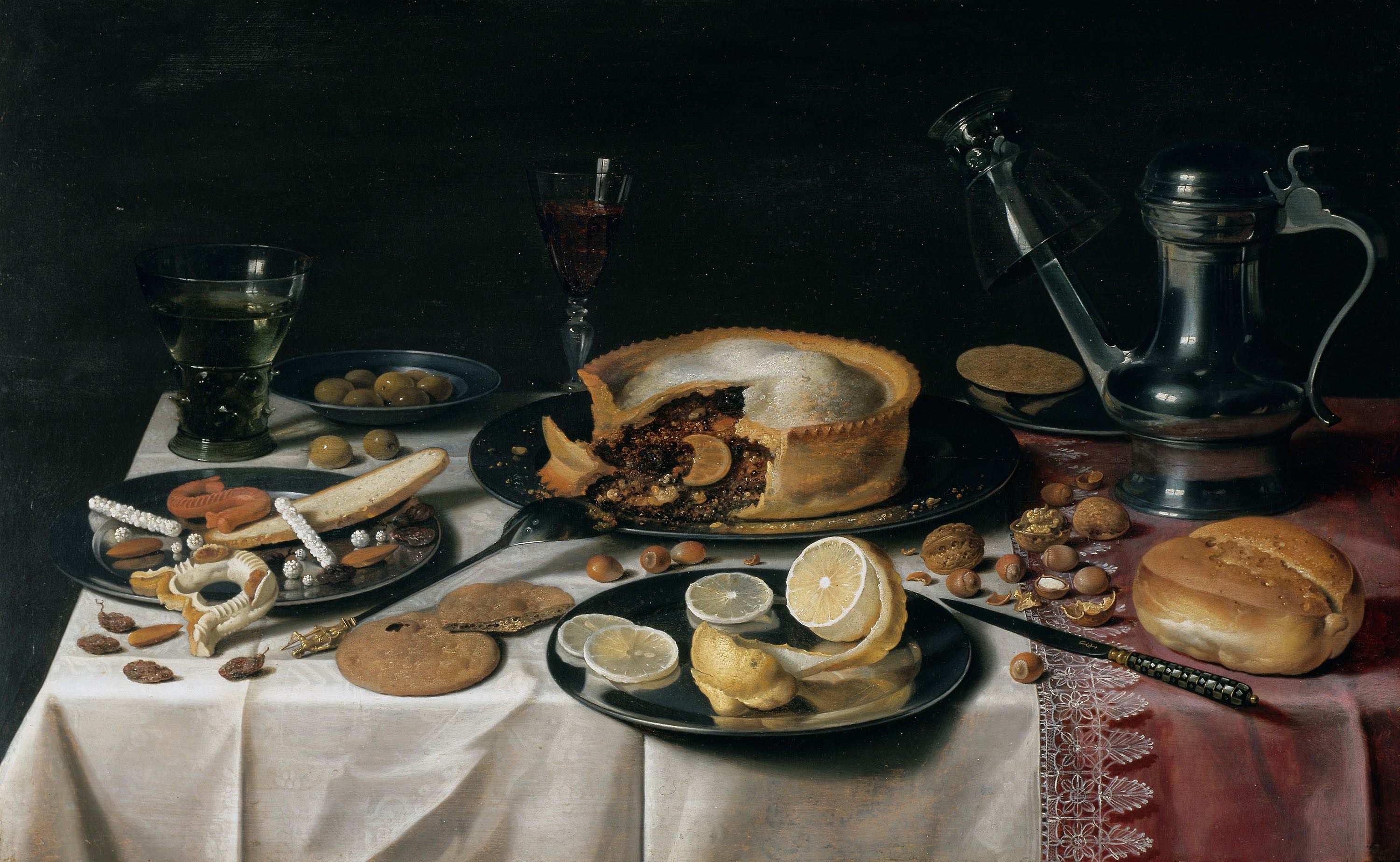
Dutch still life paintings are justly famous for their careful, illusionistic replication of objects. The smooth silver plates and glass goblet of Pieter Claesz’s Still Life seem to tease us, as do the rougher cookies and breads, and the crumbly pie. The knife handle, pointing out of the image toward us, seems just beyond our grasp, and therefore makes this magnificent spread all the more tantalizing.

Pieter Claesz, Still Life, c. 1625, oil on panel, 48 × 76.9 cm (Art Institute of Chicago)
Pieter Claesz, Still Life, c. 1625, oil on panel, 48 × 76.9 cm (Art Institute of Chicago)
Source: Information on Line, Shape and Form, Color, Space, and Texture is from Asa Mittman, Smarthistory, 2019

Surface and Depth

by ART INSTITUTE OF CHICAGO
What makes paintings feel as deep as the view from a window or as flat as a wall?

This video is part of the Art Institute of Chicago’s Art Explainer series.

Video URL: https://youtu.be/WZKqr1Wy45w

Using three artworks from the Art Institute’s collection, this video unpacks a central theme and uses innovative visual storytelling to highlight the choices artists made to shape form and meaning in their works. Ultimately, it shows that each of us already possesses a powerful tool for making sense of art: looking closely. Art Explainer videos empower you to look at and understand art from any historical period or culture. Designed for students as well as adults, this video series is produced for the web and usable in a wide range of learning environments, from mobile devices to formal school classrooms.

The following works from the Art Institute of Chicago appear in this video:

Poussin, Landscape with St. John on Patmos
Harnett, For Sunday’s Dinner
Mondrian, Lozenge Composition with Yellow, Black, Blue, Red, and Gray

Source: Art Institute of Chicago, “Surface and Depth,” in Smarthistory, January 26, 2018, accessed October 13, 2023, https://smarthistory.org/surface-depth/.

Light and shadow

by ART INSTITUTE OF CHICAGO

This video is part of the Art Institute of Chicago’s Art Explainer series.

Video URL: https://youtu.be/PnQv8Di8Ark

How does an artist use light to help keep us out of the dark?  Using three artworks from the Art Institute’s collection, this video unpacks a central theme and uses innovative visual storytelling to highlight the choices artists made to create light and shadow in their works. Art Explainer videos empower you to look at and understand art from any historical period or culture. Designed for students as well as adults, this video series is produced for the web and usable in a wide range of learning environments, from mobile devices to formal school classrooms.

The following works from the Art Institute of Chicago appear in this video:

Tanner, The Two Disciples at the Tomb
Kollwitz, Battlefield
Flavin, “monument” for V. Tatlin

Cite this page as: Art Institute of Chicago, “Light and shadow,” in Smarthistory, February 7, 2018, accessed October 13, 2023, https://smarthistory.org/light-and-shadow/.

Principles of Composition

Balance, symmetry, and emphasis

Perugino, Christ Giving the Keys of the Kingdom to St. Peter, Sistine Chapel, 1481-83, fresco, 10 feet 10 inches x 18 feet (Vatican, Rome)
Perugino, Christ Giving the Keys of the Kingdom to St. Peter, Sistine Chapel, 1481-83, fresco, 10 feet 10 inches x 18 feet (Vatican, Rome)

Balance and symmetry

Balance is an even use of elements throughout a work of art. Symmetry is a very formal type of balance consisting of a mirroring of portions of an image. Bilateral symmetry, that is, two- sided symmetry, is the most common, in which two halves of a work of art mirror each other, as in Perugino’s painting, Christ Giving the Keys of the Kingdom to St. Peter. In this painting, the symmetry gives the painting not only a sense of balance, but also a sense of calm, stability, and formality. Notice in particular the way that the building and arches in the background are painted to make the work symmetrical.

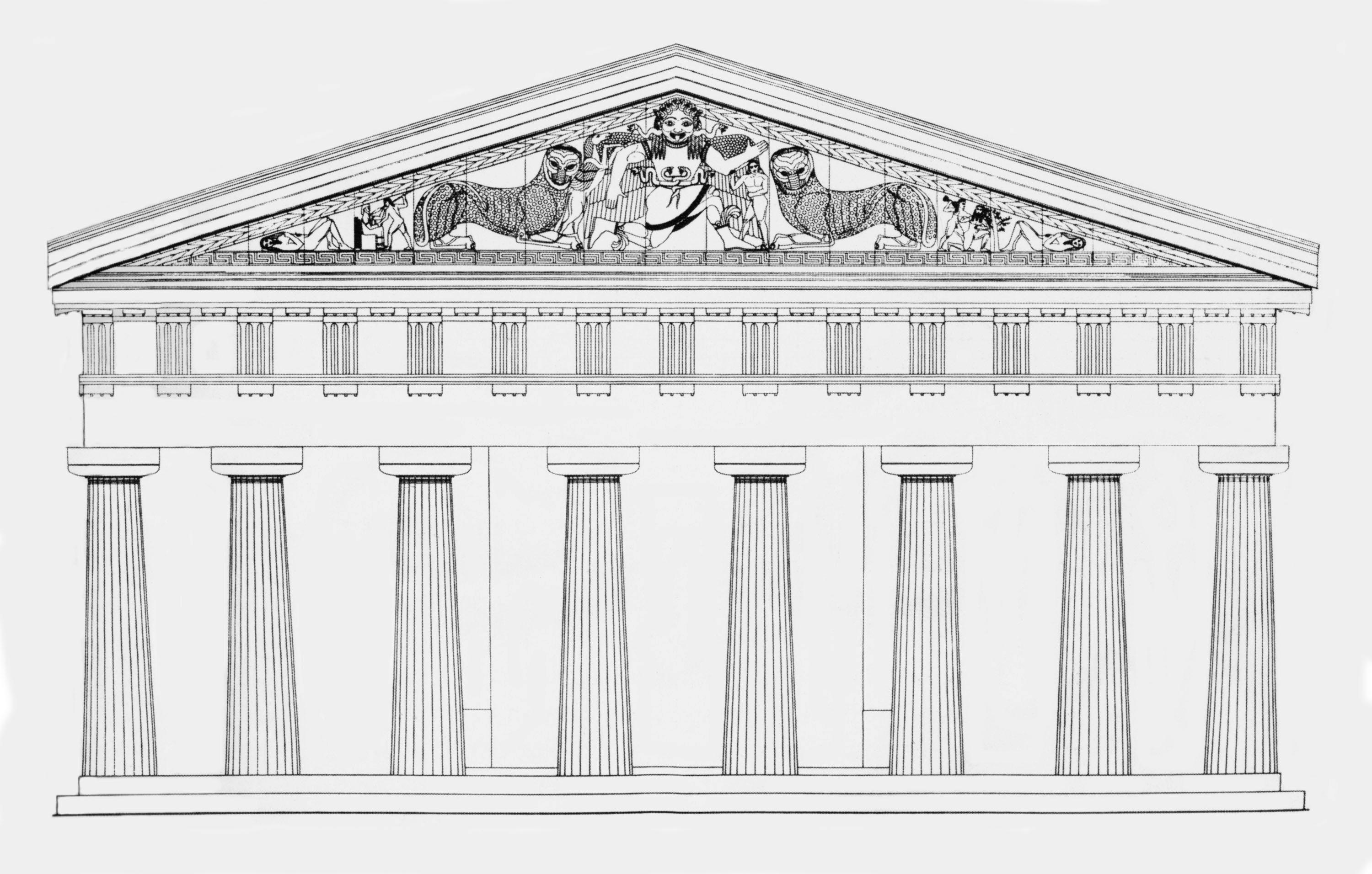
Just as the structures, themselves, are symmetrical in Perugino’s painting, symmetry is also common in major works of architecture, where it lends buildings a tone of stability and power. Classical Greek temples like the Temple of Artemis at Corfu are rigidly symmetrical.

Temple of Artemis, Corfu, Greece, ca. 600-580 BCE
Temple of Artemis, Corfu, Greece, c. 600-580 B.C.E.

In this diagram (the temple is now a ruin), even the sculpture on the façade — the front of a building — is nearly perfectly symmetrical. At the outer corners are a mirrored pair of fallen warriors, then two pairs (one now fragmentary) of fighting figures, then two mirrored panthers, and then, in the center, Medusa, with two of her children beside her (Pegasus and Chrysaor).

Pediment detail, Temple of Artemis, Corfu, Greece, c. 600-580 B.C.E.

Even the fearsome Gorgon in the center is presented facing directly outward at us, so that her face can be presented in hideous symmetry, with her great, bulging eyes, grimacing mouth, plaited hair, and even the snakes that emerge from the back of her head carved in perfect symmetry. This work should serve to counter the frequently made statement that symmetry makes works beautiful. While many cultures associate symmetry with beauty, and this temple as a whole might be described as such, a grotesque figure remains grotesque even when perfectly symmetrical.

Radial symmetry

Radial symmetry is created when an image is symmetrical around a central point or axis, like a sunflower viewed head-on. Radial symmetry creates a strong sense of unity in a work of art, and is common in sacred images.

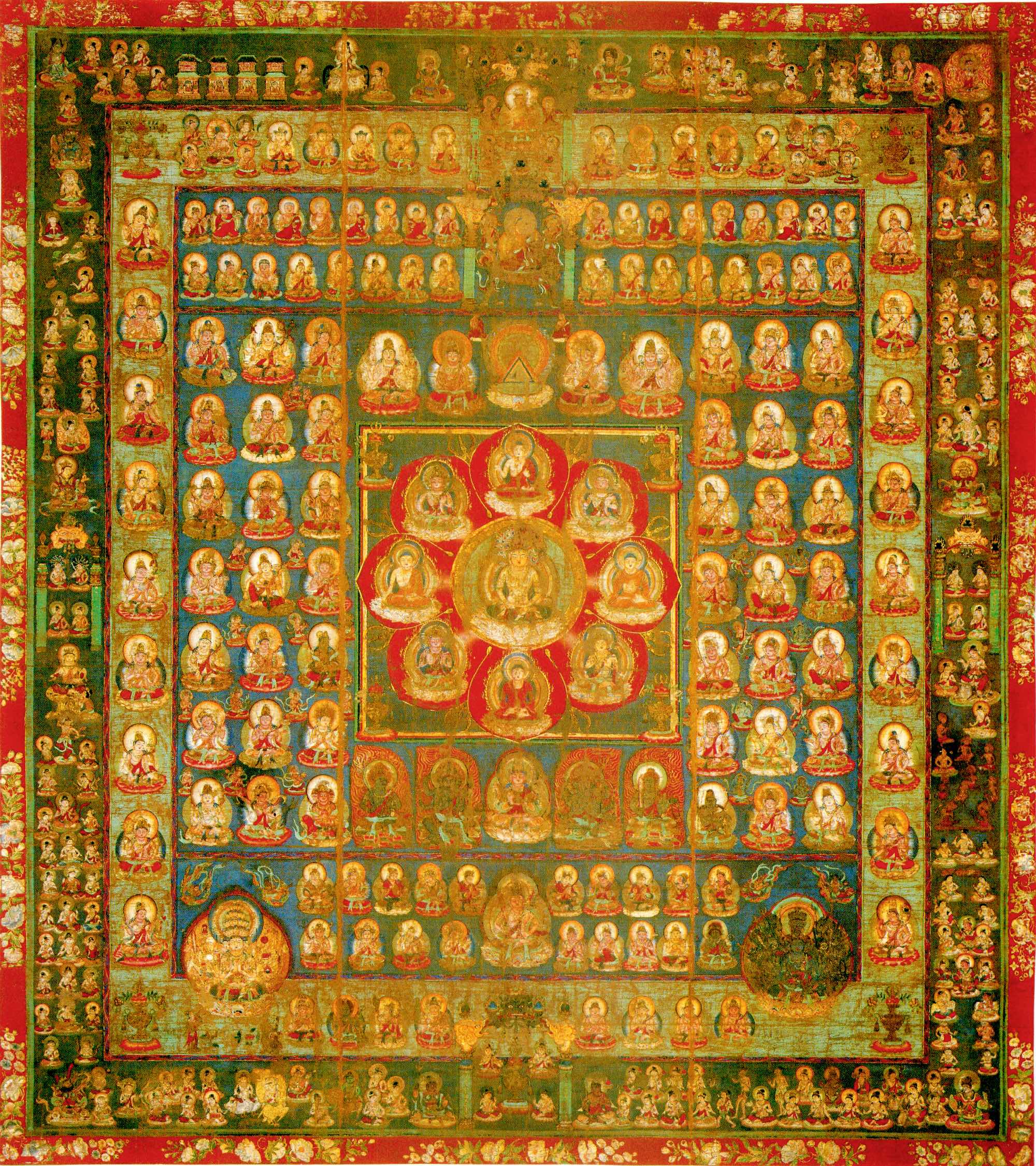
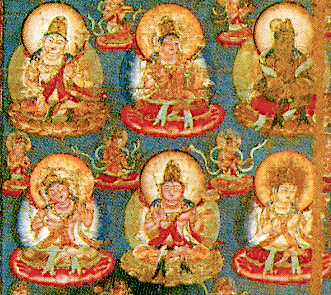
Garbhadhatu (Taizokai) Mandala (Womb World), mandala of Innate Reason and Original Enlightenment, Japan, Heian period
Garbhadhatu (Taizokai) Mandala (Womb World), mandala of Innate Reason and Original Enlightenment, Japan, Heian period (Tantric Buddhism), late 9th century, colors on silk (public domain)

In a Shingon Tantric Buddhist World Womb Mandala, all points seem to radiate outward from the central figure of the Buddha. The numerous figures around him are bodhisattvas, individuals who have chosen out of compassion to delay their entry into Nirvana in order to help others who are suffering. It is fitting that they are shown as if emanating out of the Buddha, himself, as his enlightenment and compassion are the source and model for theirs. The image also gives a sense that the universe itself is highly ordered.

Asymmetrical balance

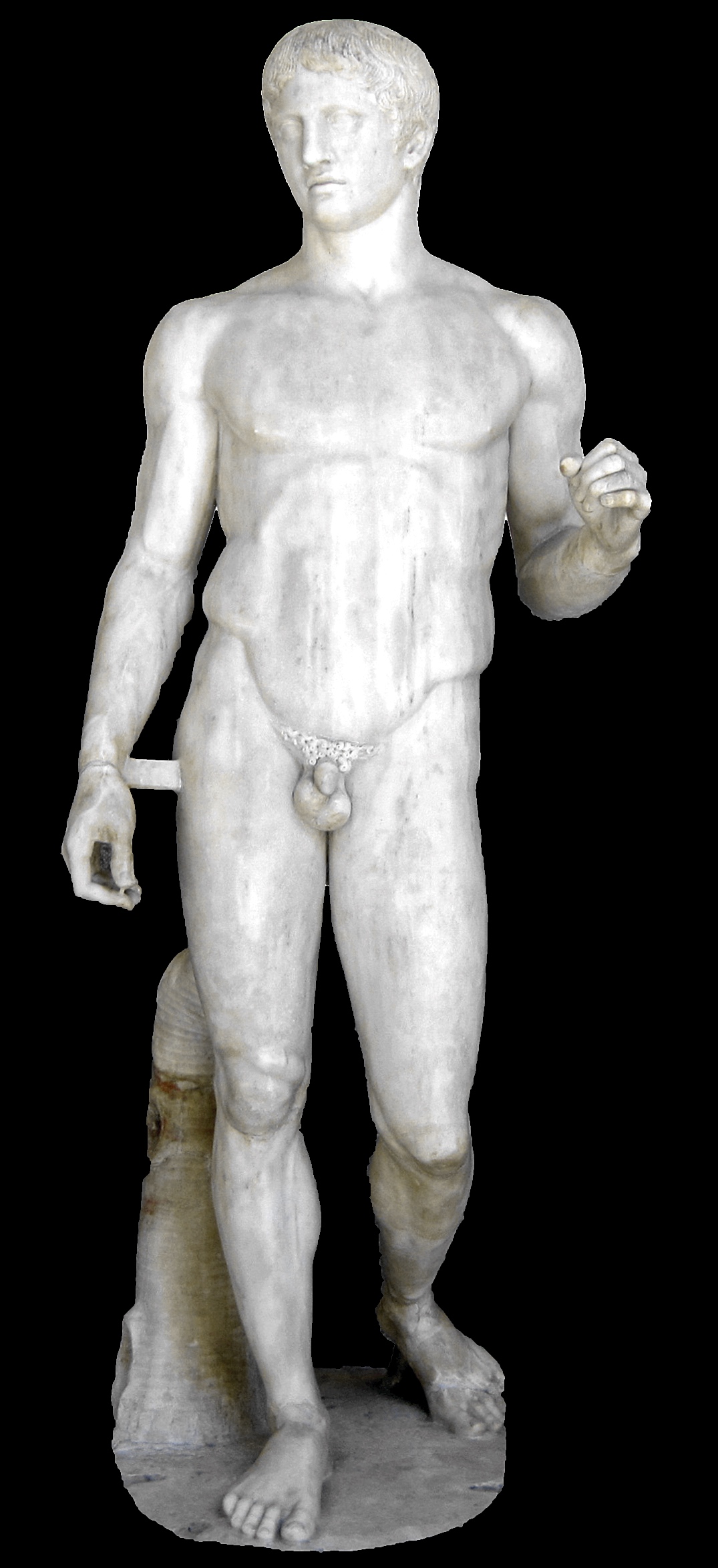
However, perfect symmetry is not necessary to create a sense of balance in an image. Asymmetrical balance is created when two sides of an image do not mirror each other, but still have approximately the same visual weight, the same amount of detail or shapes or color, and so on. The Classical Greek sculpture Doryphoros (The Spearbearer) by Polykleitos provides a clear example of asymmetrical balance. The figure does not stand in a symmetrical way, but overall, seems even, calm, balanced. In this case, the figure has his weight on his right leg, so this leg is tensed. The left leg is relaxed and bent. Balancing this out, the right arm hangs loosely, but the left arm is tensed. In this way, the body — which itself is symmetrical, or would be if he were posed with his feet side by side, looking straight ahead, with his arms hanging down — is balanced. This pose is called contrapposto, and is often used to give standing human figures a sense of life and animation.

Polykleitos, Doryphoros (Spear-Bearer), c. 450-40 B.C.E., ancient Roman marble copy found in Pompeii of the lost bronze original


Polykleitos, Doryphoros (Spear-Bearer), c. 450-40 B.C.E., ancient Roman marble copy found in Pompeii of the lost bronze original, 211 cm (Archaeological Museum, Naples)

Emphasis

Emphasis consists of drawing attention to one or more points in a work. This can be accomplished through any of the visual elements. In the World Womb Mandala, the Buddha is emphasized through location (he is centered in the image), color (the vivid red petals around him draw the eye), line (all of the rows of figures essentially guide the eye inward to the center through implied lines, and the lines dividing the red petals direct us inward, as well), symmetry (the radial symmetry focuses us inward to the center), and so on. In essence, we cannot help but return, again and again, to the Buddha, the focus of the image and also the focus of Buddhist devotion.

Movement
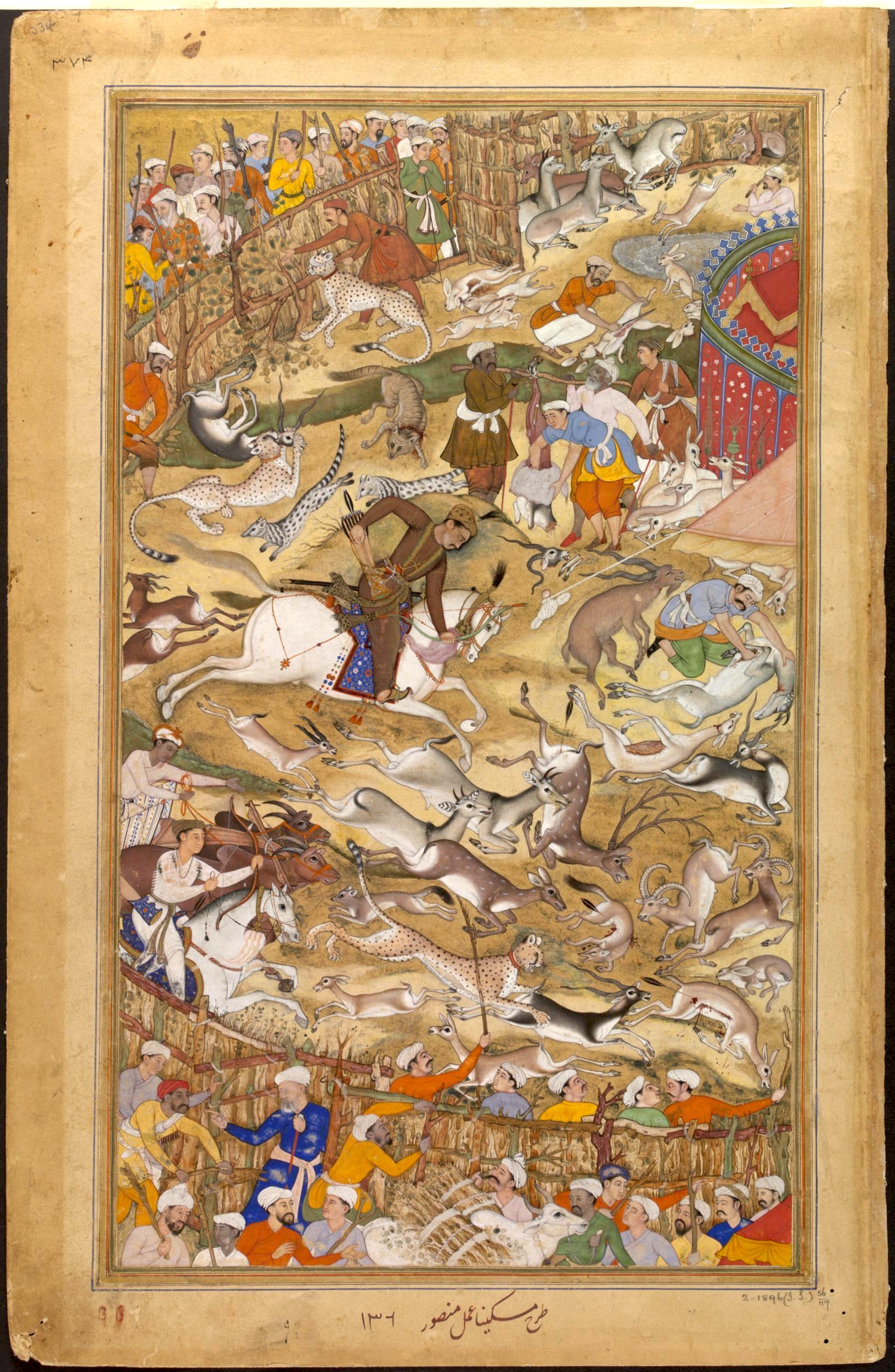
Akbar on horseback, hunting animals within an enclosure, illustration from the Akbarnama, c. 1590-95
Akbar on horseback, hunting animals within an enclosure, illustration from the Akbarnama, c. 1590-95, Mughal Empire, India, opaque watercolor and gold on paper, 32.1 x 18.8 cm (Victoria and Albert Museum, London)

Movement refers to a sense of motion as the eye is guided through a work of art. This can be accomplished by showing figures in motion, or simply through the visual elements.

An Indian illumination — that is, a painting in a hand-made book — from the Akbarnama showing Akbar hunting in an enclosure demonstrates both types. As with the Dürer woodcut, Four Horsemen of the Apocalypse, the rider on his horse charges rapidly from left to right across the image. The smaller animals scatter, darting in all directions and also hunting one another. Their movements create a strong sense of movement throughout the image. However, there are formal elements that intensify this.

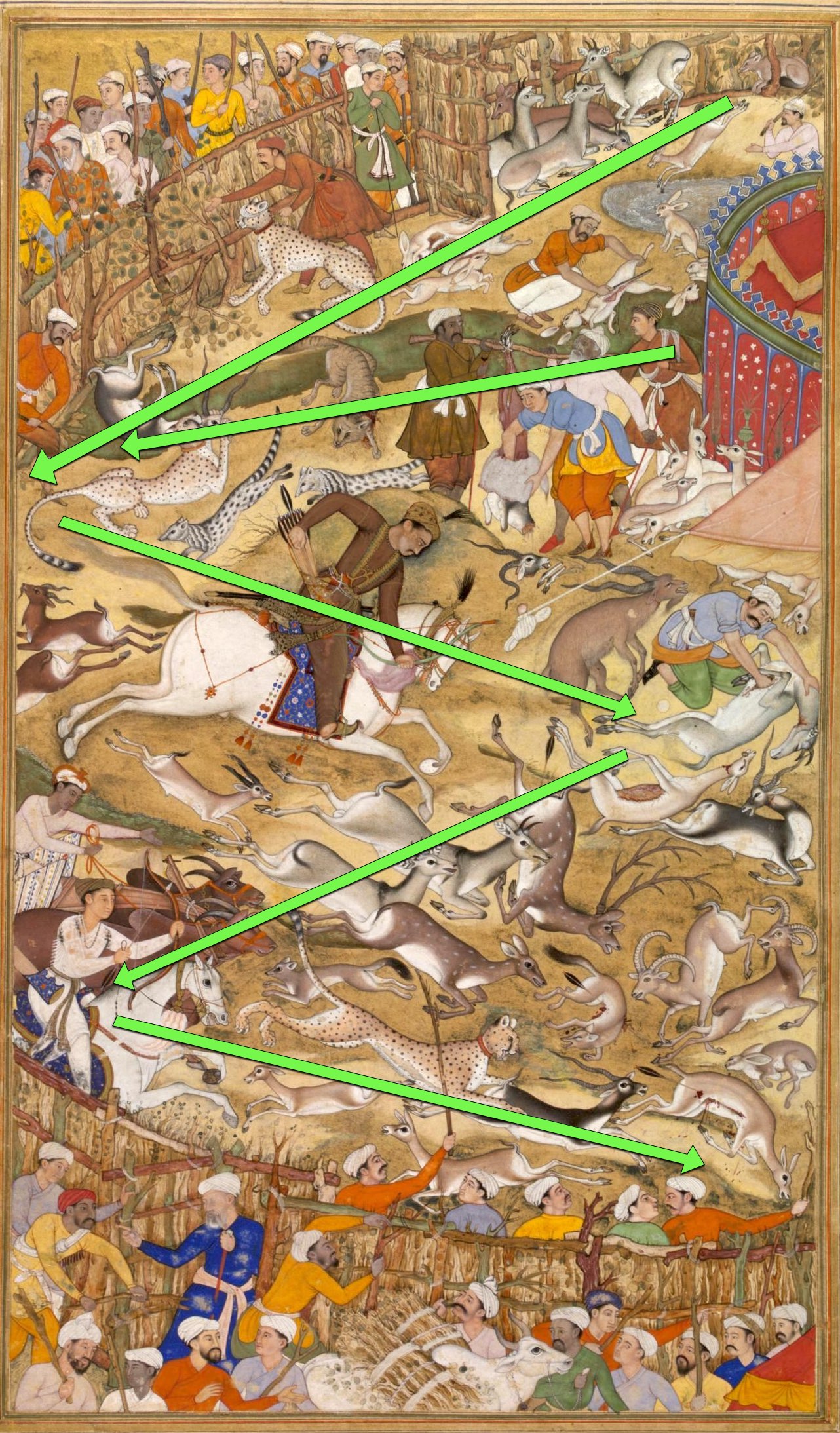
Akbar on horseback, hunting animals within an enclosure, illustration from the Akbarnama, c. 1590-95
Akbar on horseback, hunting animals within an enclosure, illustration from the Akbarnama, c. 1590-95, Mughal Empire, India, opaque watercolor and gold on paper, 32.1 x 18.8 cm (Victoria and Albert Museum, London)

Diagonals

Just as the horizontal lines behind the riders in the Dürer woodcut suggested their movement forward, so here, lines and colors help convey the motion of people and animals. There is a strong zigzag that brings us from top to bottom, or bottom to top.

Starting at the top-right corner, the fences form a strong diagonal, accompanied by the slash of green representing a stream. These meet at the left edge, where the momentum then follows Akbar on his large white horse, also emphasized by the line of darker earth that moves in a downward diagonal from the horse’s mouth. This motion then again reverses direction, in a downward diagonal, back to the left edge, which in turn bounces back to the bottom right edge.

Our eyes therefore move throughout the image not only because the figures in it are depicted in motion, but also because of the manipulation of the visual elements.

Proportion and scale
Polykleitos, Doryphoros (Spear-Bearer), c. 450-40 B.C.E.
Polykleitos, Doryphoros (Spear-Bearer), c. 450-40 B.C.E., ancient Roman marble copy found in Pompeii of the lost bronze original, 211 cm (Archaeological Museum, Naples)

Proportion

Proportion refers to the relationship of parts of a body or form to one another and of the parts to the whole, for example, the size of the head of a figure in relation to the entire body.

Scale

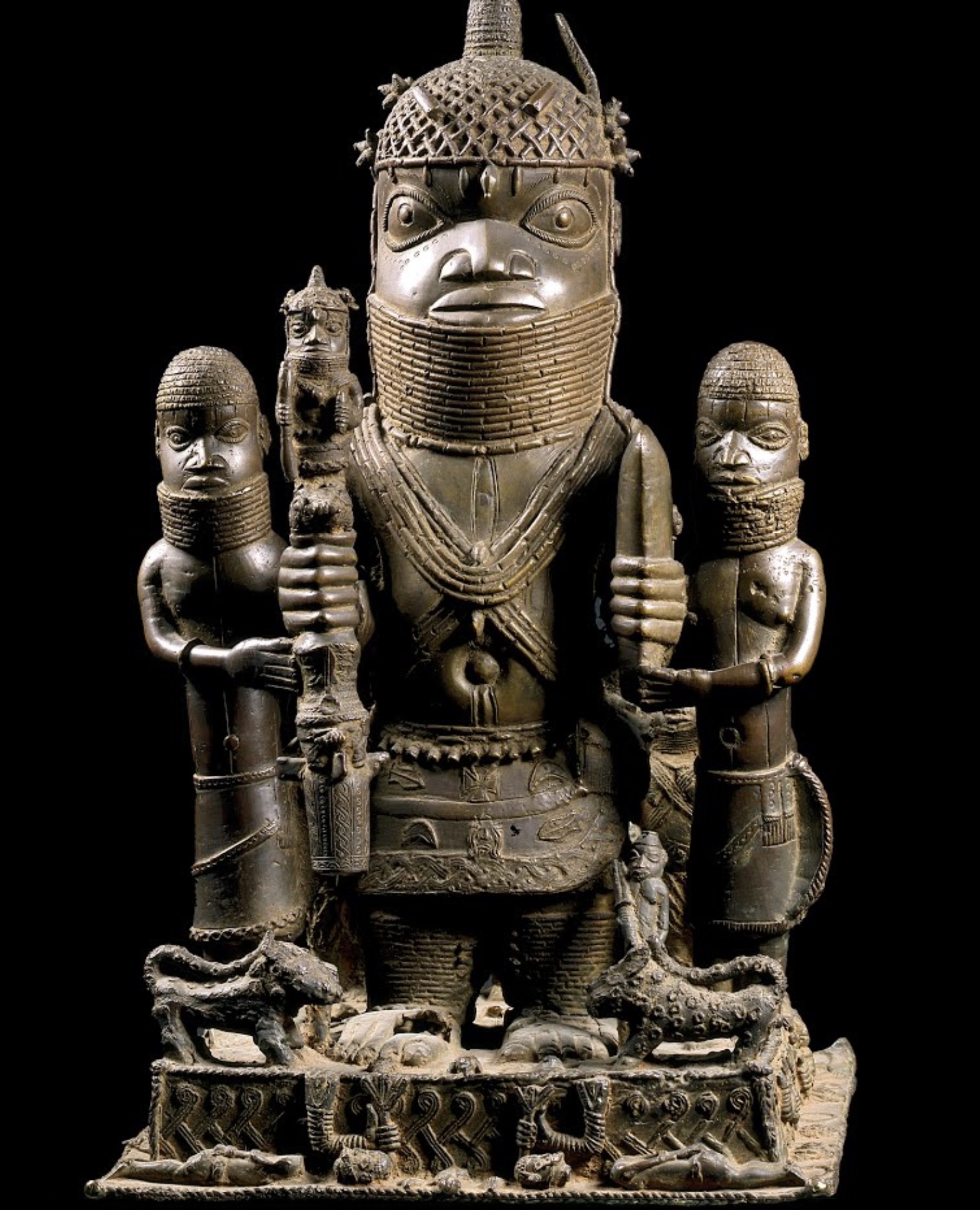
Scale is the relationship of parts of an image to the image as a whole, or to something in the world outside of the image, for example, the size of the figure of a king in an image as compared to the size of the figure of his servant in the same image, or the size of a statue of the king as compared to the size of an actual person. Beginning with proportion, we can look again at Doryphoros. We will compare his proportions to those of an Altar Group from Benin with Oba (King) Akenzua I and Two Attendants.

Doryphoros’ proportions were laid out according to mathematical formulas in order to create an image that the sculptor believed presented the “ideal man.”

Doryphoros is about seven “heads” tall, so to speak, whereas the Akenzua is approximately two and a half “heads” tall. Doryphoros’  limbs fit within the range of average human proportion, whereas Akenzua’s legs are considerably shorter than his torso.

Altar group with Oba Akenzura I, Benin, Nigeria, eighteenth century
Altar group with Oba Akenzua I, Benin, Nigeria, eighteenth century, brass, 63 cm. (Ethnological Museum, Berlin)

While their proportions are quite different, both present figures considered to be ideal by their cultures. Doryphoros embodies quite literally the focus on external beauty — according to the tastes of the day — that was prevalent in Classical Greece, whereas the image of Akenzua shows, with the intentional enlargement of the head, the greater importance of the intellect in the culture.

Perugino, Christ Giving the Keys of the Kingdom to St. Peter, Sistine Chapel, 1481-83
Perugino, Christ Giving the Keys of the Kingdom to St. Peter, Sistine Chapel, 1481-83, fresco, 10 feet 10 inches x 18 feet (Vatican, Rome)

Hieratic scale

Scale can refer to any relationship of parts to the whole, but one particular type is of great significance in many periods: Hieratic scale is scale based on relative importance. That is, the more important a figure, the larger he or she is in relation to the figures around him or her. This is quite different from the naturalistic scale found in works organized by linear perspective, like Perugino’s painting.

Akenzua, for example, is considerably larger than the figures that flank him. These are not children, but adult male attendants. We are not supposed to therefore assume that Akenzua is a giant, but rather, that he is far more important than the other two men. Also note that the other two have rather different proportions: their heads are much smaller in relation to their bodies, and their arms and legs longer. This reminds us that Akenzua’s proportions are absolutely deliberate, not the result of incompetence but of a conscious effort to convey a cultural meaning.

Before leaving this work, though, two more details should be mentioned. At their feet are small cats, but these are leopards — traditional symbols of the king — and so even the attendants are comparatively giant. And below the cats are fallen men, bound with their hands behind them, decapitated. The symbolism of decapitation as the ultimate, dehumanizing death highlights the importance of the scale of the head of the king who towers over them.

Pattern, repetition and rhythm, variety and unity

Garbhadhatu (Taizokai) Mandala (Womb World), mandala of Innate Reason and Original Enlightenment, Japan, Heian period
Garbhadhatu (Taizokai) Mandala (Womb World), mandala of Innate Reason and Original Enlightenment, Japan, Heian period (Tantric Buddhism), late 9th century, colors on silk
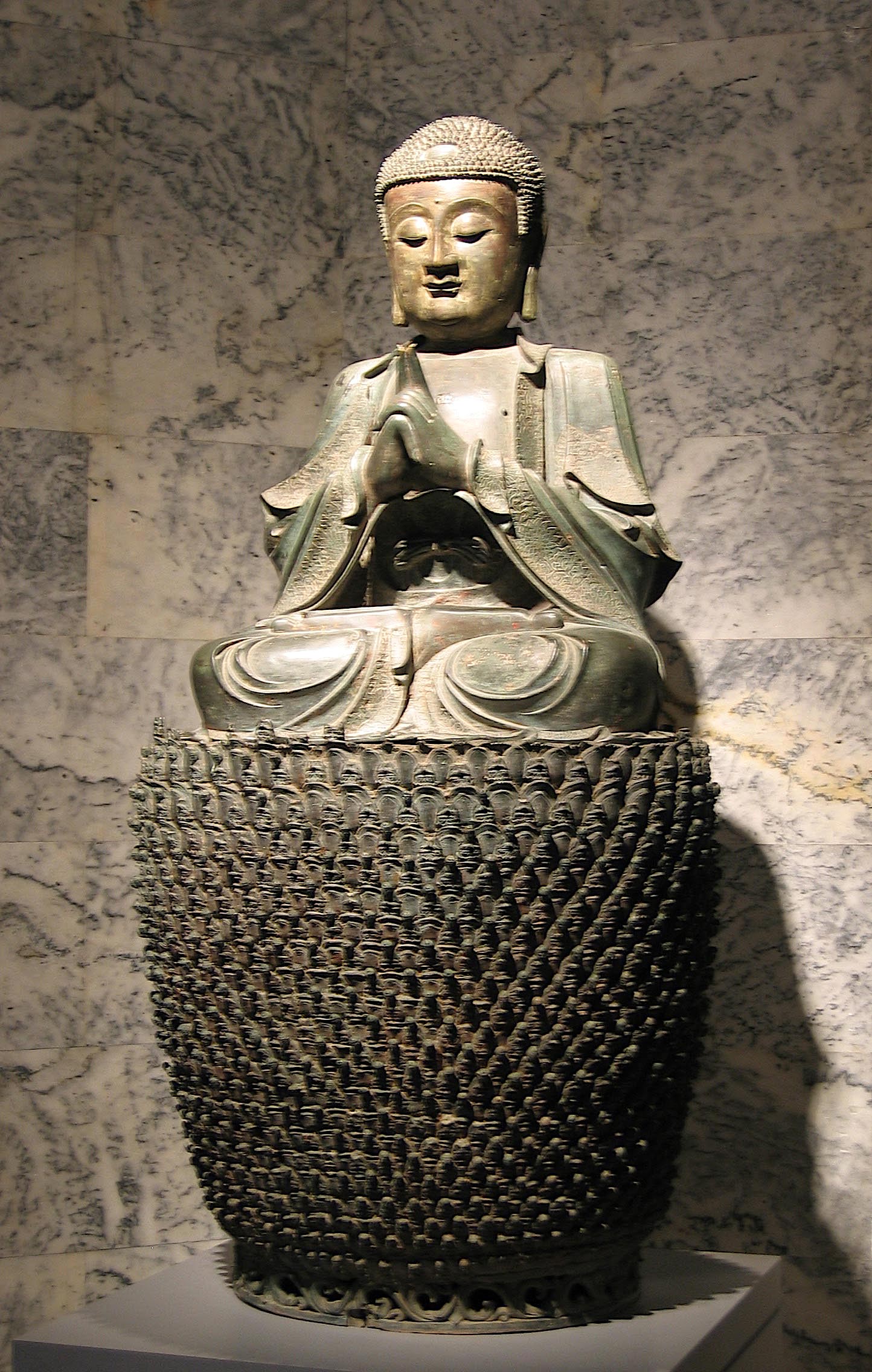
Vairocana Buddha, 16th-17th century, China, bronze, 99 cm (Cantor Arts Center)

When an image or object is repeated throughout a work of art, or a part of a work, this is called either pattern or repetition.

Repetition and pattern

Repetition can be less structured than pattern, which is more regular. Both can work to create a sense of rhythm, as discussed below. The large base of a Ming Dynasty Chinese Bronze statue of Vairochana Buddha is composed of literally thousands of tiny bodhisattvas (Bodhisattvas are enlightened beings who have chosen to stay on earth to help others achieve enlightenment), which therefore seem to serve to support Buddha figuratively, as well as visually. Their repetition is very regular, establishing a clear pattern. This is also the case in the Buddhist mandala from the 9th century. The pattern in both cases emphasizes the unity of purpose shared by these thousands of figures, each an embodiment of the ideal of compassion.

Rhythm

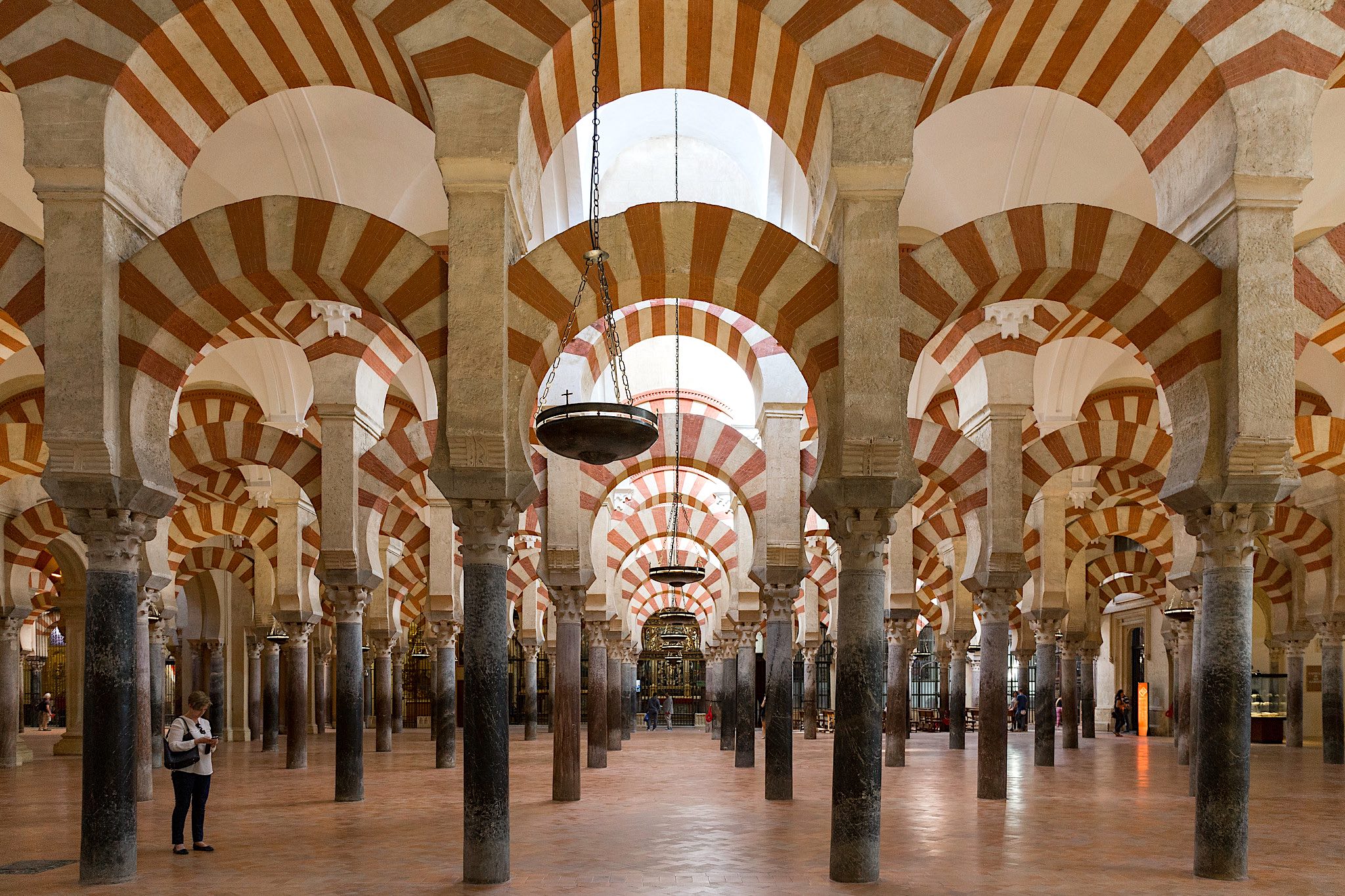
Rhythm is the visual tempo set by repeating elements in a work of art or architecture. The arches and columns of the Great Mosque of Cordoba provide a good example. They are spaced very evenly, setting up an even tone to the building. This is then enlivened by the rhythm created by the striped pattern on the arches.

Hypostyle hall, Great Mosque at Cordoba, Spain, begun 786 and enlarged during the 9th and 10th centuries
Hypostyle hall, Great Mosque at Cordoba, Spain, begun 786 and enlarged during the 9th and 10th centuries (photo: wsifrancis, CC BY-NC-ND 2.0)

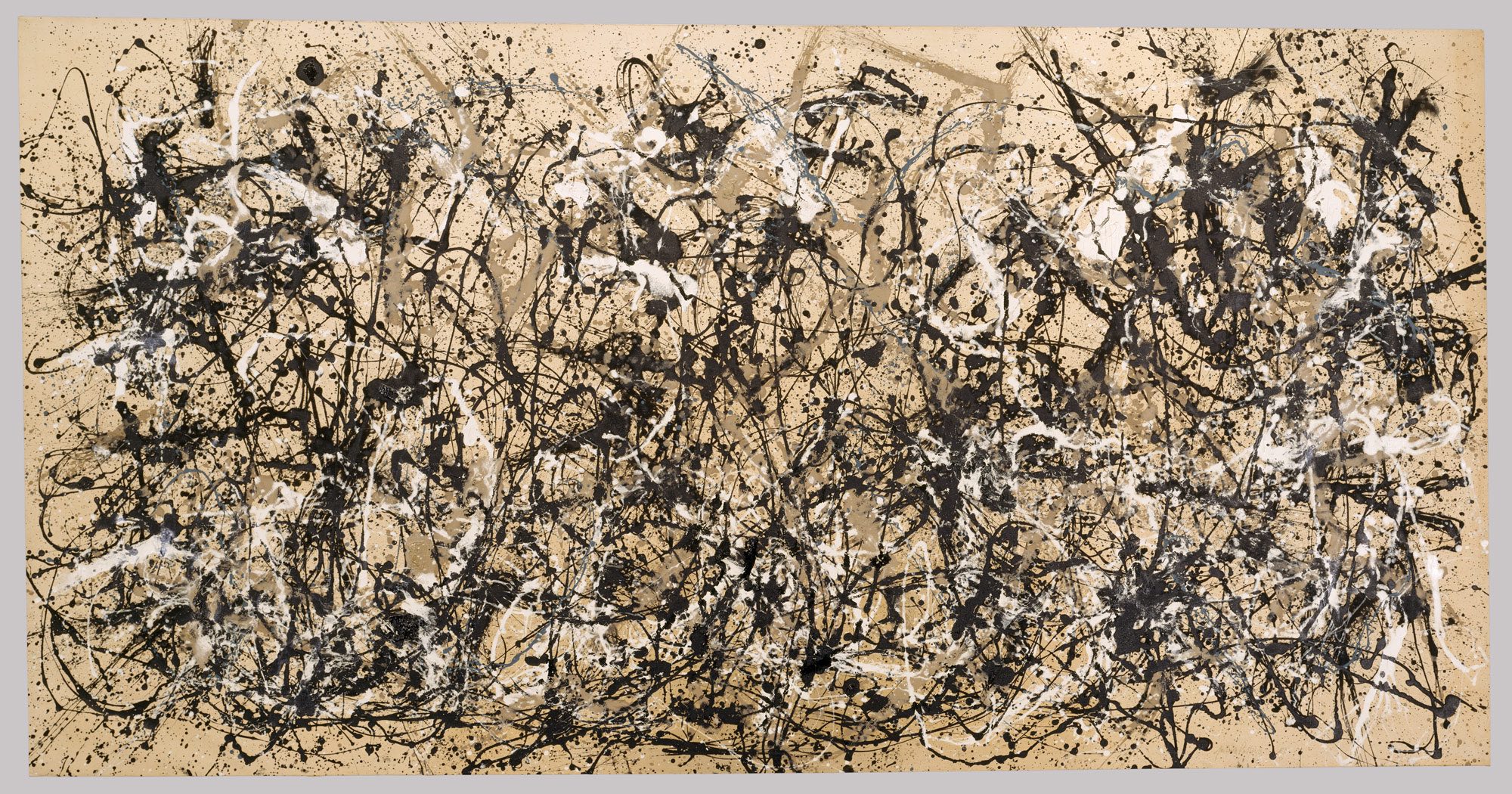
For contrast, we could look at Jackson Pollock’s Autumn Rhythm (# 30). Pollock was a fan of jazz music, and tried to capture something of its loose, syncopated rhythms. The resulting drip-paintings (they were made with the large canvases lain on the floor of his studio) have similarly loose, improvisational compositions. Despite its lack of formal structure, there is a clear rhythm running horizontally across the painting, and Pollock uses the title of the work to draw our attention to it.

Jackson Pollock, Autumn Rhythm (Number 30), 1950
Jackson Pollock, Autumn Rhythm (Number 30), 1950, enamel on canvas, 266.7 x 525.8 cm (The Metropolitan Museum of Art)
Detail, Garbhadhatu (Taizokai) Mandala (Womb World), mandala of Innate Reason and Original Enlightenment, Japan, Heian period
Detail, Garbhadhatu (Taizokai) Mandala (Womb World), mandala of Innate Reason and Original Enlightenment, Japan, Heian period (Tantric Buddhism), late 9th century, colors on silk

Variety and Unity

Variety is the use of different visual elements throughout a work, whereas unity is a feeling that all the parts of a work fit together well. These do not have to be opposites, as a work filled with variety might also have unity.

The World Womb Mandala is an excellent example. Unlike the Ming Dynasty Bronze statue of Buddha, where all of the bodhisattvas are more or less identical, the many bodhisattvas on the World Womb Mandala are each individualized. At a distance, they all become one, expressing great unity, but taken one at a time, each as an object of devotional contemplation, they contain more variety than it would at first appear.

The information on the Principles of Composition were written by Dr. Asa Mittman and published in Smarthistory, 2029

Architecture

Related to sculpture, architecture creates three-dimensional objects that occupy a given space and create a visual relationship with the space around them. The differences between the sculpture and architecture are in their scale and utility. Early human structures provided shelter from the elements. As hunter-gatherer societies transitioned to farming they made more permanent shelters, eventually formed communities, towns and cities. For thousands of years, architecture reflected the specific environment and materials available in any given region, including rock caves or huts of wood, soil and brick. Many were assemblages of materials like grasses, leaves and animal hides.

Cave made of large bones and mammoth tusks

“Mammoth House”, Frozen Woolly Mammoth Yuka Exhibit, Yokoyama, Japan, Summer 2013. This replica was made for the exhibit with real mammoth fossils and tusks. Author: Nandaro

Nomadic peoples in some parts of the world still utilize similar materials and techniques.

Woman in flowered gown standing in front of a round shack on a pink rug
Turkman woman standing at the entry to a grass and hide covered yurt. Collection of the Library of Congress Prints and Images File

These are examples of “skin and skeleton” construction. In the case of the mammoth, literally. Any building that has an internal structure of one material and a cladding, or exterior, of another might be referred to as “skin and skeleton.” Another structural system is the “shell” system in which the exterior cladding and the load-bearing structure are the same material. A log cabin would be an example of a “shell” structural system.

In simple design terms, architecture adheres to Louis Sullivan’s dictum that “form follows function”. Architecture’s function reflects different human needs. For example, warehouses take the shape of large squares or rectangles because they need only to enclose a space that protects and stores products and materials in the most efficient manner. A home is designed with other functions in mind, including cooking, resting, cleaning and entertaining. So the interior design of a home includes specialized areas for these different functions. A church or school design would have their own set of spatial requirements because they provide for large groups of people at once.

Architecture solves problems concerning the use of space, interior design and the landscape that surrounds it. The limitations imposed on architecture by the laws of physics are solved to a large extent by engineering. The greatest limitations on design are the physical loads exerted by a structure’s weight. Compression loads refer to vertical weight and shear loads travel at an angle or horizontally. Buildings need stable foundations and framing systems that support the spanning of open space.

Methods and Materials

The basic methods in building design and construction have been used for thousands of years. Stacking stones, laying brick or lashing wood together in one form or another are still used today in all parts of the world. But over the centuries, innovations in methods and materials have given new expression to architecture and the human footprint on the landscape. We can look to historical examples for clues that give context to different style periods.

In western culture, one of the earliest settlements with permanent structures was discovered at Catalhoyuk in Turkey (pictured below). The rich soil that surrounds the settlement indicates the inhabitants relied in part on farming. Dated to about 7500 BCE (Before Common Era), the dwellings are constructed from dried mud and brick and show wooden support beams spanning the ceilings. The design of the settlement incorporates a cell-like structure of small buildings either sharing common walls or separated by a few feet. The roofs are flat and were used as pathways between buildings.

Wooden ladder leading to a log ceiling over a white stone room
Stipich Bela, ‘Restoration of interior, Catalhoyuk, Turkey’

A significant advance came with the development of the post and lintel system. With this, a system of posts – either stone or wood – are placed at intervals and spanned by beams at the tops. The load is distributed down the posts to allow for areas of open space between them. Its earliest use is seen at Stonehenge (below), a prehistoric monument in southern England dating to about 3000 BCE.

Row of rectangular stones on a green field
Stonehenge, 30 July 2007 Source https://www.flickr.com/photos/garethwiscombe/1071477228/in/photostream/ Author garethwiscombe CC-BY 2.0
Pillars holding up wooden boards and bars over a brick ground
Post and lintel support in contemporary use; Image by Chris Gildow, Used with Permission

A colonnade continues the post and lintel method as a series of columns and beams enveloping larger areas of space. Colonnades can be free standing or part of a larger structure. Common in Egyptian, Greek and Roman architectural design, their use creates visual rhythm and implies a sense of grandeur. Over time columns became categorized by the capital style at their tops. The smooth and unadorned Tuscan and fluted Doric columns give way to more elaborate styles: the scrolled Ionian and the high relief Corinthian.

The Parthenon, a Greek temple to the mythic goddess Athena, was built in the 5thcentury BCE in Athens and is part of a larger community of structures in the Acropolis. All are considered pinnacles of classic Greek architecture. Ionic colonnades march across all sides of the Parthenon, the outer boundary of a very ordered interior floor plan.

Large crumbling building made of pillars
Parthenon, Athens, Greece, Image by Onkel Tucal, CC-BY-SH 3.0
Rectangles of dots and lines making a floor plan
Floor plan of the Parthenon. Licensed through Creative Commons

The dots are columns in the colonnade.

Walls of stone pillars carved with shapes and figures
The Great Hypostyle Hall at Karnak, Luxor, Egypt. C. 19th Dynasty. Covers 54,000 sq. ft. An example of post and lintel construction. The columns are close together to support the weight of the lintel and the roof. CC PD, Free for personal and commercial use, No attribution required

The colonnade is part of our contemporary surroundings too. Parks and other public spaces use them to the same effect: providing visual and material stability in spanning areas of open space.

Image of a colonnade made from stone and metal
Chris Gildow, ‘Contemporary colonnade’. Used with Permission

The development of the arch gave architecture new alternatives to post and lintel construction. Arches appeared as early as the 2nd millennium BC in Mesopotamian brick architecture. They supply strength and stability to walls without massive posts and beams because their construction minimizes the shear load imposed on them. This meant walls could go higher without compromising their stability and at the same time create larger areas of open space between arches. In addition, the arch gave buildings a more organic, expressive visual element. The Colosseum in Rome (below), built in the first century CE, uses repeated arches to define an imposing but decidedly airy structure. The fact that it’s still standing today is testament to the inherent strength of the arch.

Round crumbling building with many arched windows
The Colosseum, 1st Century CE. Rome. Photo by David Illiff, image licensed through Creative Commons

Roman aqueducts are another example of how effectively the arch was used. Tall and graceful, the arches support themselves in a colonnade and were used to transport a network of water channels throughout ancient Rome.

Tall stone wall made of arches in front of blue sky
Roman Aqueduct, c. 1st century CE. PD

From the arch came two more important developments: extending an arch in a linear direction – basically putting one arch right after another – formed a vault, encapsulating tall, narrow spaces with inverted “U” shaped ceilings. The compressive force of the vault required thick walls on each side to keep it from collapsing. Because of this many vaults were situated underground – essentially tunnels – connecting areas of a larger building or providing covered transport of people, goods and materials throughout the city. Roman basilicas, public spaces used for law courts and other assemblies, were basically long arched, vaulted buildings.

An arch rotated on its vertical axis creates a dome, with its curving organic scoop of space reserved for the tops of the most important buildings. The Pantheon in Rome sports a dome with an oculus – a round or elliptical opening at the top, that is the massive building’s only light source. The dome of the Pantheon was made with unreinforced concrete, a process that was lost to the West after the fall of Rome until modern times. It was the largest dome for centuries and remains the largest unreinforced concrete dome in the world.

Round ceiling with round window in the center and square holes around
Dennis Jarvis, Dome of the Pantheon with oculus, 126 CE. Rome. PD

These elements combined to revolutionize architectural design throughout Europe and the Middle East in the form of bigger and stronger churches, mosques and even sectarian government buildings. Styles changed with technology.

Romanesque architecture was popular for nearly three hundred years (800 – 1100 CE). The style is characterized by barrel or groin vault ceilings, thick walls with low exterior buttresses and squared off towers. Buildings reached a point where they struggled to support their own weight. The architectural solution to the problem was a flying buttress, an exterior load-bearing column connected to the main structure by a segmented arch or ‘flyer’. Even with exterior buttresses the Romanesque walls were thick and didn’t allow for large openings.

St. Foy at Conques, France, is an example of Romanesque church architecture. Note the thickness of the walls and buttresses and the relative small size of the windows.

Three large steeples on a church in a mountain town
Abbey Church of St. Foy de Conques, France, 12th c. Image by Marc Figueras, CC BY-SH 3.0
Sketch of half an arch in a brick wall
Diagram of a flying buttress from St. Denis basilica, Paris. From the Dictionary of French Architecture from 11th to 16th Century, 1856. Licensed through Creative Commons

Flying buttresses became a kind of exoskeleton that transferred the heavy weight of Romanesque stone roofs through their arches and into the ground, away from the building. They became catalysts for the later Gothic style based on higher, thinner walls, pointed arches, ribbed vaults, and spired towers. Also, the thinner walls of the Gothic style allowed for more stained glass windows and interior illumination.

Large room of a church with arched ceilings and stained glass windows in the back above a cross
Church of St. Denis, 7th -12th centuries CE. Saint-Denis, France; Image by Mossot; PD

St. Denis basilica in France (above) is one of the first Gothic style churches, known for its high vaulted ceilings and extensive use of stained glass windows. The architecture of the church became a symbol of spirituality itself: soaring heights, magnificently embellished interiors and exteriors, elaborate lighting and sheer grandeur on a massive scale. Abbot Suger in the 12th century in Paris inspired master masons to build higher and to allow for bigger windows and more light to echo the grandeur of Heaven. This style was made possible by the pointed arches, pointed vaults, and flying buttresses that characterize Gothic architecture.1

By the 12th century the High Gothic style in France was developed and would inspire architecture in many other European countries – Italy remained an outlier for the most part into the Renaissance. In France, Chartres Cathedral about 50 miles southwest of Paris exhibits the Gothic style as it developed. Begun as a Romanesque church in 1145, the rebuilding of Chartres in the High Gothic style began in earnest in 1194 after a fire in that year. It continued through the 12th and 13th centuries and exhibits the hallmarks of High Gothic style: high nave with pointed arches, elaborate flying buttresses, thin walls with large, ornate stained glass windows.

Five photos of a church from different angles
Chartres Cathedral, Chartres, France, Image by MathKnight, Feb. 15, 2016; CC BY-SH 4.0

The parts of a Gothic basilican church are diagrammed below.

Diagram of a church with pointed roof and four pointed pillars over arches
Gothic Cathedral, section with architectural labels, image by TTaylor, Sept. 1, 2007. CC BY-SH 3.0

The Doges Palace in Venice, Italy (pictured below) housed the political aristocracy of the Republic of Venice for a thousand years. Built in 1309 CE, its rhythmic levels of columns and pointed arches, divided by fractals as they rise, give way to elaborate geometric patterns in the pink brick façade. The ornamental additions at the top edge reinforce the patterns below.

Wall with arched windows and a balcony standing over more arches
Emustonen, ‘The Doges Palace’, 1309 CE, viewed from St. Mark’s Square, Venice, Italy. Image by Martti Mustonen and licensed through Creative Commons

By the end of the High Gothic phase most of the innovations that drove architecture and building styles were in place. There wouldn’t be a real change until the material discoveries of the 18th, 19th and 20th centuries. We will look at those transformations next.

Licenses and attributions: https://courses.lumenlearning.com/atd-sac-artappreciation/chapter/oer-1-27/

1 https://en.wikipedia.org/wiki/Suger
Source:  Introduction to Art by Muffet Jones, Boise State University Pressbooks, Creative Commons Attribution 4.0 International License.

Architecture: What’s the Difference Between a Plan, an Elevation and a Section?

Video URL:  https://www.youtube.com/watch?v=3REqM7wGrXA

TRANSCRIPT:

This video is designed to help you tell the difference between the different views used to show an interior space. These are plans, elevations and sections. To help demonstrate this visually we have used an orange.

A perspective drawing is used to create a realistic drawing of an object, showing this object in 3 dimensions. The further away the objects in the drawing the smaller they will become.

Plans, elevations and sections are 2D visuals that represent a 3D object. Combining different 2D visuals allows you to create an accurate representation of a design. Or in the instance of interior design, a space.

This is a plan view. In basic terms, a plan is a birds-eye view of a space. When drawing a floor plan, the roof would be removed so the interior space can be seen.

This is an elevation view. An elevation is a view from the side of an object, when drawing interior elevations, this would represent one of the walls. This would include any windows or doors as well as any built-in furniture that is in direct contact with the wall.

This is a section view. A section is a cut through of a space which will show more of the room’s features. It also allows you to show some structural detail. A section line can be cut from any part of the space, depending on what you would like to show.

Copyright: National Design Academy (https://www.nda.ac.uk/blog/identify-plans-elevations-sections/)

Describing What You See – Art History and Visual Analysis

Introduction to art historical analysis

by DR. ROBERT GLASS
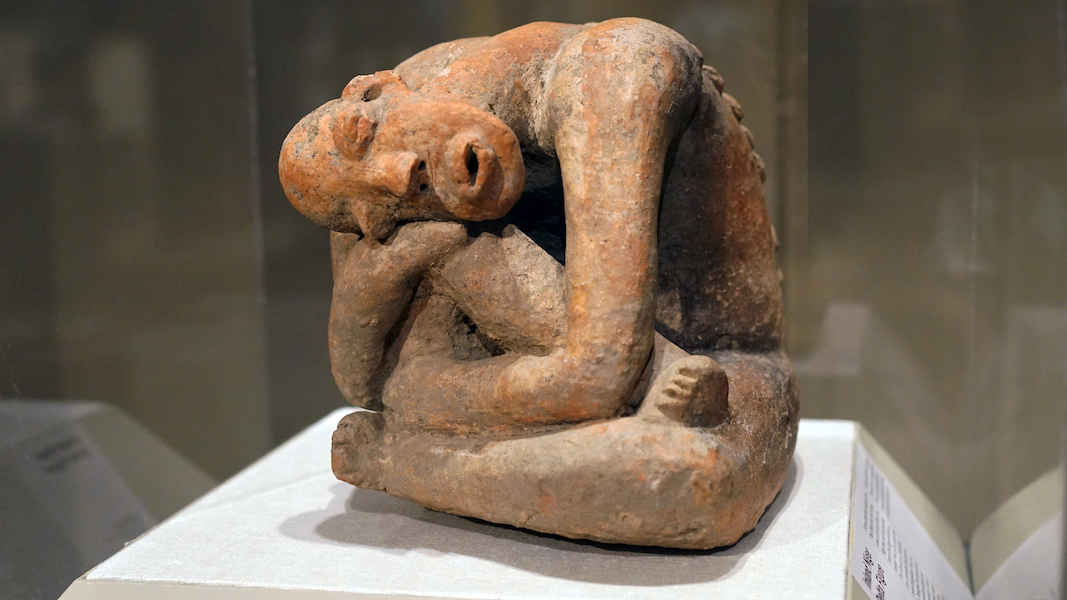
Seated Figure, terracotta, 13th century, Mali, Inland Niger Delta region, Djenné peoples,
Seated Figure, terracotta, 13th century, Mali, Inland Niger Delta region, Djenné peoples, 25/4 x 29.9 cm (The Metropolitan Museum of Art)

Why does a work of art look the way it does? Who made it and why? What does it mean? These questions and others like them lie at the heart of art historical inquiry. Art historians use various types of analysis to provide answers. These have varied over time and continue to evolve, but in general, three categories can be distinguished. In the essays and videos on Smarthistory, different types of analysis are used, often without identifying them explicitly. If you become familiar with the three categories below, you will be able to recognize them.
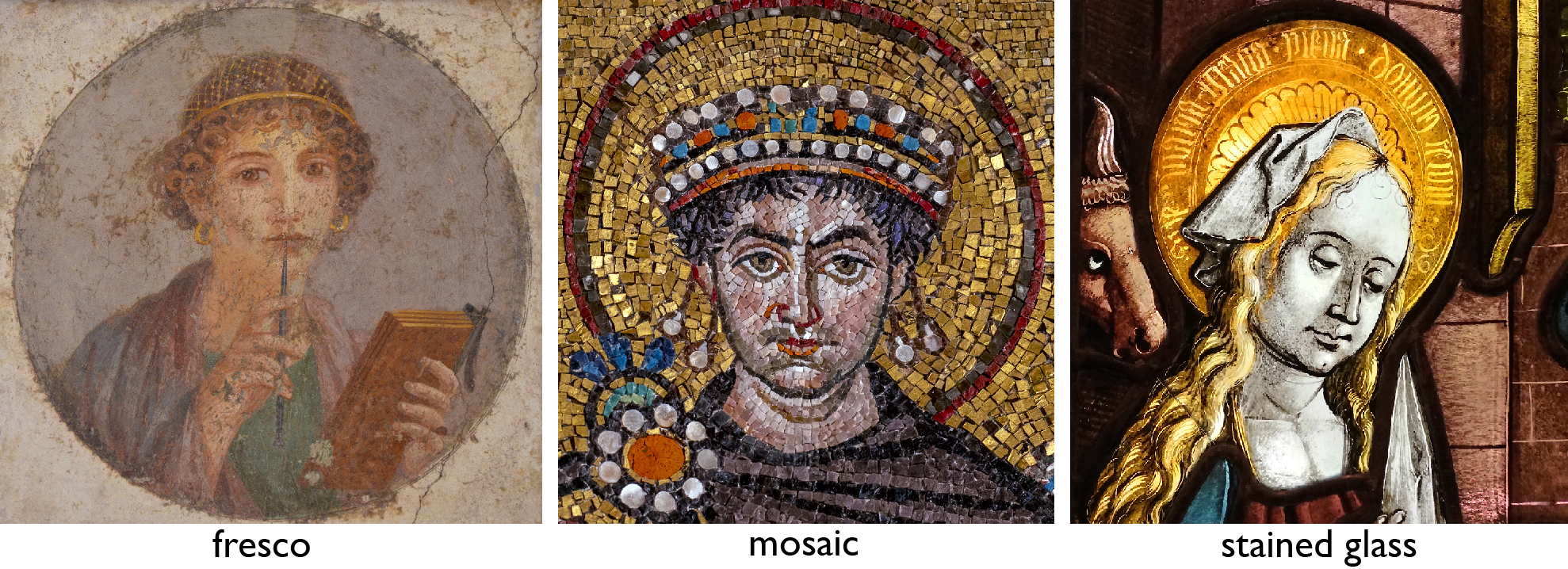
Left: Woman with wax tablets center: Justinian and Attendants, mosaic, north wall of the apse, right: Circle of Peter Hemmel von Andlau
Left: Woman with wax tablets and stylus, c. 50 C.E., fresco (National Archaeological Museum, Naples; photo: Meidosensei, CC BY-SA 2.0); center: Justinian (detail), Justinian and Attendants, mosaic, north wall of the apse, San Vitale, Ravenna, Italy, c. 547 (photo: Steven Zucker, CC BY-NC-SA 2.0); right: Circle of Peter Hemmel von Andlau (Strassburger Werkstattgemeinschaft), Adoration of the Magi (detail), 1507, Munich, Germany, pot metal and colorless glass, vitreous paint, and silver stain, 72.4 x 45.7 cm (Cloisters, The Metropolitan Museum of Art; photo: Steven Zucker, CC BY-NC-SA 2.0)

Art as physical object

Oil and pigments on canvas, carved marble, woven fibers, a concrete dome—most works of art and architecture are physical things. As such, a fundamental determinant of the way they look is the material of which they are made. In architecture, the word used for this is simply materials. In art, the term medium (plural: media) is also used.

Materials have specific properties that dictate the ways they can be manipulated and the effects they can produce. For example, marble will crack under its own weight if not properly balanced and supported, which imposes limits on the sculptural forms or architectural designs that can be created with it. Fresco painting, stained glass, and mosaic are all capable of creating breathtaking images, but their visual qualities differ significantly due to the distinct physical properties and working methods of each medium. This latter aspect—the way a medium is worked or used—is called technique. Together, materials and technique determine basic visual features and the parameters within which an artist or architect must work.

Learning to recognize specific media and techniques and how they have been used historically are fundamental art historical skills. Not only do they allow you to understand the logic behind specific visual qualities, but they may also help identify when and where a work was made since certain media and techniques are characteristic of specific periods and places.

Conservation

Technological advances have led to new methods of analyzing materials and techniques. Today this research is carried out primarily by art conservators. Because art and architecture, like all physical things, are subject to the corrosive effects of time and environment, conservation science is a crucial field. Training in art conservation typically involves coursework in chemistry as well as the practice and history of art.

While the main job of conservators is preservation, their investigative techniques can also benefit art historians. Technologies such as X-radiography, ultraviolet illumination, and infrared reflectography can reveal features of an object invisible to the human eye, such as the inside of a bronze statue, changes made to a painting, or drawing under a painted surface. X-ray fluorescence can identify the pigments in paint or the composition of metals by their chemical profiles. Dendrochronology can establish the earliest date a wooden object could have been made based on tree ring growth patterns. Analysis of materials and techniques using methods such as these can help art historians answer questions about when, where, how, or by whom, a work was made.
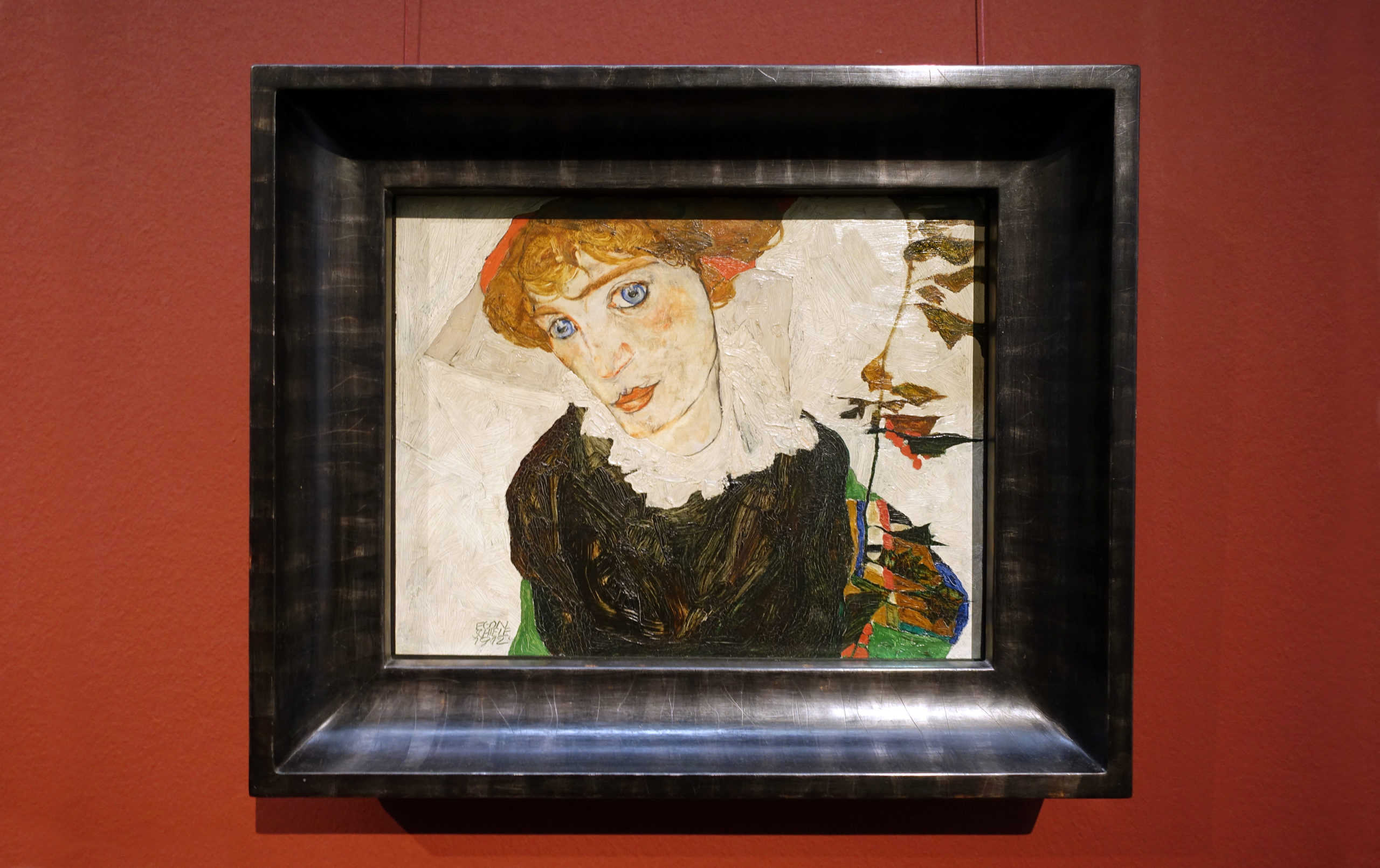
Egon Schiele, Portrait of Wally Neuzil, 1912
Egon Schiele, Portrait of Wally Neuzil, 1912, oil on panel, 32 x 39.8 cm (Leopold Museum, Vienna; photo: Steven Zucker, CC BY-NC-SA 2.0)

Art as visual experience

Most art is visually compelling. While materials and technique determine the range of what is possible, the final appearance of a work is the product of numerous additional choices made by the artist. An artist painting a portrait of a woman in oil on canvas must decide on the size and shape of the canvas, the scale of the woman and where to place her, and the types of forms, lines, colors, and brushstrokes to use in representing the sitter and her surroundings. In a compelling work of art, myriad variables such as these and others come together to create an engaging visual experience.

Visual (formal) analysis

Art historians use visual analysis to describe and understand this experience. Often called formal analysis because it focuses on form rather than subject matter or historical context, this typically consists of two parts: description of the visual features of a work and analysis of their effects. To describe visual properties systematically, art historians rely on an established set of terms and concepts. These include characteristics such as format, scale, composition, and viewpoint; treatment of the human figure and space; and the use of form, line, color, light, and texture.

In describing visual qualities, formal analysis usually identifies certain features as contributing to the overall impression of the work. For example, a prominent linear form might suggest strength if straight and vertical, grace or sensuality if sinuous, or stability and calm if long and horizontal. Sharp contrasts in light and dark may make an image feel bold and dramatic whereas subdued lighting might suggest gentleness or intimacy. In the past, formal analysis assumed there was some elementary level of universality in the human response to visual form and tried to describe these effects. Today, the method is understood as more subjective, but still valued as a critical exercise and means of analyzing visual experience, especially in introductory art history courses.
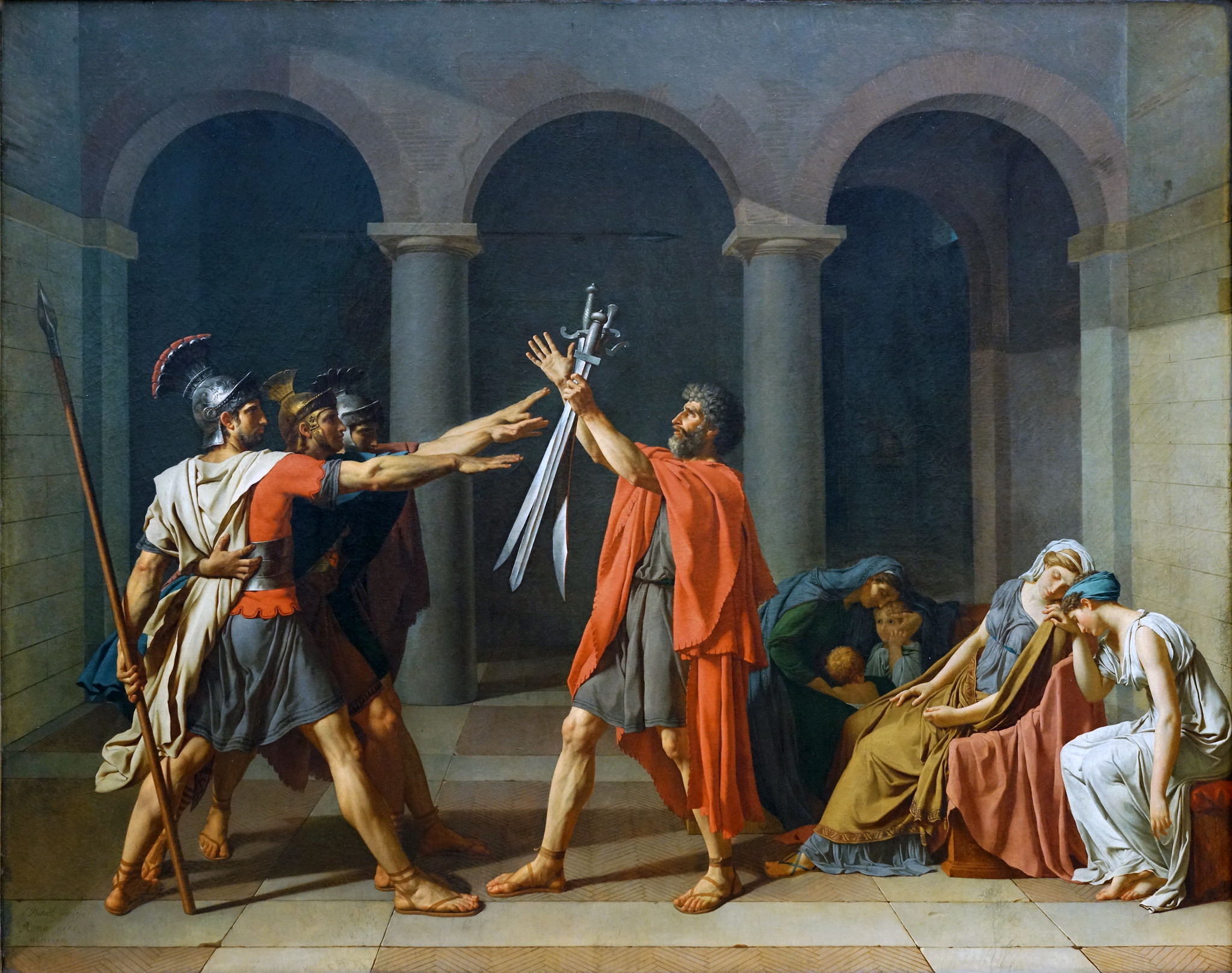
Jacques-Louis David, Oath of the Horatii , 1784
Jacques-Louis David, Oath of the Horatii, 1784, oil on canvas, 3.3 x 4.25 m, painted in Rome, exhibited at the salon of 1785 (Musée du Louvre; photo: Steven Zucker, CC BY-NC-SA 2.0)

Style

Formal analysis is a powerful tool for appreciating art. Armed with it, you can analyze any work based simply on the experience of looking at it. But the method is also important for understanding art in its historical context. This is because the visual properties of works made by an individual artist or, more generally, by artists working in the same time and place, typically have common features. Art historians call these shared characteristics style. As art historian James Elkins elegantly phrased it, style is “a coherence of qualities in periods or people.” [1] This may include consistency in things like medium, function, and subject matter, but when art historians use the term style, they primarily mean formal characteristics.

Style varies by time and place, so like medium and technique, it can be used to determine the origin of a work of art. Because of its complexity, style is a far more specific indicator than materials and technique alone. Early art historians used stylistic analysis to categorize the vast legacy of undocumented art, assigning works to cultures, artistic circles, or individual artists based on their formal qualities. Today, stylistic analysis continues to be used to establish origins when unknown works are discovered or previous attributions revised.

In addition to helping categorize individual works, style has shaped the narratives told by art historians in fundamental ways. Until the mid-20th century, most histories of art focused on tracing stylistic development and change. As a result, many of the period divisions traditionally used for Western art are based on style. Some examples are Geometric, Orientalizing, Archaic, and Classical in ancient Greece, Romanesque and Gothic in Medieval Europe, and the Early, High, and Late Renaissance. Today style is only one of many aspects of art that interest art historians, but the power of tradition has ensured that style-based period divisions and labels remain widely used. Likewise, familiarity with the style of specific periods, places, and artists is still considered fundamental art historical knowledge and often remains the focus of introductory art history textbooks and courses.

Art as cultural artifact

While understanding the physical properties and visual experience of art is important, today most art historical research focuses on the significance of works as cultural artifacts. This category of analysis is characterized by a variety of approaches, but all share the basic objective of examining art in relation to its historical context. Most often, this is the time and place in which a work was created—typically we want to know why and by whom it was made and how it originally functioned. But since works of art and architecture often survive for centuries, art historians may also study a work’s cultural significance at later historical moments.
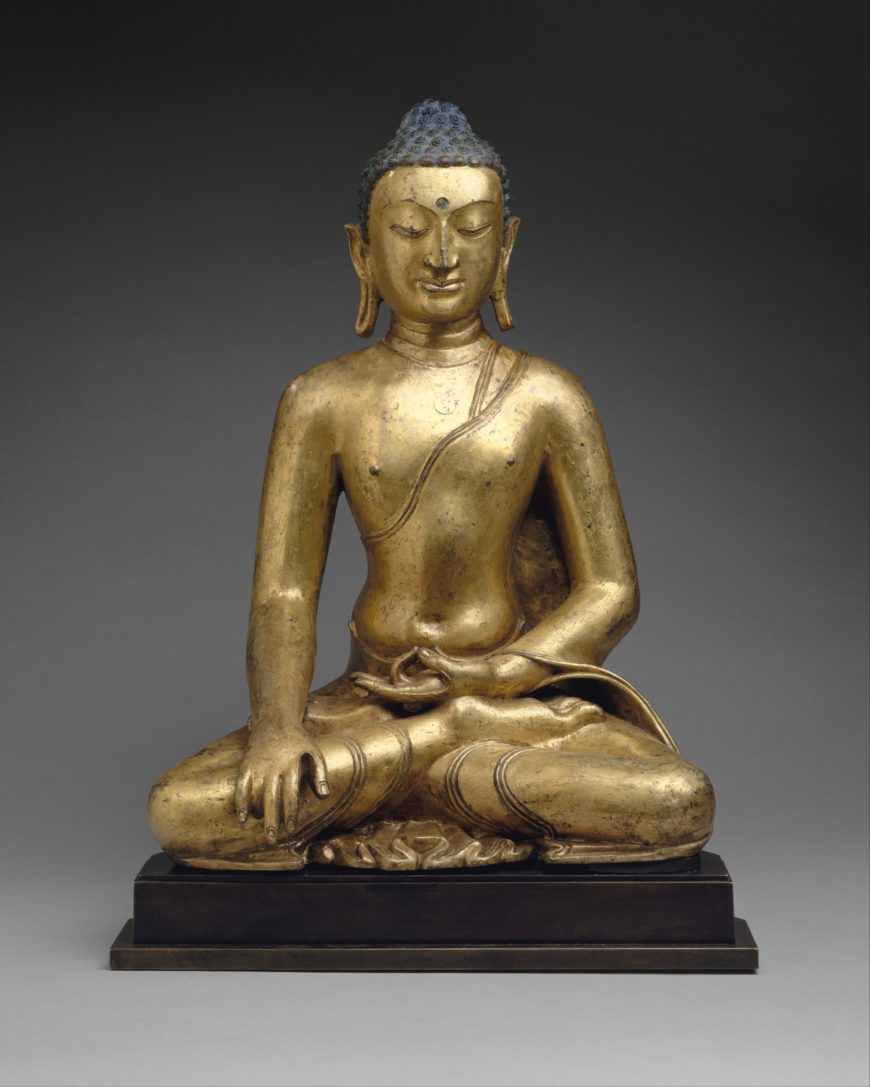
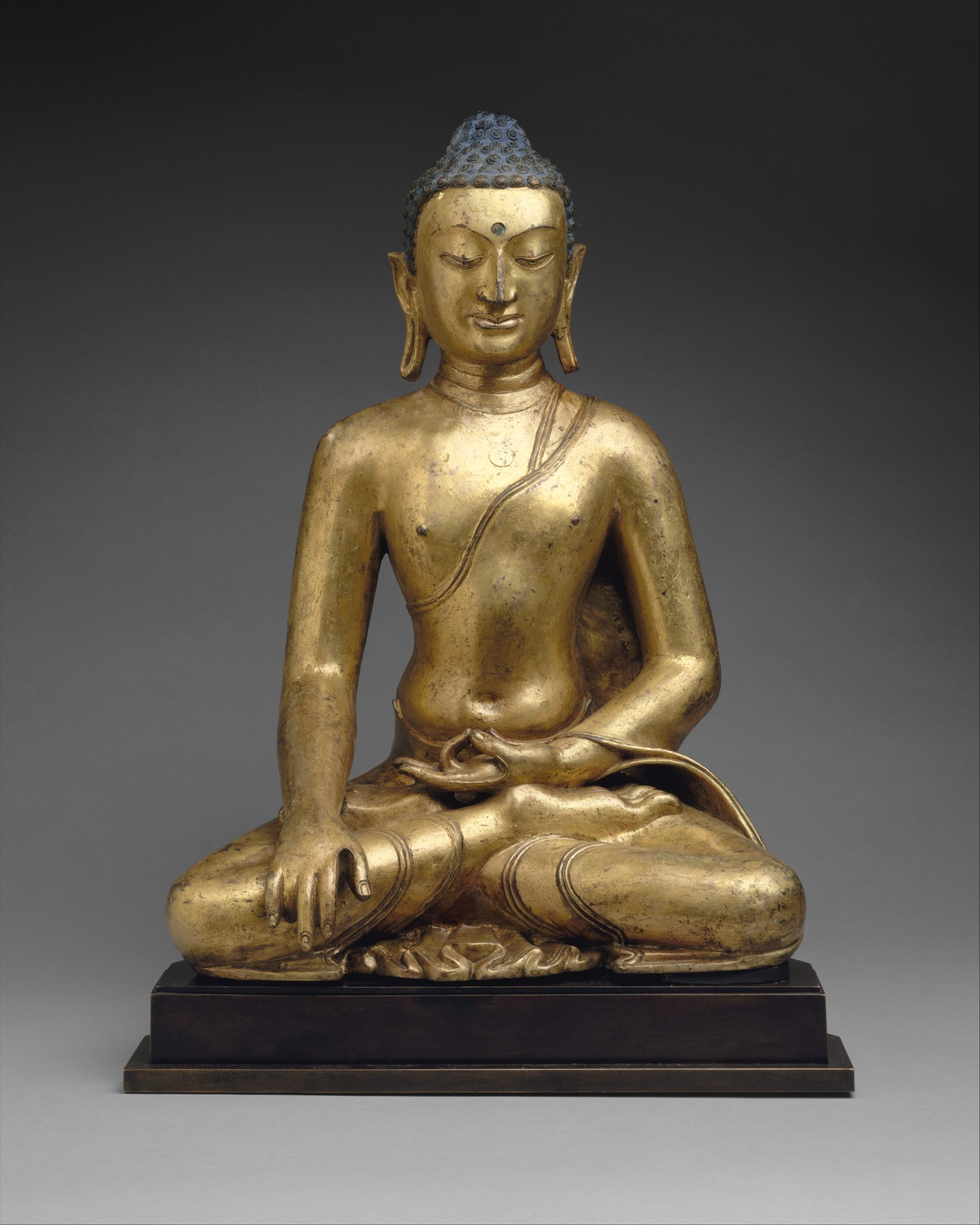
Buddha Shakyamuni or Akshobhya, the Buddha of the East, 11th–12th century
Buddha Shakyamuni or Akshobhya, the Buddha of the East, 11th–12th century, Tibet, gilt copper, 58 cm high (The Metropolitan Museum of Art)

Subject matter / iconography

One of the most basic types of contextual analysis is the interpretation of subject matter. Much art is representational (i.e., it creates a likeness of something), and naturally we want to understand what is shown and why. Art historians call the subject matter of images iconography. Iconographic analysis is the interpretation of its meaning. In many cases, such as an image of the crucified Christ or seated Buddha, identifying the subject presents few problems. When the iconography is obscure or treated in an unusual way, art historians try to understand it by studying the historical context in which the image was made, typically through comparison with texts and other imagery from the time. With challenging images, scholars may disagree on which contextual materials are relevant, resulting in conflicting interpretations. For many complex or enigmatic works, the meanings of the subject matter continue to be debated and reinterpreted today.

Function

Another common aspect of art investigated through contextual analysis is function. Historically, many works of art and nearly all architecture were intended to serve some purpose beyond the aesthetic. Understanding function is crucial because it usually plays a role in determining many features, including iconography, materials, format, and aspects of style. At the most basic level, art historians analyze function by identifying types—an altarpiece, portrait, Book of Hours, tomb, palace, etc. Studying the history and use of a given type provides a context for understanding specific examples.

Analysis of function becomes more complex when the personal motivations of the people responsible for making a work are considered. For much of history, this includes not only artists but also the patrons who commissioned works and in some cases, advisors acting on the patron’s behalf. When such agents can be identified, definitively or hypothetically, their motivations become potential contexts for understanding purpose and appearance.
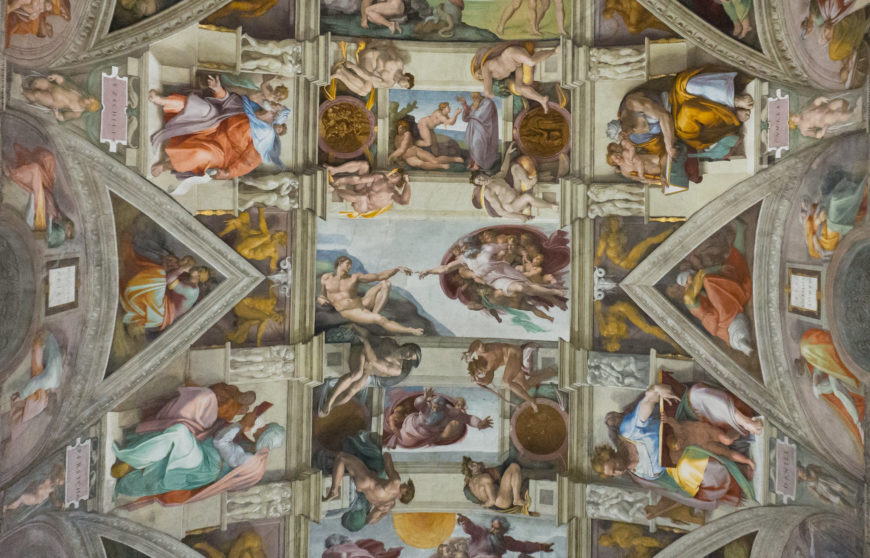
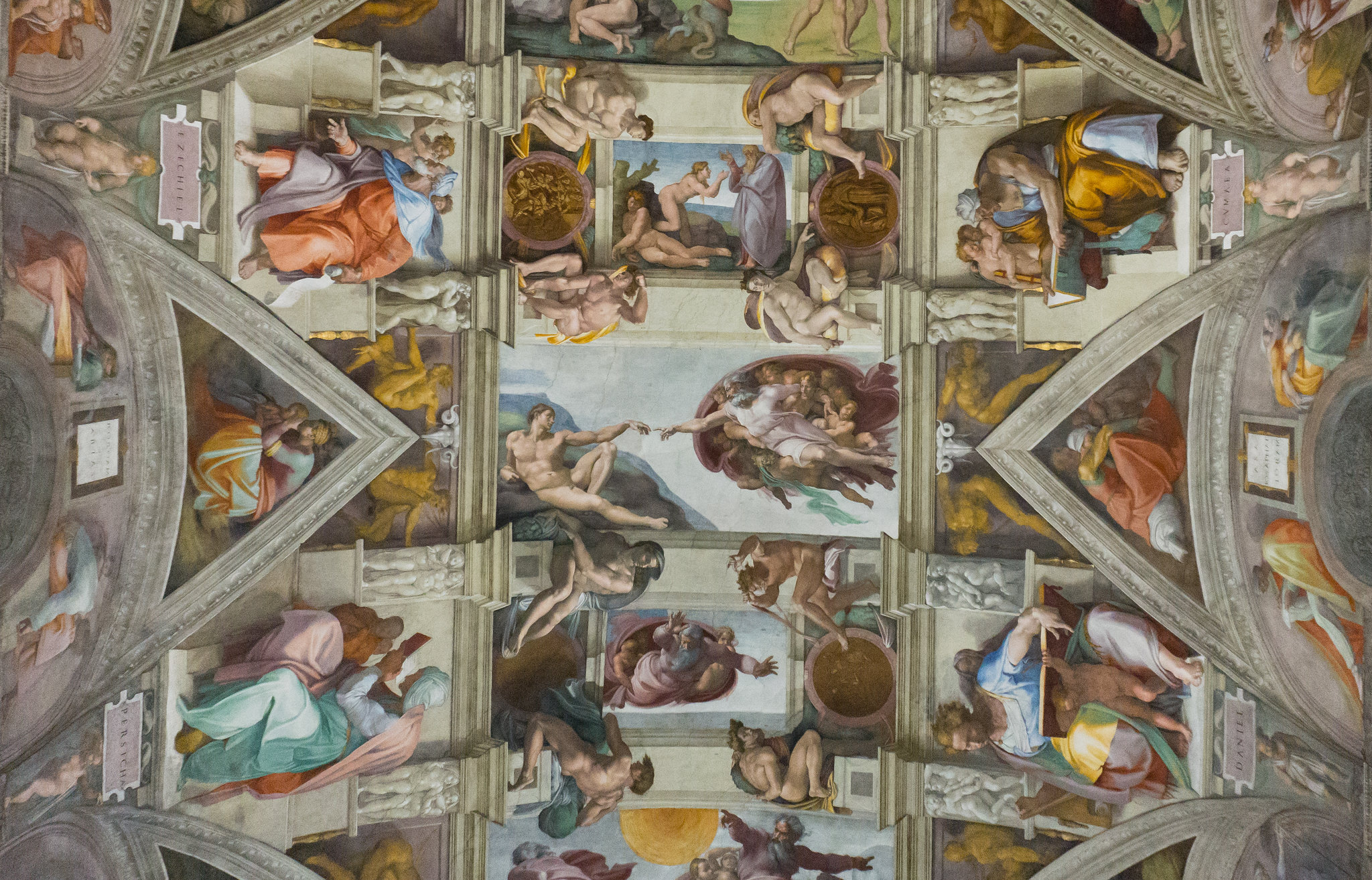
Michelangelo, Ceiling of the Sistine Chapel (detail), 1508–12, Vatican, Rome (photo: Kent G Becker, CC BY-NC-ND 2.0)
Michelangelo, Ceiling of the Sistine Chapel (detail), 1508–12, Vatican, Rome (photo: Kent G Becker, CC BY-NC-ND 2.0)

With complex works, this can soon raise interpretive quandaries. Take, for example, Michelangelo’s famous frescos on the ceiling of the Sistine Chapel. Are these highly original paintings best understood in relation to the function of the chapel (a key ritual site in the Vatican palace), or the concerns of the painter, Michelangelo, or of the patron, Pope Julius II, or of one or more of the Julius’s advisors at the papal court? The answer is likely some combination of these, but the contextual materials relevant to each are so vast and diverse that there is no one way to interpret them.

Thinking critically

This raises a final point about analyzing the meaning of art and architecture as cultural artifacts. While art historians rely on facts as much as possible and seek to interpret works in ways that are historically plausible, we recognize that subjectivity is inescapable. As discussed in “What is art history?,” we interpret the past in ways that make sense in the present. Today, art historians continue to ask traditional questions like those noted above, but they also ask new ones inspired by social developments such as feminism, globalism, multiculturalism, and identity politics.

So, as you read, watch, and listen, try to recognize the approaches being used and to think critically about them. Is the speaker or writer talking about the work as a physical object, visual experience, or cultural artifact? (Often it will be some combination.) What contexts are being used to explain meaning? Which contexts are not considered? This may leave you with as many questions as answers, but that is good. You are here not only to gain knowledge, but also to develop a curiosity about the world and the ability to think critically about it.

Notes:

[1] James Elkins, “Style,” Grove Art Online, Oxford Art Online (Oxford University Press, accessed August 15, 2017).

Additional resources

Read a chapter in our textbook, Reframing Art History, about learning to look and think critically.

Read a chapter in our textbook, Reframing Art History, about close looking and approaches to art.

Cite this page as: Dr. Robert Glass, “Introduction to art historical analysis,” in Smarthistory, October 28, 2017, accessed December 27, 2023, https://smarthistory.org/introduction-to-art-historical-analysis/.

How to do visual (formal) analysis

by DR. BETH HARRIS and DR. STEVEN ZUCKER

With Giovanni Bellini, Madonna of the Meadow, c. 1500, oil and egg on synthetic panel, transferred from wood, 67.3 x 86.4 cm (The National Gallery). Speakers: Dr. Steven Zucker and Dr. Beth Harris.

Video URL:  https://youtu.be/sM2MOyonDsY
Cite this page as: Dr. Beth Harris and Dr. Steven Zucker, “How to do visual (formal) analysis,” in Smarthistory, September 18, 2017, accessed December 27, 2023, https://smarthistory.org/visual-analysis/.

Art historical analysis with Goya’s Third of May, 1808

by DR. STEVEN ZUCKER and DR. BETH HARRIS

Francisco de Goya, Third of May, 1808, 1814, oil on canvas, 266 x 345.1 cm (Museo del Prado. Madrid) 

URL: https://youtu.be/_QM-DfhrNv8

Cite this page as: Dr. Steven Zucker and Dr. Beth Harris, “Art historical analysis with Goya’s Third of May, 1808,” in Smarthistory, August 9, 2015, accessed December 27, 2023, https://smarthistory.org/art-historical-analysis/.
Describing what you see: sculpture

by DR. BETH HARRIS and DR. STEVEN ZUCKER
Describing what you see: Sculpture, Henry Moore’s Reclining Figure, 1951, plaster and string, 105.4 x 227.3 x 89.2 cm (Tate Britain) © The Henry Moore Foundation.   

URL: https://youtu.be/Mbvaz0EPK_g

Additional resources
This sculpture at Tate Britain

Cite this page as: Dr. Beth Harris and Dr. Steven Zucker, “Describing what you see: sculpture,” in Smarthistory, April 6, 2019, accessed December 27, 2023, https://smarthistory.org/describing-sculpture/.
Previous/next navigation

Previous: Introduction
Next: How art can help you analyze

License

Icon for the Creative Commons Attribution 4.0 International License

ARTS 101: Art and Architecture from the Prehistoric World through the Medieval World Copyright © 2024 by Karen Brown is licensed under a Creative Commons Attribution 4.0 International License, except where otherwise noted.
Share This Book

Share on X Share on LinkedIn Share via Email
Pressbooks

Powered by Pressbooks

  • Pressbooks User Guide
  • |Pressbooks Directory
Pressbooks on YouTube Pressbooks on LinkedIn