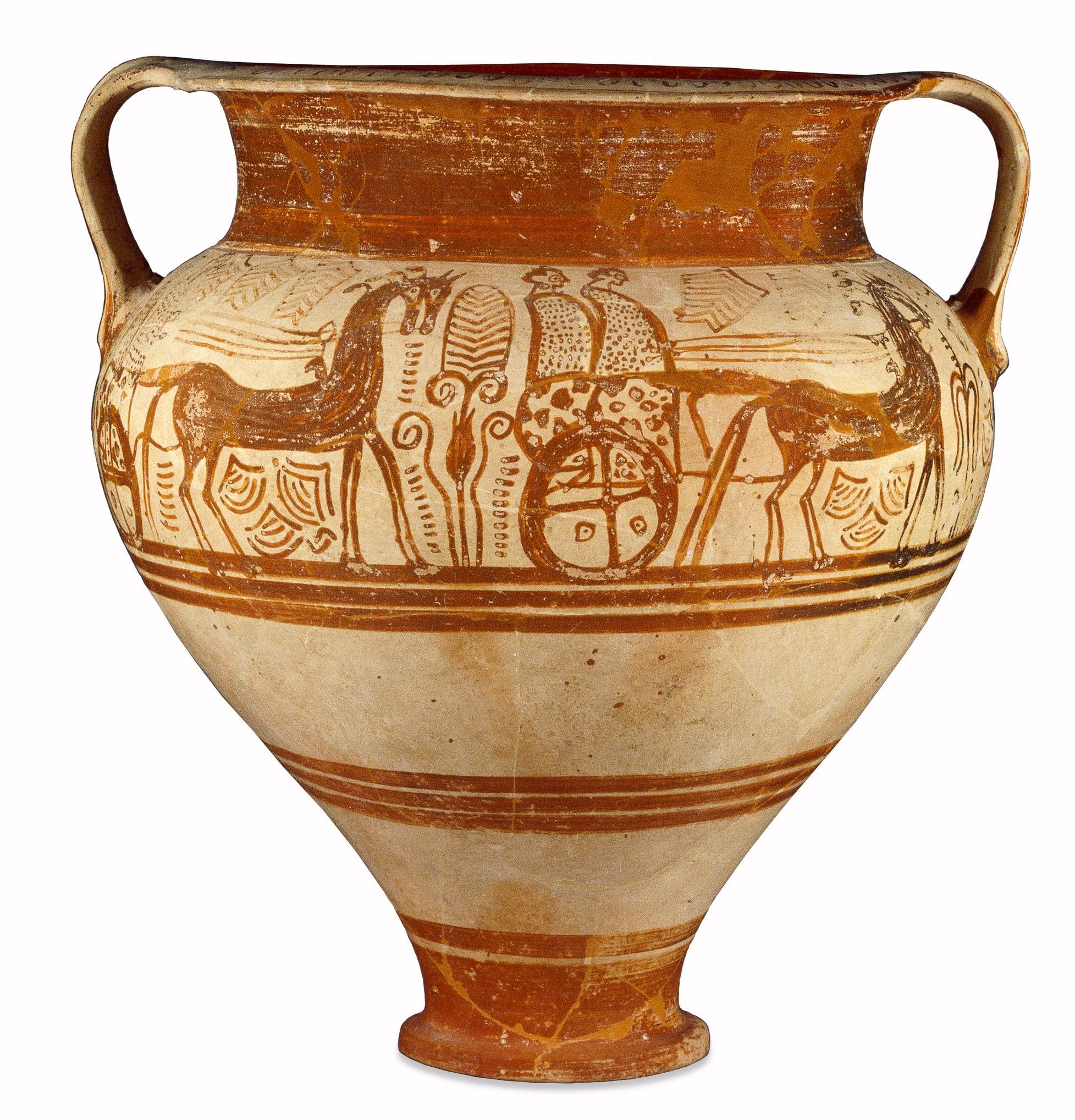
"

Chapter 4: The Ancient Aegean

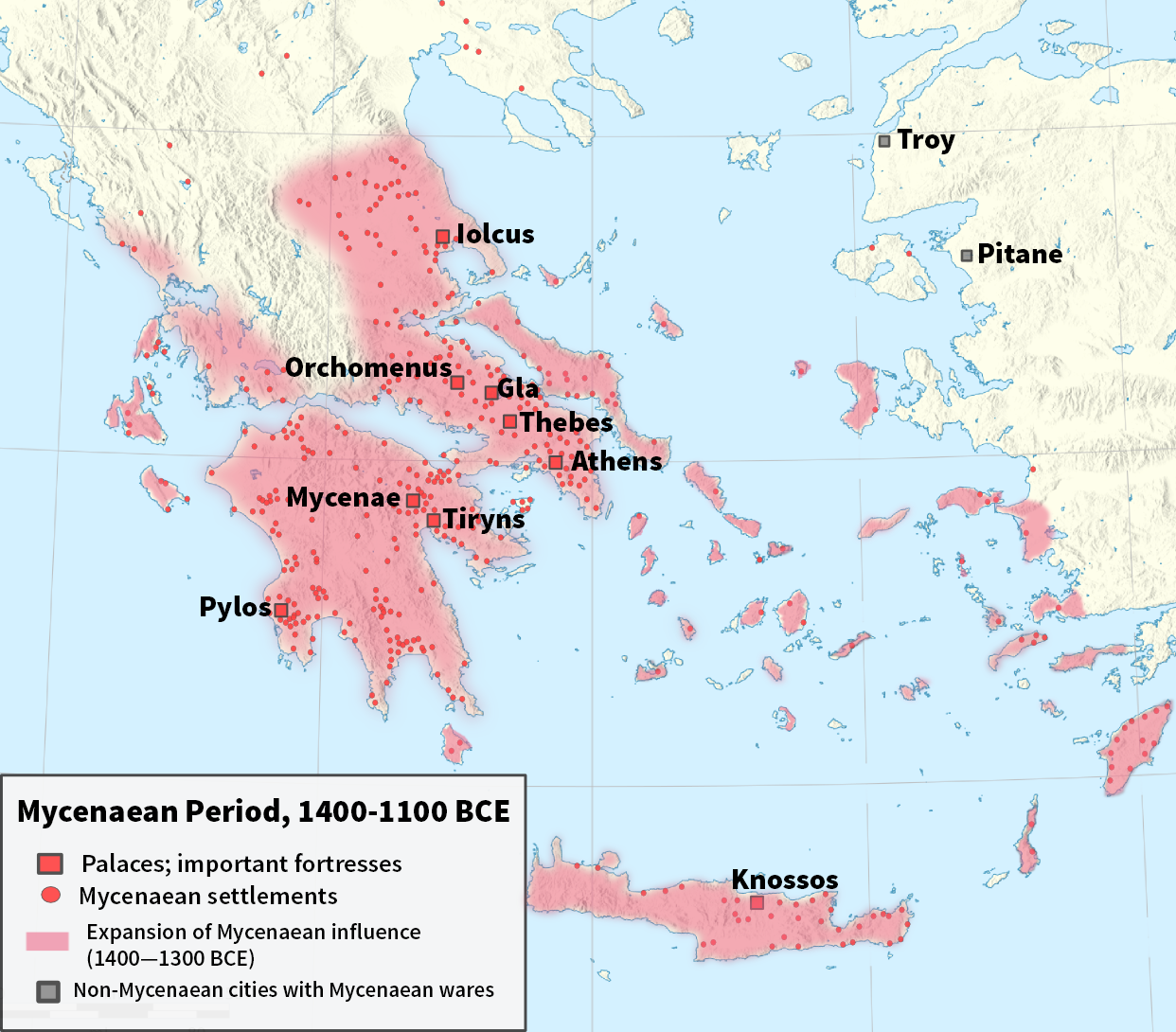
The Ancient Aegean – an introduction

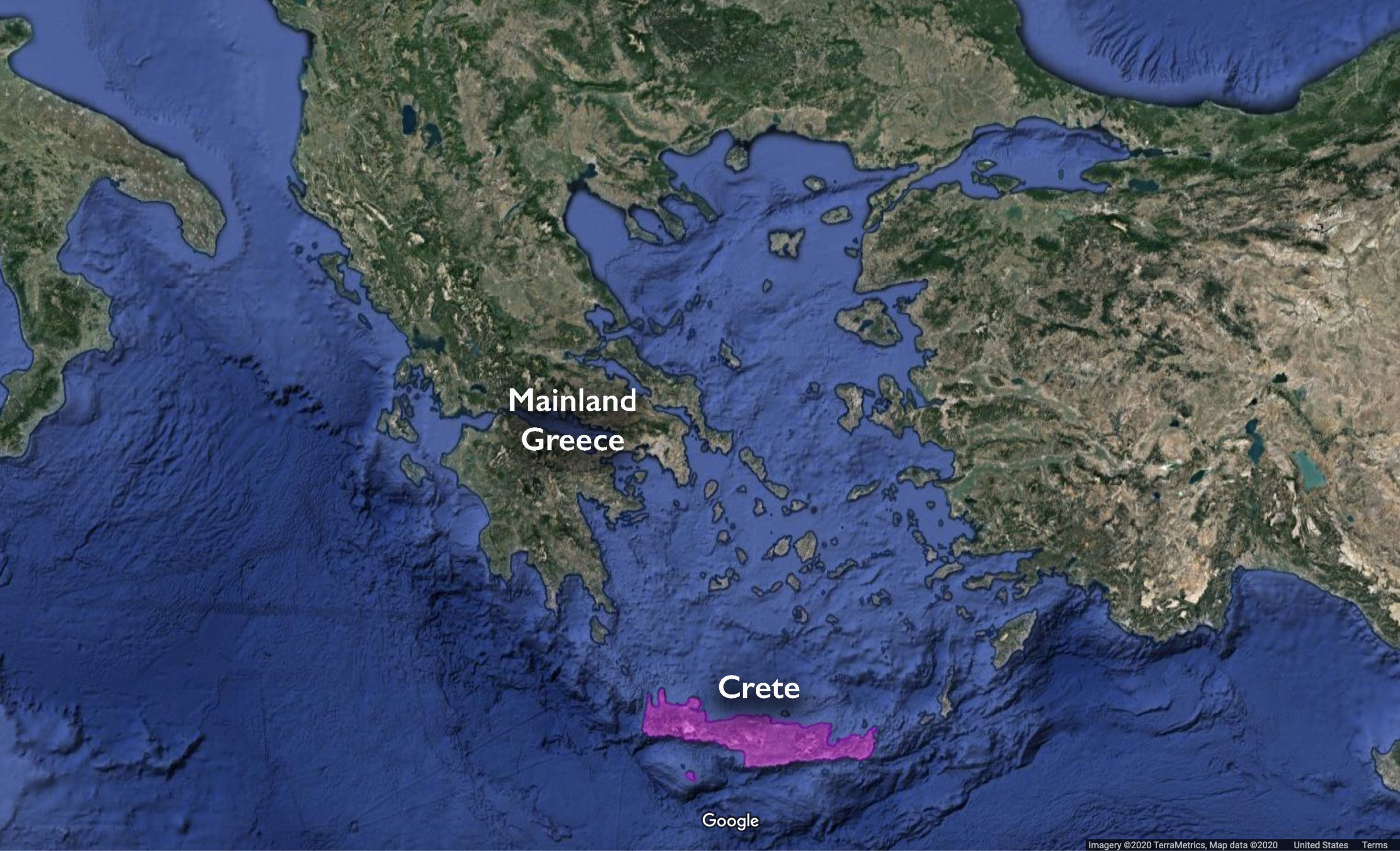
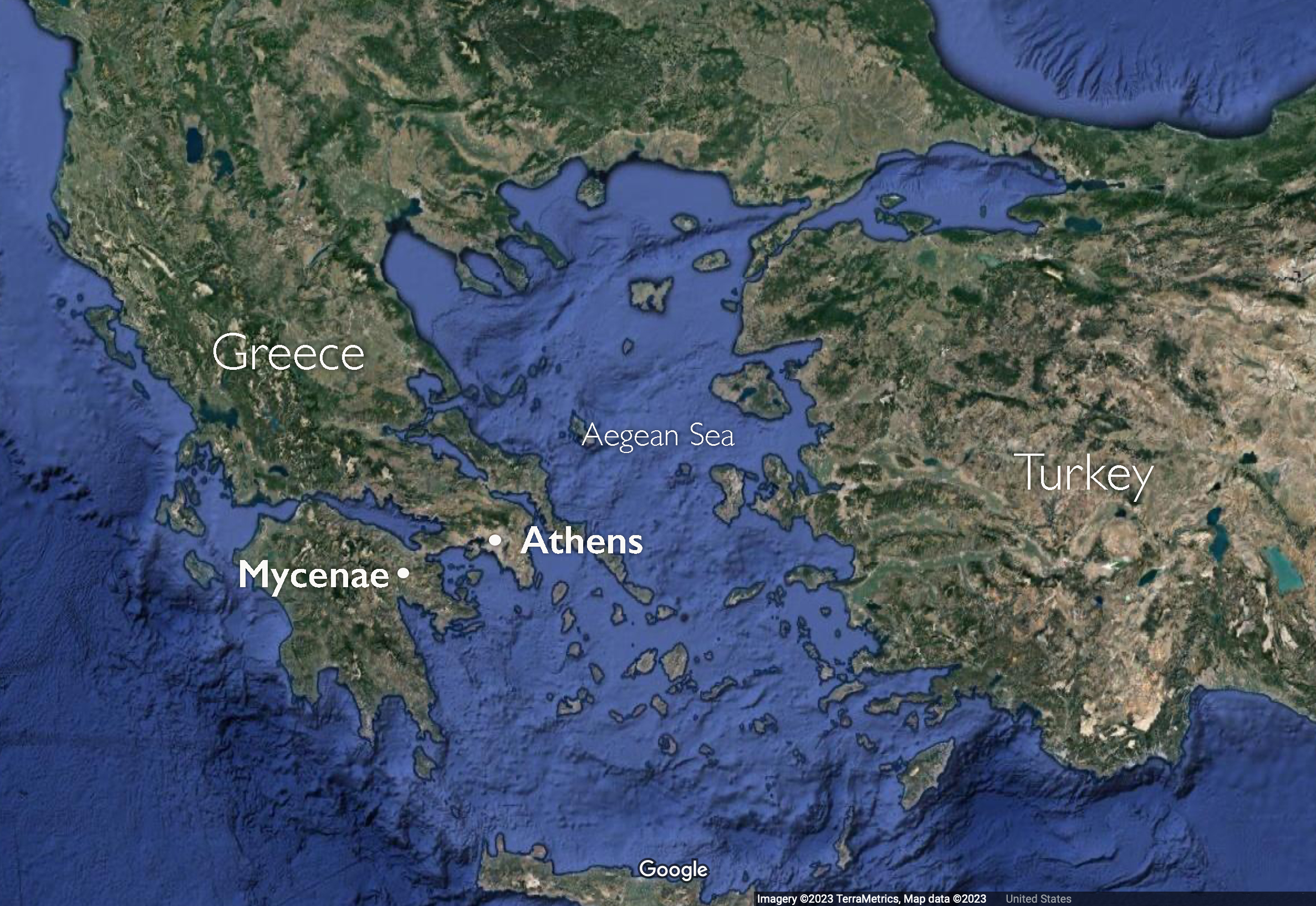
Map with ancient Aegean cultures (© Google)

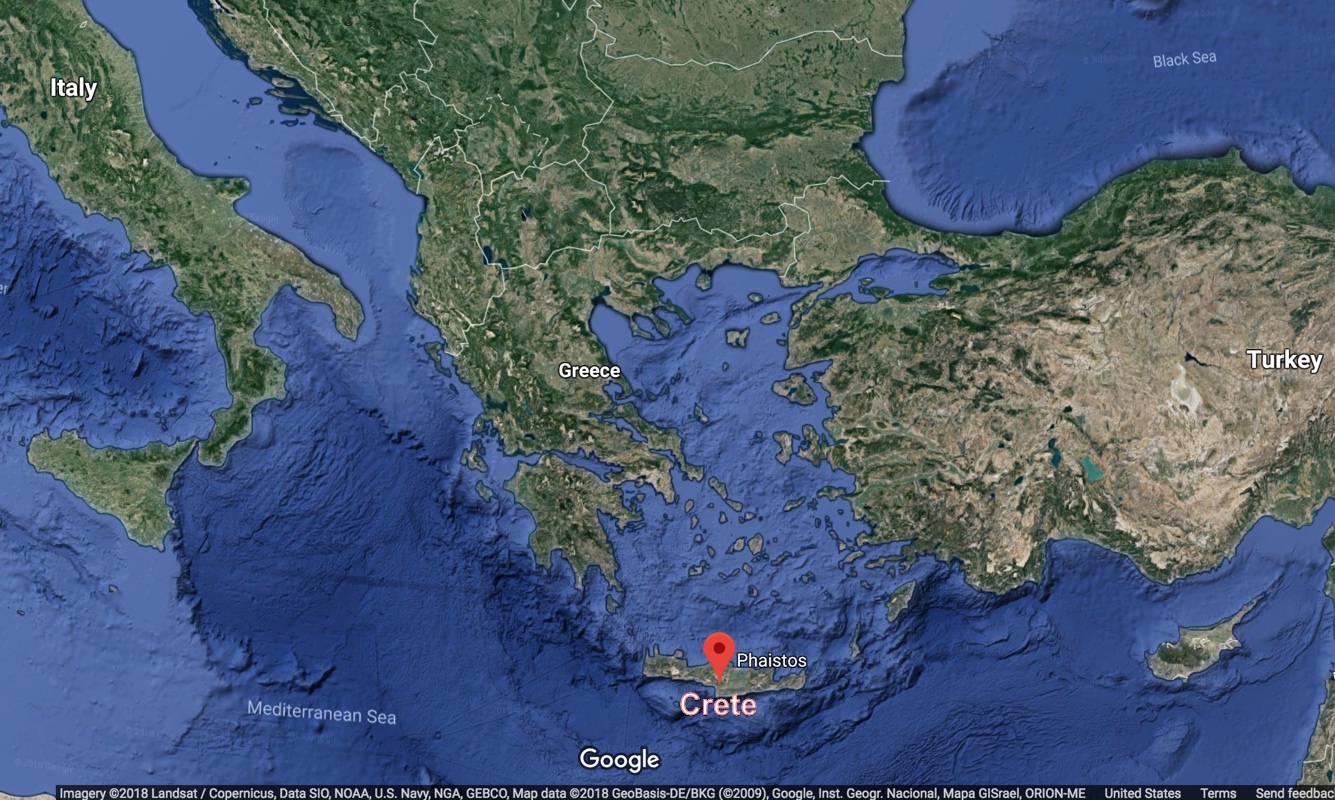
The Aegean refers to the Aegean Sea, the northern portion of the Mediterranean between Greece and Turkey and extending south to the island of Crete. In art history this designation refers to the era of the Bronze Age, the 3rd and 2nd millennium B.C.E. This era encompasses three different but inter-related cultures:

  1. the Cycladic islands
  2. the Minoans of Crete and nearby islands
  3. the Mycenaeans of the mainland of Greece.
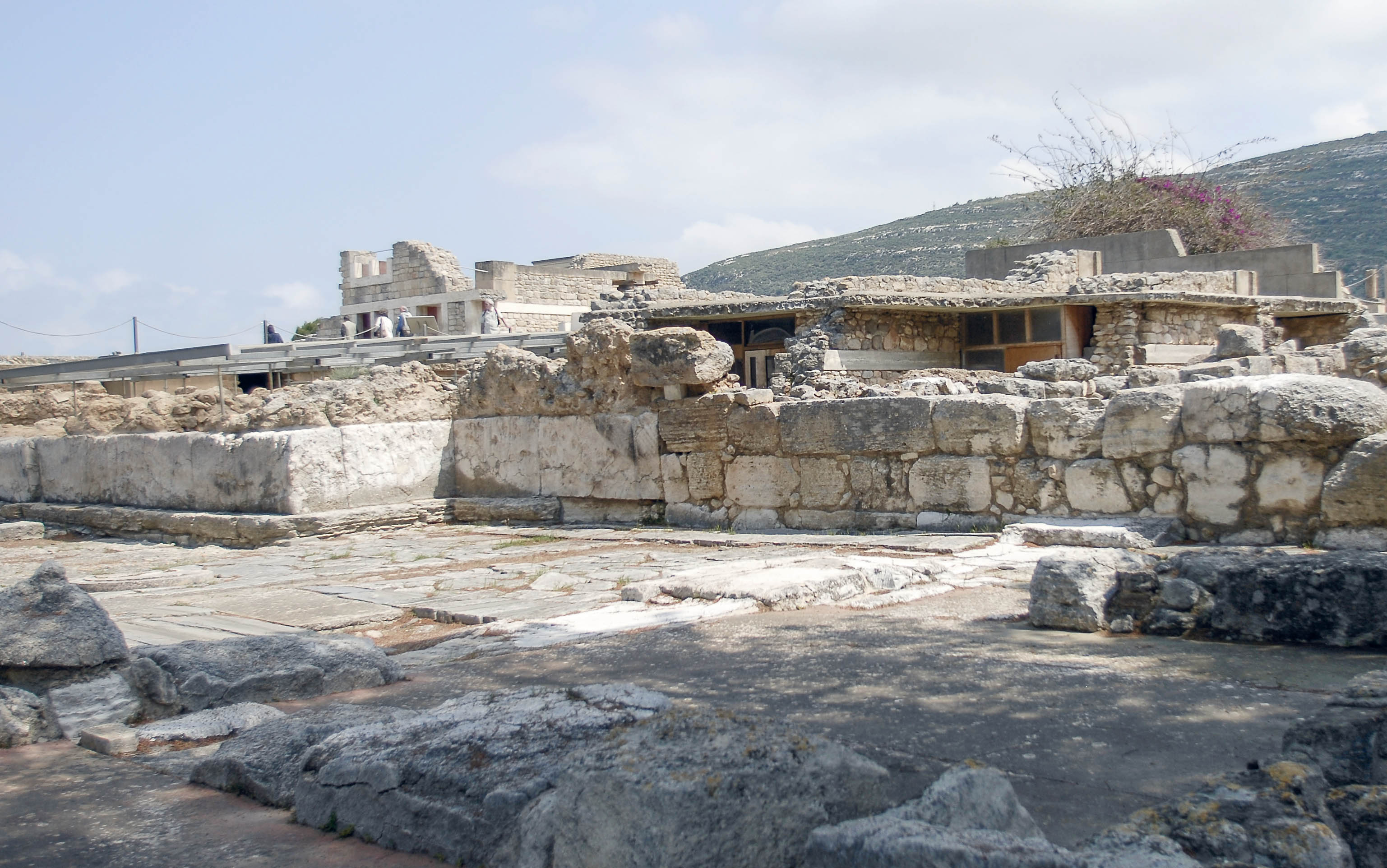
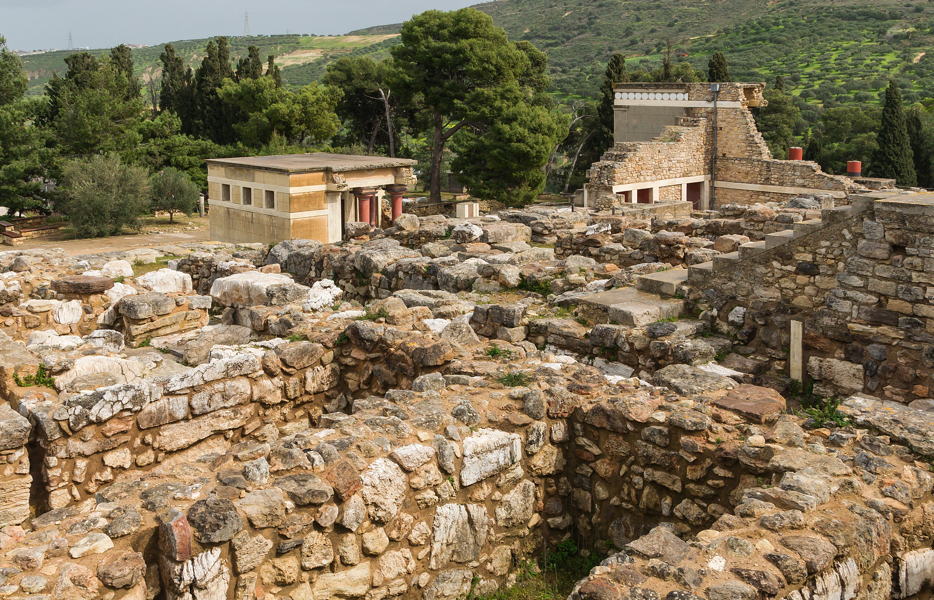
The archaeological site at Knossos, with restored rooms in the background, Crete (photo: Jebulon, public domain)
The archaeological site at Knossos, with restored rooms in the background, Crete

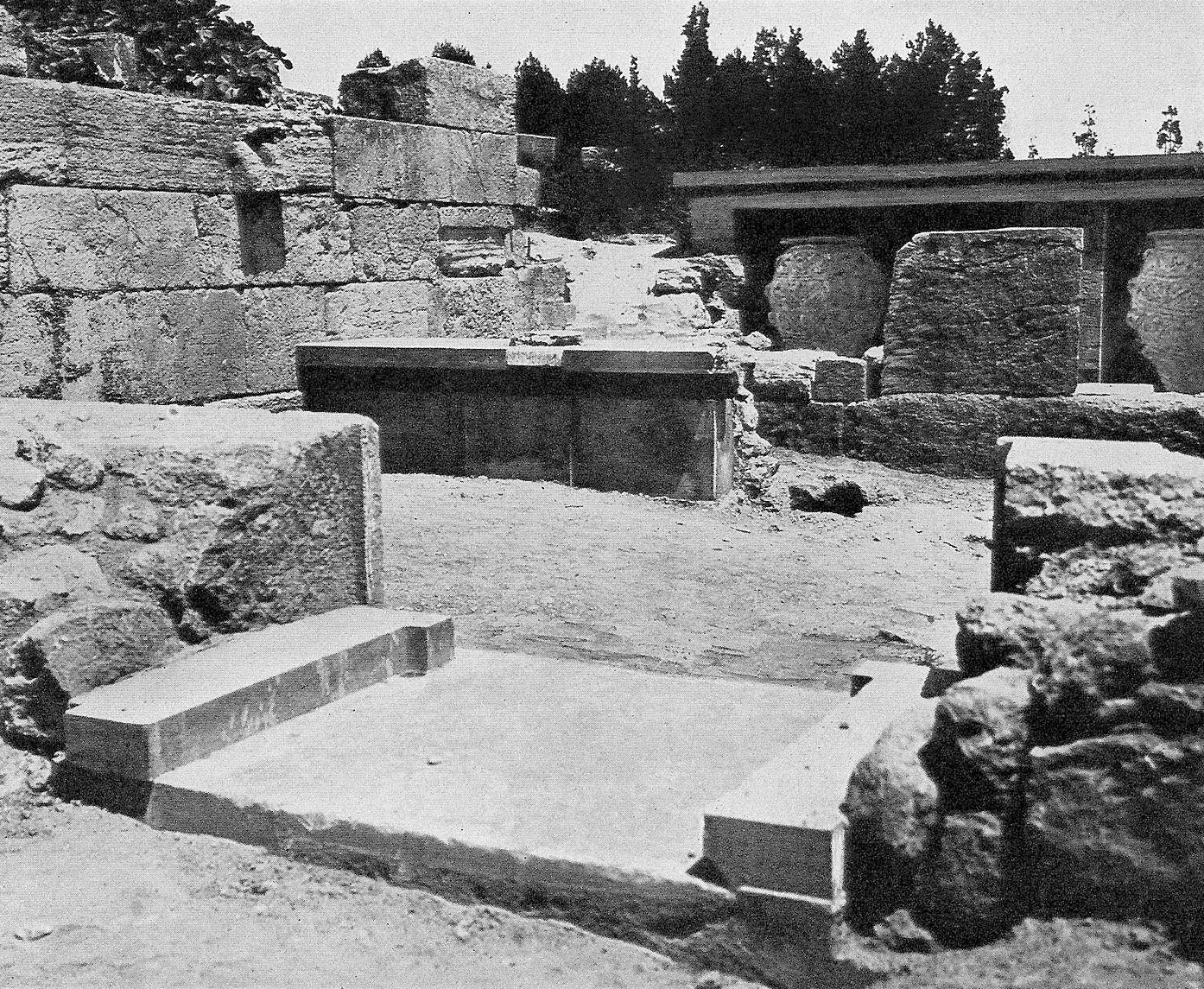
Throne Room excavations at Knossos, from the title page of a brochure appealing for support issued by the Cretan Exploration Fund (1900)

Relative to many ancient cultures, those of the Aegean were only recently discovered, at the end of the 19th century. The Classical Greeks and Romans never faded from memory but the Mycenaeans and Minoans were largely forgotten, except in myth; it is the people and places of Bronze Age Crete and Greece featured in the Iliad and Odyssey of Homer.

Two archaeologists who set out to find the people mentioned in Homer’s epics, Heinrich Schliemann and Sir Arthur Evans, had little more than the poems themselves and some obscure remains to lead them. Schliemann dug several Aegean Bronze Age sites, most famously Troy from 1870–73, and Mycenae (the mythical house of Atreus, best known from the tragic play the Oresteia of Aeschylus) in 1876. In 1900, Evans, following the first explorations of the site by Minos Kalokairinos in 1877, began to fully uncover Knossos, the site associated with the mythical palace of King Minos of Crete.

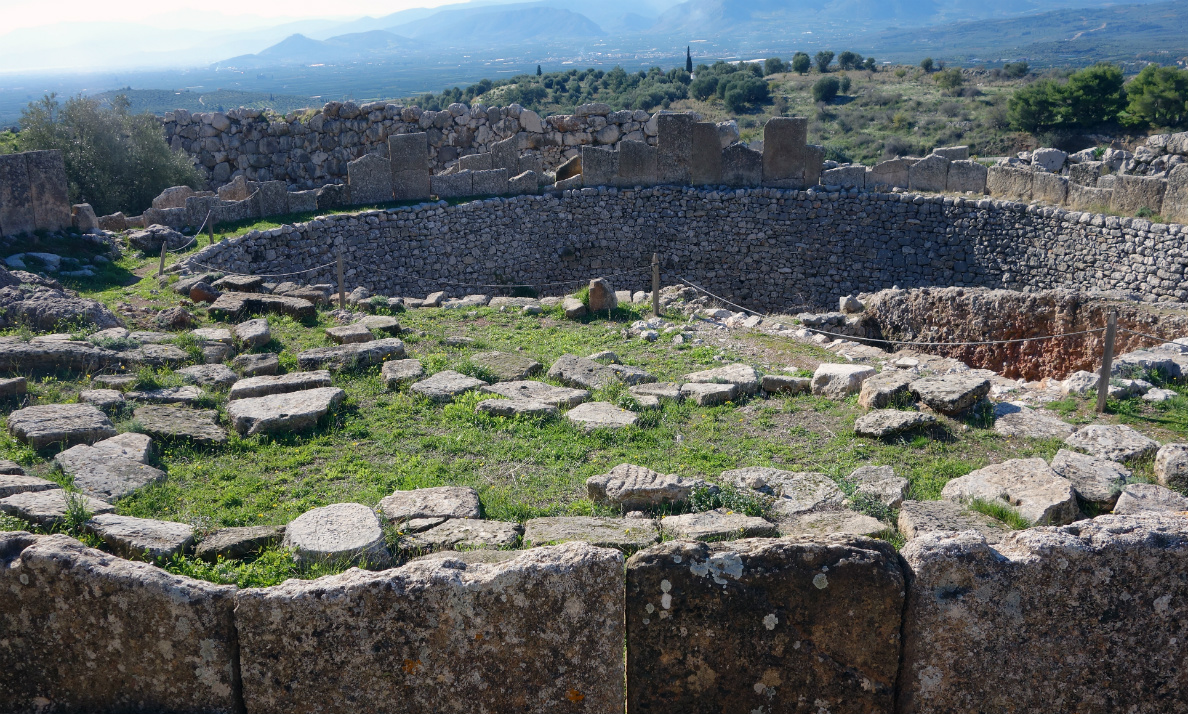
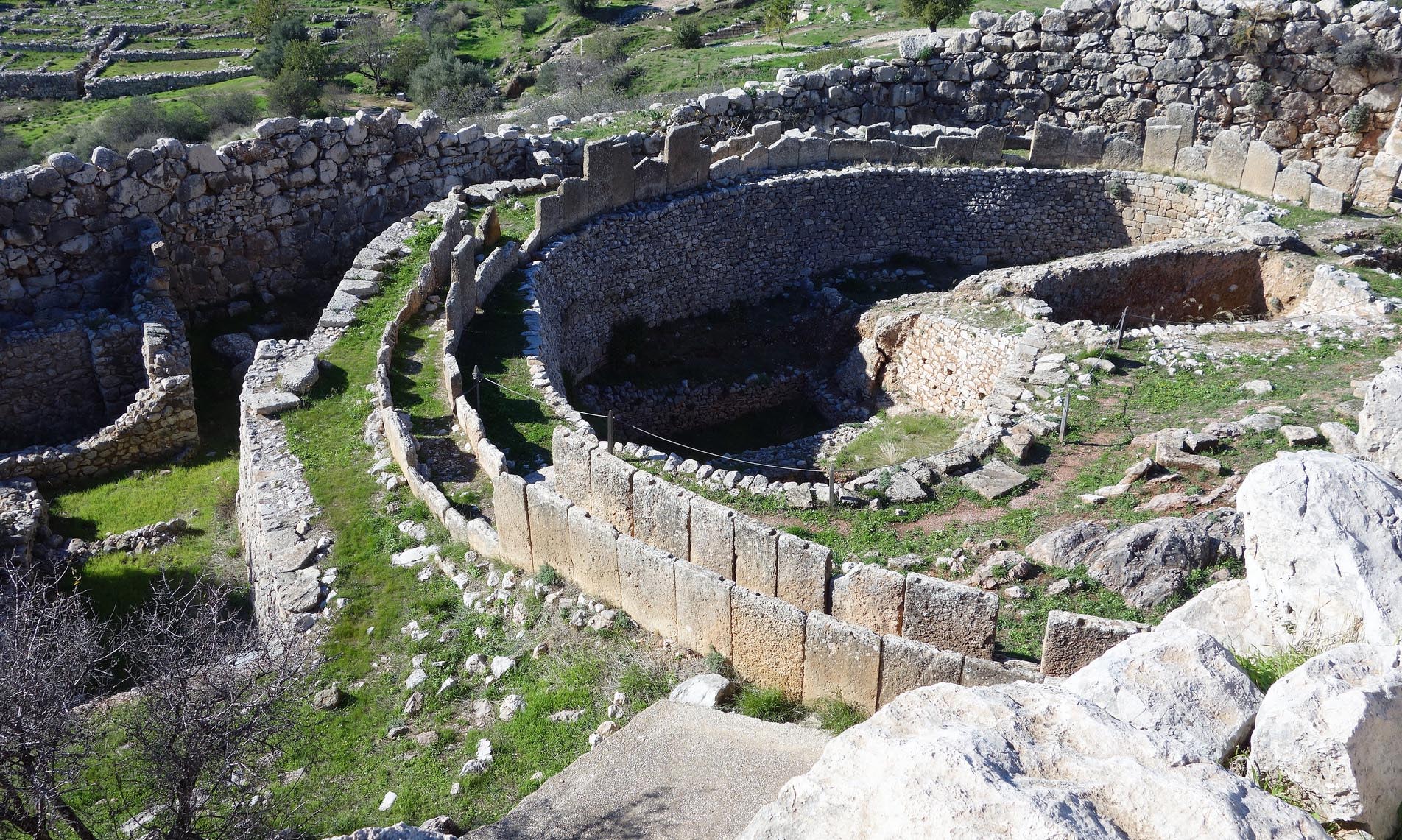
Grave Circle A, Mycenae, Greece, c. 1600-1100 B.C.E.

Since these early discoveries, the study of the Aegean has been primarily archaeological and not so much art historical. We now know that the Minoans and Mycenaeans both wrote languages, used sophisticated identity and security mechanisms as part of religious and economic bureaucracies which centered around large sites with imposing central buildings. They were great seafarers and traders, talented potters, painters, jewelers, weavers and carvers of stone.


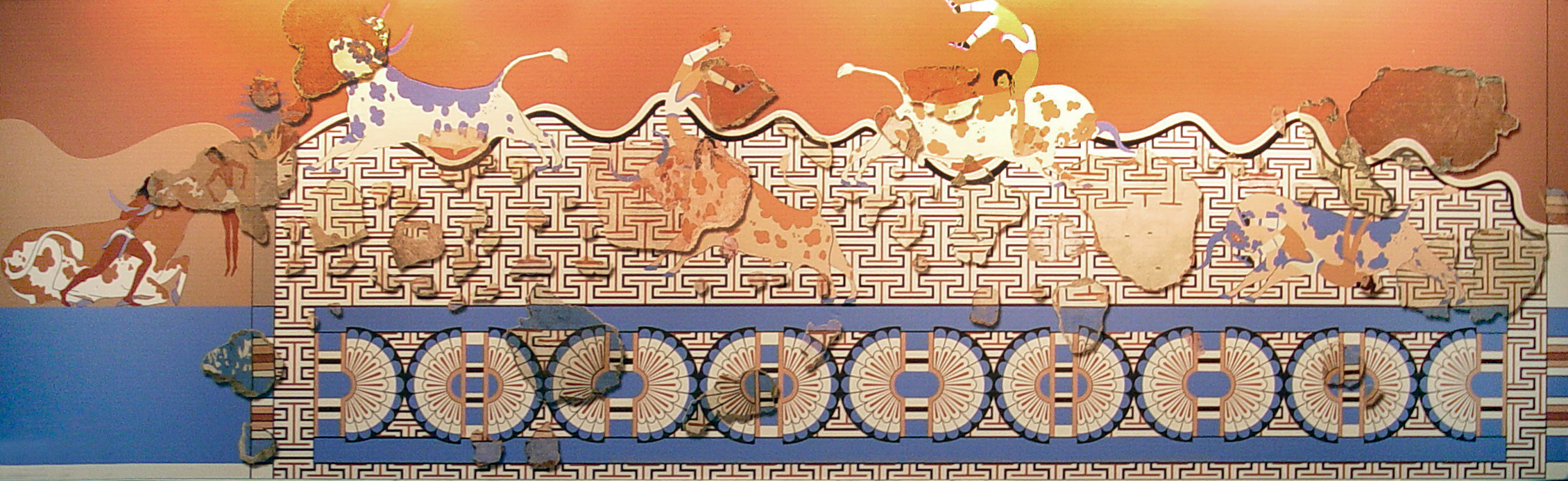
Reconstructed Minoan Fresco from Avaris, Egypt. Now Archaeological Museum Iraklion, Crete, Greece (photo: Martin Dürrschnabel, CC-BY-SA-2.5)
Reconstructed Minoan Fresco from Avaris, Egypt. Now Archaeological Museum Iraklion, Crete, Greece (photo: Martin Dürrschnabel, CC-BY-SA-2.5)

The prehistoric Aegean was the first truly international age, and much of the art shows influence across cultures: Minoan wall painting owes much to Egyptian art; late Bronze Age Cypriot pottery imitates Mycenaean pieces. Today, the sites and art of the Minoans and Mycenaeans are some of the most popular of the ancient world.

Source: Dr. Senta German, “An introduction to the ancient Aegean,” in Smarthistory, August 25, 2020, accessed September 9, 2024, https://smarthistory.org/an-introduction-to-the-ancient-aegean/.

The Bronze Age in the Aegean

  • Active trade relationships between this region and Egypt & the Ancient Near East
  • Difficulties in dating – dependence on relative dating (with pottery as the source of possible dates) 
  • Cyclades – No written language – mineral rich 
  • Minoans on Crete – written texts  – hieroglyphic, Linear A and Linear B.   Only Linear B can be deciphered.
  • Mycenae – conquered Crete – copied their arts 
TERMS TO KNOW
  • fresco – buon fresco and fresco secco
  • corbel arch
  • ashlar masonry
  • capitals (cushion)
  • citadel
  • megaron
  • post and lintel
  • tholos tomb
  • rhyton
  • flying gallop pose

CYCLADIC ART

Cycladic Art  – an introduction

Early Cycladic Figures

Cycladic Male Harp Player – two videos

Akroteri, Thera


Cycladic Art – An introduction

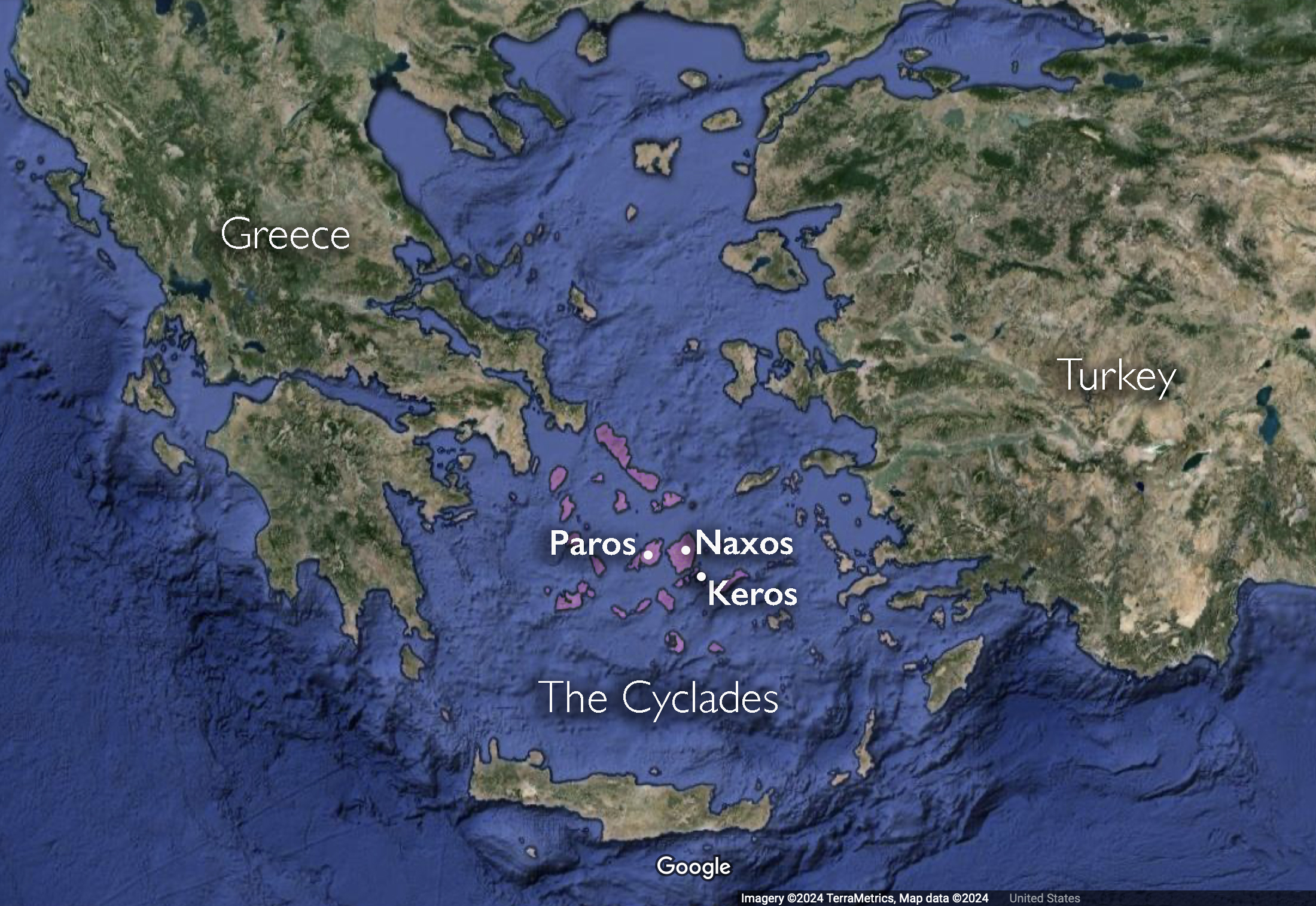
Map of the Cyclades (© Google)

The Cyclades (often referred to as the Greek Islands) are a group of islands to the southeast of Mainland Greece in close proximity to one another, so much so, from each island you can nearly always see at least one other. This capacity to see each other, and invite travel between them, resulted in a common culture growing up among these islands in the Early Bronze age (around 3000 B.C.E.). For the next thousand years, until about 2000 B.C.E small farming settlements grew into large towns with neatly built stone buildings. Metal smelting became common and trade flourished with not only the mainland of Greece but also Crete and the Anatolian coast (today, Turkey).


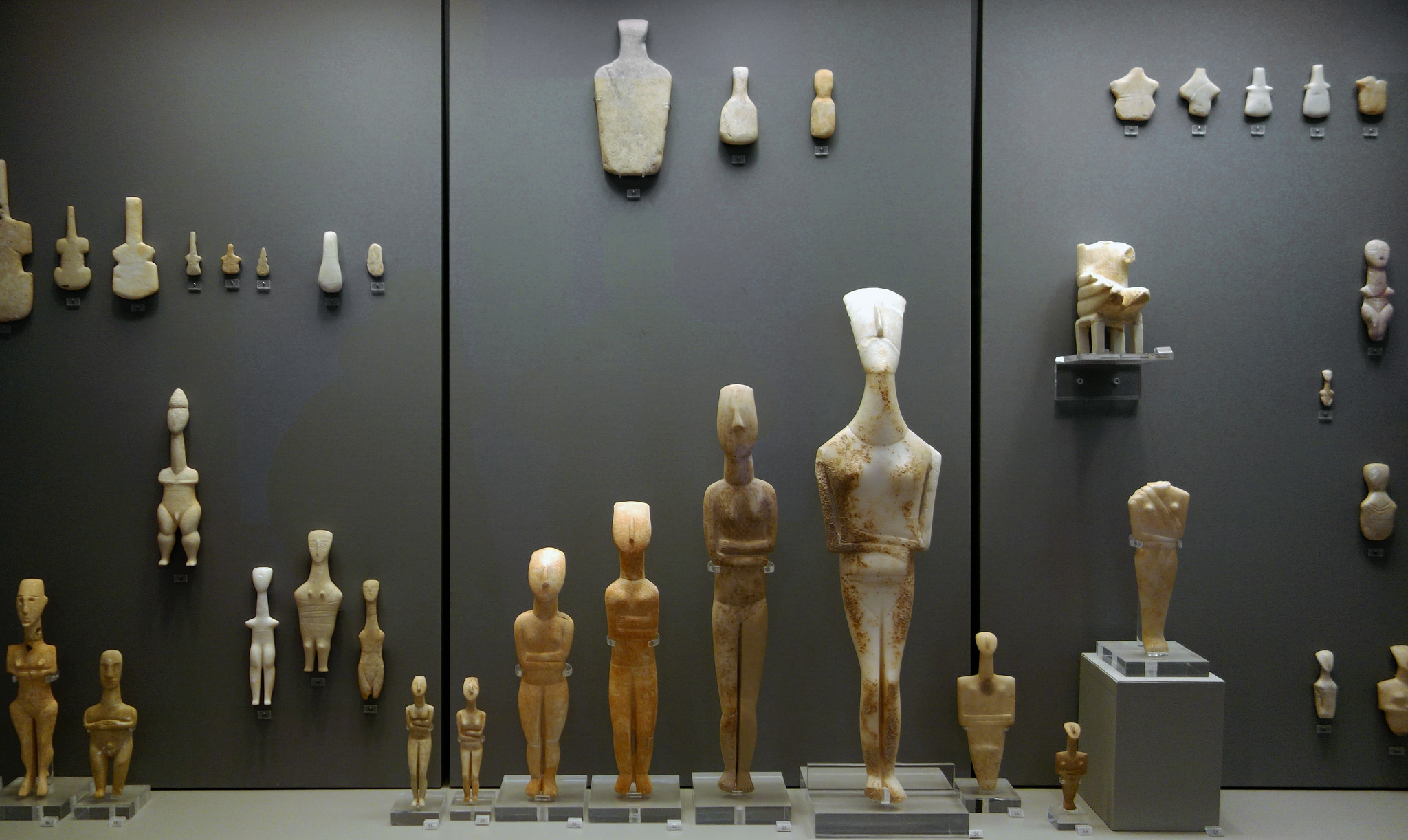
Cycladic period figures, marble, (National Archaeological Museum, Athens)
Cycladic period figures, marble (National Archaeological Museum, Athens)

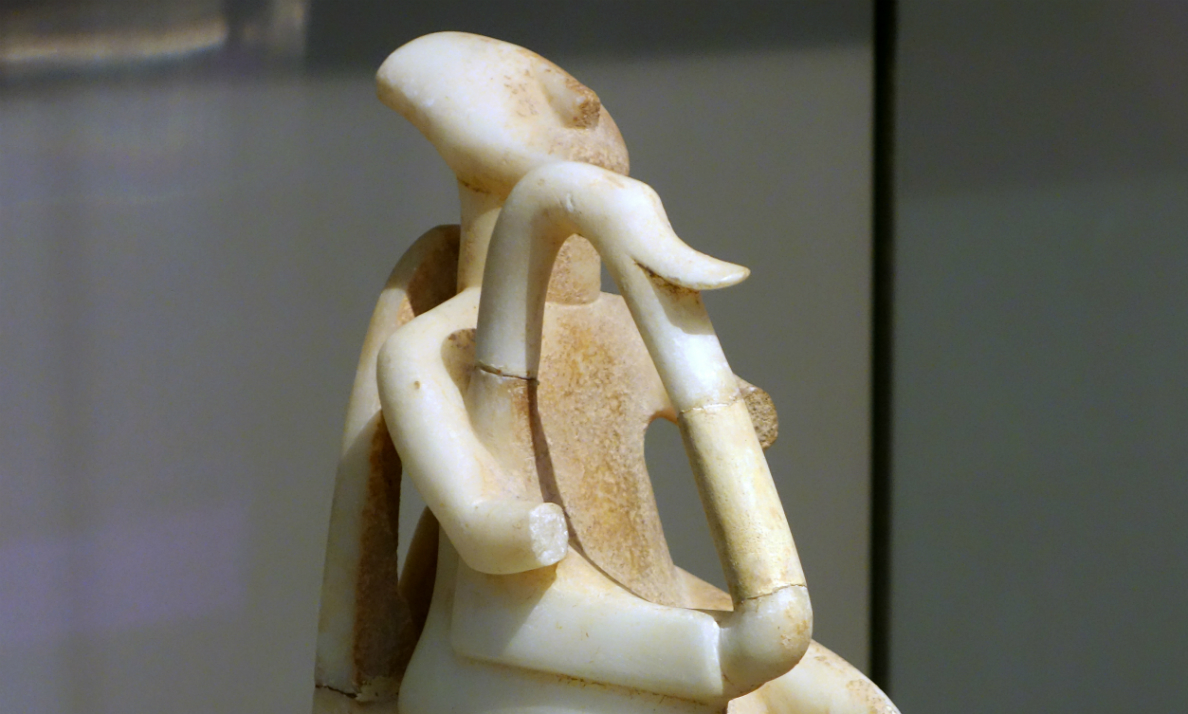
Male harp player from Keros, c. 2600–2300 B.C.E.,
Male harp player from Keros, c. 2600–2300 B.C.E., Early Cycladic period, marble, 22.5 cm high (National Archaeological Museum, Athens)

Found in the tombs

The Early Bronze Age people of the Cyclades had a unique way of burying their dead, in stone slab lined pits, sometimes in two stories. But, what is really remarkable is what has often been found in these tombs: elegantly carved small-scale marble sculptures, nearly all of women, known as Cycladic figurines. These form the first stylistically coherent sculptural type to develop in Europe and have featured prominently in the prehistoric art history of Greece. Several Modern artists were influenced by Cycladic figurines as well, including Pablo Picasso, Constantin Brâncusi, and Amedeo Modigliani.

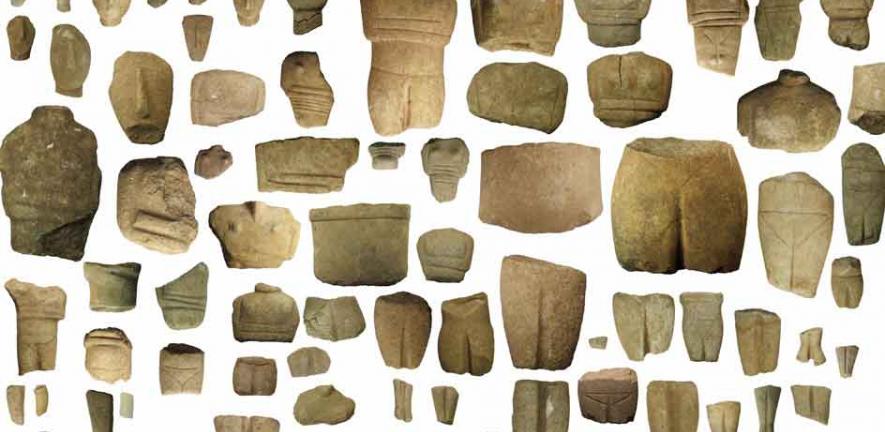
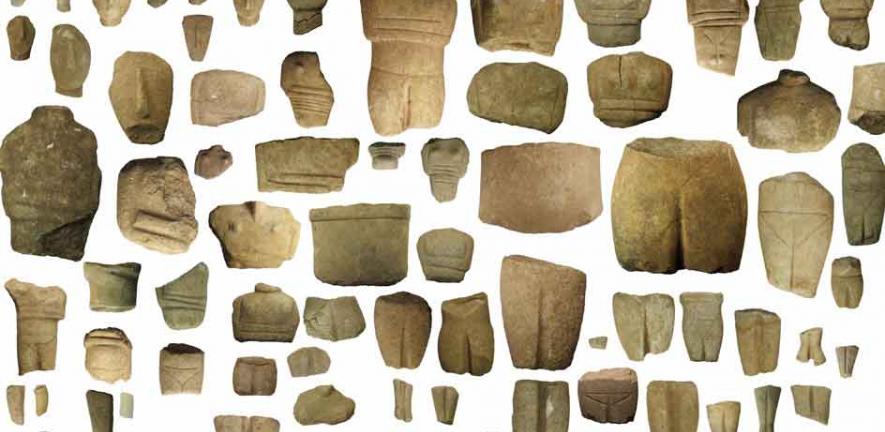
The use and meaning of these sculptures have been a mystery since their first discovery at the end of the 19th century. The fact that some 75% of Early Cycladic archaeological sites have been looted in search of figurines to sell on the antiquities market hasn’t helped; looting destroys the contextual information which enables us to understand artifacts. However, recent archaeological excavations on the island of Keros, have produced some fascinating information. Specifically, at the site of Dhaskalio-Kavos two large deposits have been found filled with hundreds of figures which were all purposefully broken in the Early Bronze Age before their burial. Archaeologists believe that the site was an important religious sanctuary which drew people from all over the Cyclades.


Broken figurines found during archaeological excavations on the island of Keros
Broken figurines found during archaeological excavations on the island of Keros (Island of Broken Figurines)
The dynamic early Bronze Age culture of the Cyclades ends abruptly, around 2000 B.C.E., when all settlement sites are abandoned. The reason for this abandonment remains a mystery. People don’t again settle on the islands in large numbers for another two hundred years.

Additional resources:

Source: Dr. Senta German, “Cycladic art, an introduction,” in Smarthistory, August 25, 2020, accessed September 9, 2024, https://smarthistory.org/intro-cycladic-art/.

Early Cycladic figurines

by Dr. Monica Bulger
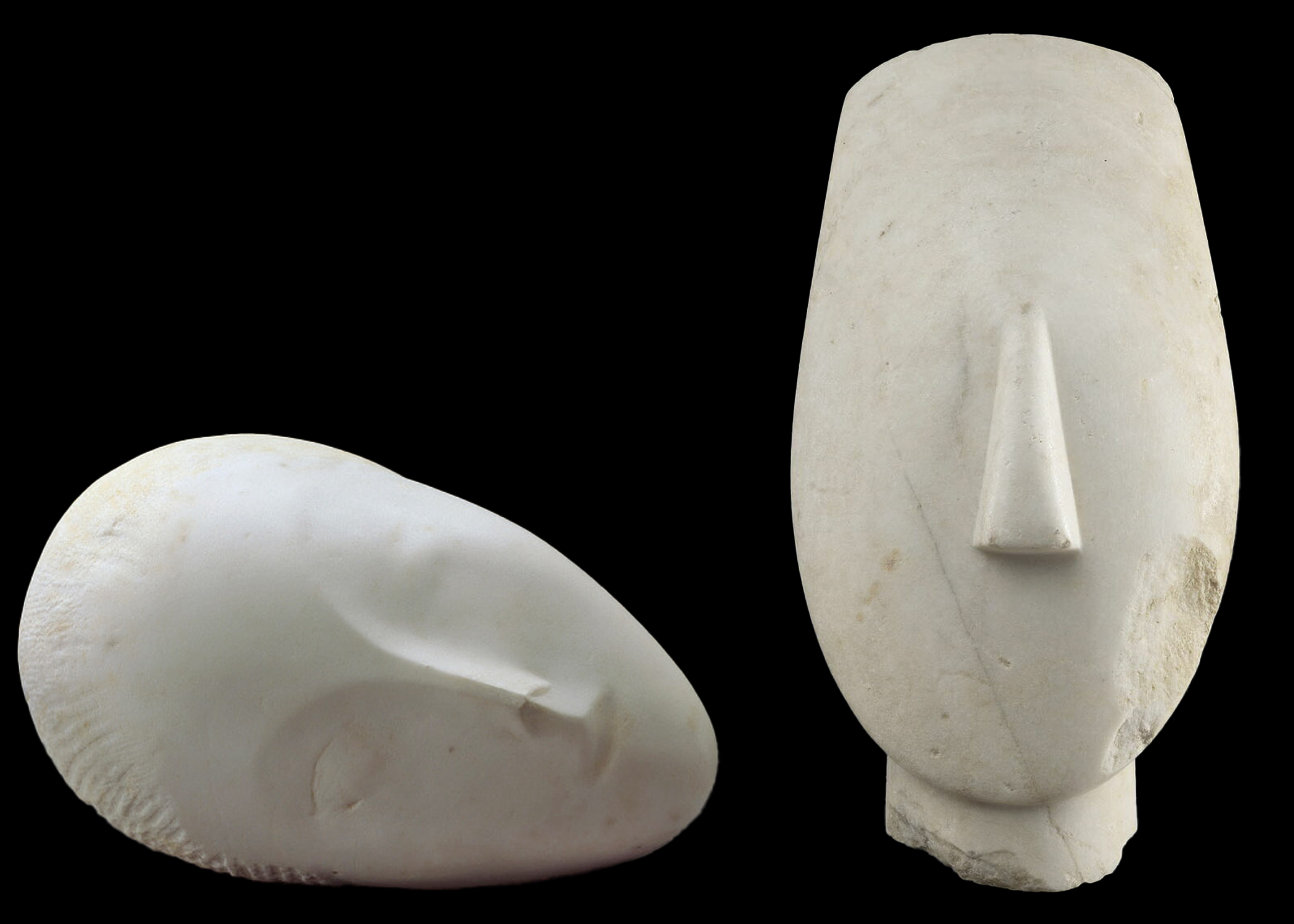
Left: Constantin Brȃncuși, Sleeping Muse I, 1910 right: Head of an Early Cycladic figurine, 2600–2400 B.C.E.,
Left: Constantin Brȃncuși, Sleeping Muse I, 1910, marble, 17.2 x 27.6 x 21.2 cm (Hirshhorn Museum and Sculpture Garden, Washington, D.C.); right: Head of an Early Cycladic figurine, 2600–2400 B.C.E., marble, 14 x 27 x 10 cm (Musée du Louvre, Paris)

Consequences of collecting

In the early 1900s, as European artists explored new ways of representing the human form, many took inspiration from sculptures that were thousands of years old. Famous artists including Constantin Brȃncuși and Pablo Picasso were captivated by the sparse simplicity of marble figures made in the Cyclades between c. 3200 B.C.E. and 2300 B.C.E. [1] These ancient stone sculptures represent people simply. Their arms and legs are marked by incisions, often not even separated from the body. Their faces only have sculpted noses, while the rest of the facial features (once added in paint) are now usually invisible to the modern viewer. Although they are simplified, these statues are still easily recognizable as people. Their minimalism inspired modern artists and made the statues seem almost modern themselves, contributing to their popularity amongst collectors.

Map of the Cyclades (underlying map © Google)

In the 1950s and 1960s, Cycladic figures became immensely popular on the art market. Collectors paid millions of dollars to purchase Cycladic statues at auctions. The economic potential of these figures led looters to seek them out. Looters illegally removed hundreds of marble figures from the Cyclades, selling them to dealers who then realized significant profits. The popularity of Cycladic figures on the market has also resulted in a proliferation of forgeries. It is difficult to assess the true extent of this looting, but current statistics about the provenance of Cycladic figures give us an idea of how much damage it caused: although well over a thousand Cycladic figures are known today, only about 200 of them come from excavations conducted by trained archaeologists. [2]

The widespread looting of Cycladic statues had disastrous consequences for our understanding of them. When an artifact is removed from its original context by a non-expert, valuable information is lost. So many Cycladic figures entered modern collections without archaeological data that we are still unsure of what the statues’ identities and functions originally were. [3] In the following paragraphs, we will consider what we do know about Cycladic figures, including where they were made, how their appearances evolved over time, and what their forms can tell us about their possible original functions.

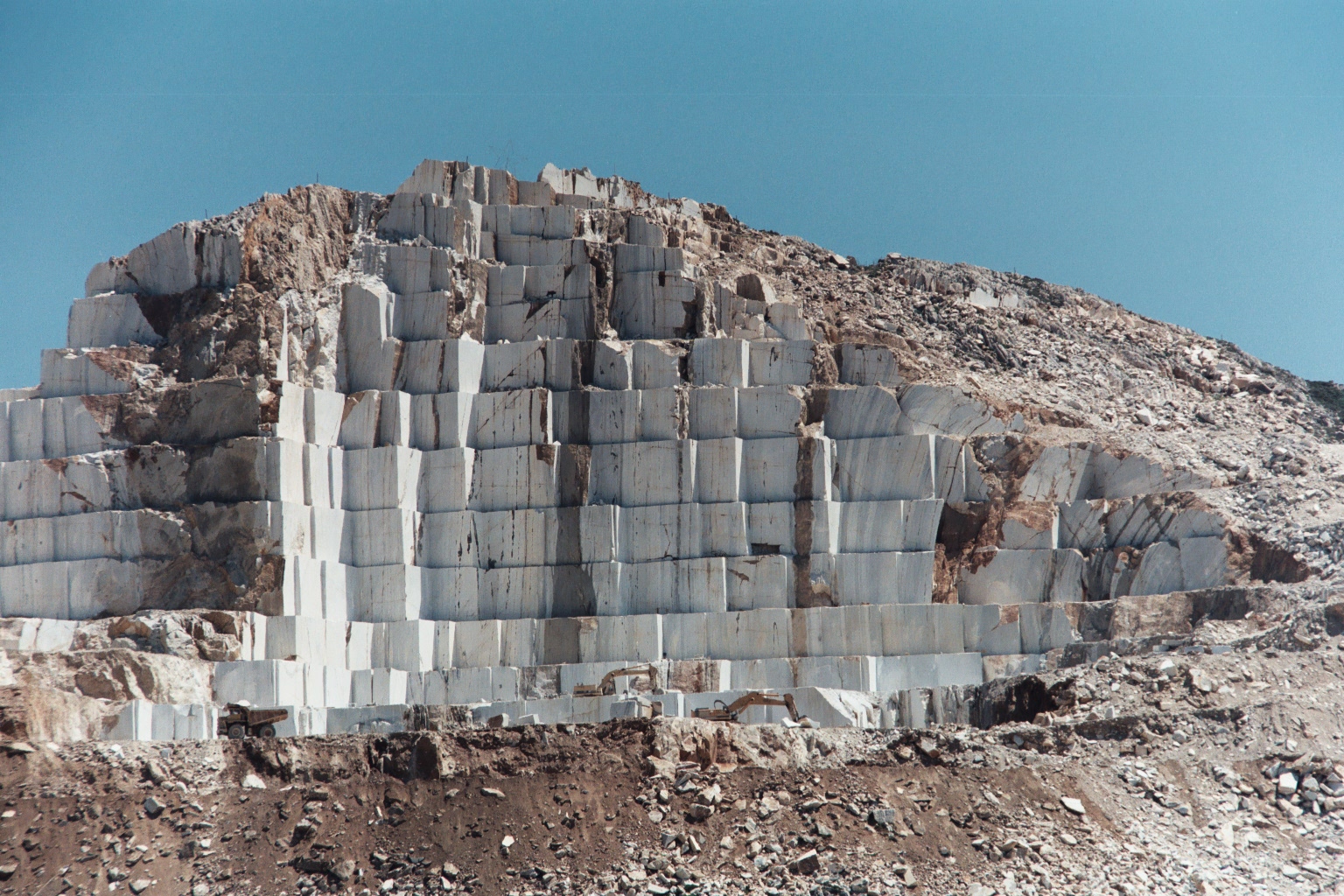
Marble quarry in Naxos (photo: Heiko Gorski, CC BY-SA 3.0)
Marble quarry in Naxos (photo: Heiko Gorski, CC BY-SA 3.0)

Natural resources on the Cyclades

The Cyclades’ natural resources enabled their inhabitants to make marble sculptures. People living in the Cyclades during the Early Cycladic period traveled between the islands regularly, trading with one another and acquiring materials from their neighbors. Many Cycladic islands have extensive supplies of high quality marble. While some small Early Cycladic figures might have been made from found pebbles or stones, other larger figures were probably crafted from thin blocks of marbles taken from quarries on Naxos or Paros. [4] Once an Early Cycladic craftsman acquired a piece of marble, he used tools made from hard, locally available materials (like obsidian) to carve it and incise details into its surface. [5] He then used emery, another mineral that is naturally prevalent in the Cyclades, to smooth the statue down to its final shape. [6] Finally, the statue was painted.

We do not have enough archaeological evidence to determine whether Early Cycladic craftspeople traveled between islands to work for different customers, or whether their products were traded by merchants. [7] Our understanding of Early Cycladic societies and sculptors is further limited because they did not use written language, and so left no written records for us to read. However, we do know that their work was facilitated by the rich natural world in which they lived.

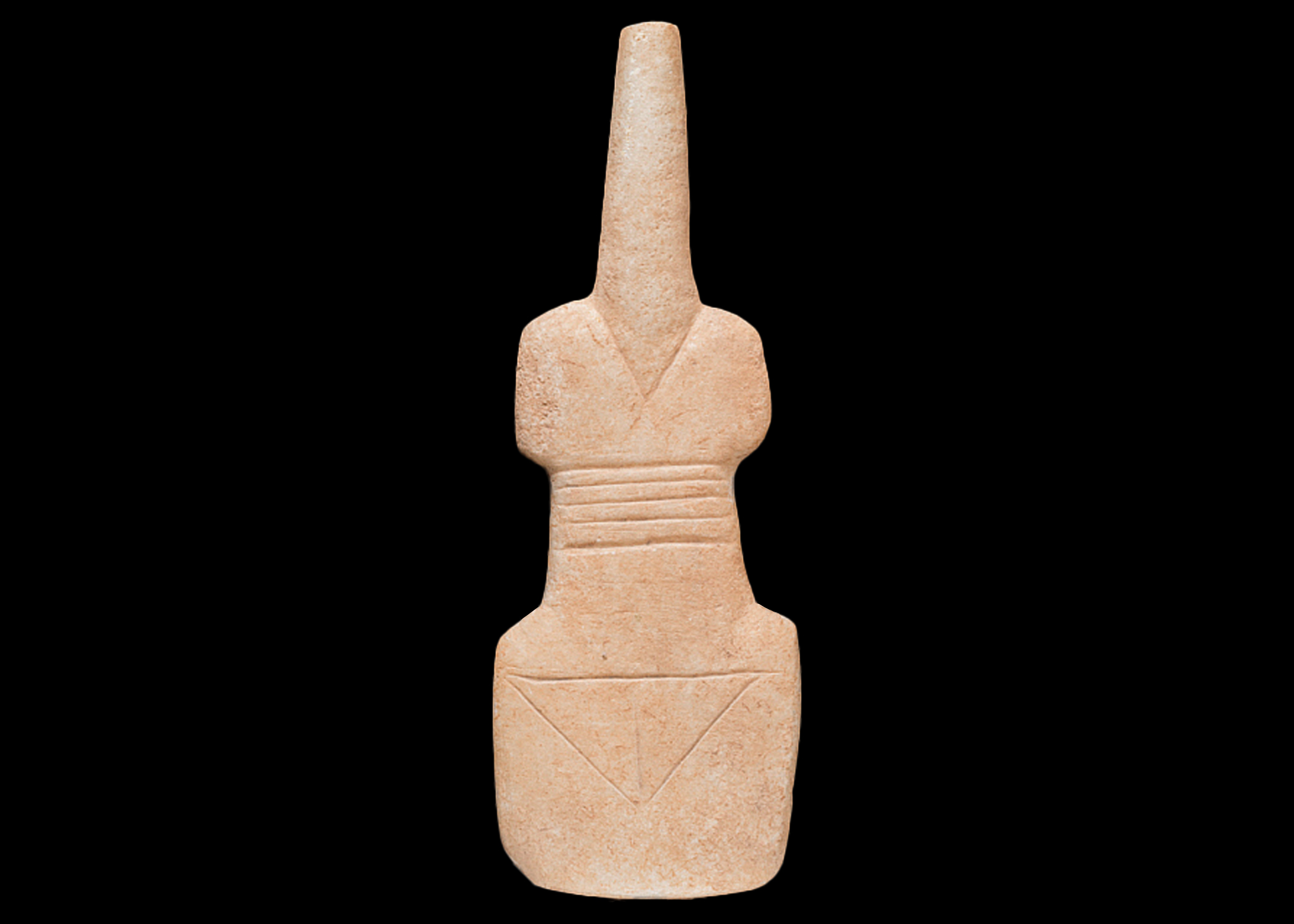
"Violin" type Early Cycladic figurine, 3200–2700 B.C.E., marble, 21.9 x 7.6 x 1.9 cm (The Menil Collection, Houston)
“Violin” type Early Cycladic figurine, 3200–2700 B.C.E., marble, 21.9 x 7.6 x 1.9 cm (The Menil Collection, Houston)

Stylistic simplicity in Early Cycladic figurines

Most Early Cycladic statues represent women. [8] The earliest Cycladic figurines tend to represent women in a more abstracted, schematic manner than their later counterparts. These early statues are often referred to as “violin” figurines because their overall shape recalls that of a violin. [9] One well-preserved example in the Menil Collection reveals how even these simplified violin figures can be recognized as female. Although the figure has no defined head or limbs, it does have an incised pubic triangle, marking it as a woman. These simplified violin figures were especially popular during the first phase of Early Cycladic culture, from c. 3200–2700 B.C.E. [10]

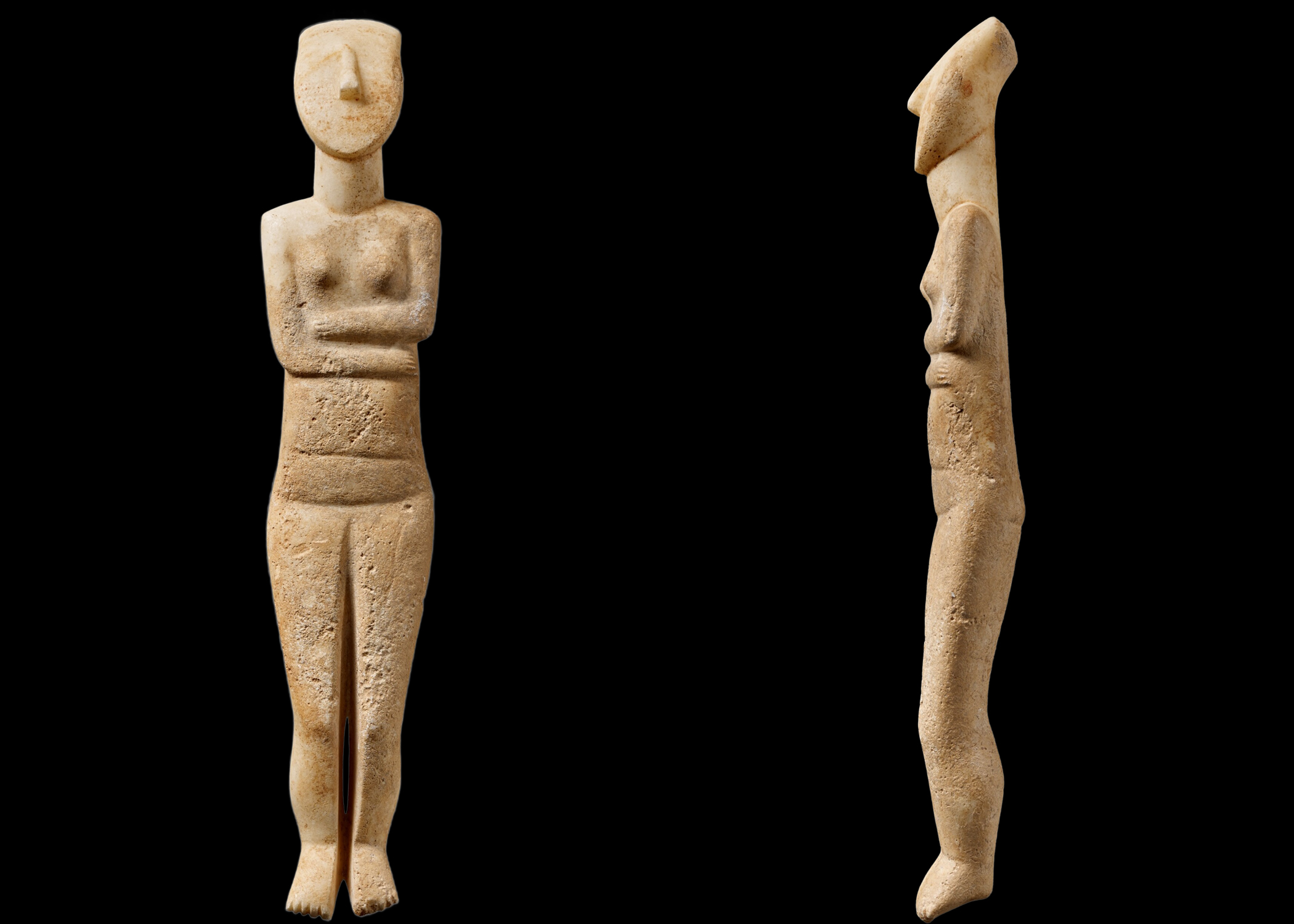
Front and side views of an Early Cycladic folded-arm figurine, 2700–2500 B.C.E., marble, 49.5 x 9 x 6 cm (The J. Paul Getty Museum, Los Angeles)

Around 2700 B.C.E., Cycladic sculptors developed a new kind of female figurine that soon came to dominate production. Today scholars refer to these statues as folded-arm figurines, or FAFs, because they are shown with their arms folded across their middles. [11] Although FAFs are simplified, they are more naturalistic than the violin figures that preceded them. We can see all of the typical features of FAFs on one statue in the Getty Museum. Overall, the figure is elongated. Its wedge-shaped head is tilted back and only its nose is sculpted. Other facial features that were originally added in paint have now mostly faded away. The woman has small articulated breasts, which indicate that she is female. Her arms fold over her abdomen, the left resting atop the right. Her legs are bent slightly at the knees and are not entirely separated from one another. When we consider the sculpture from the side, we see that its feet are not flat: the toes point slightly downwards. Like most other FAFs, this sculpture would not have been able to stand up on its own. Although modern museums often display FAFs upright, they must have been laid on their backs or propped up against walls in antiquity. [12]

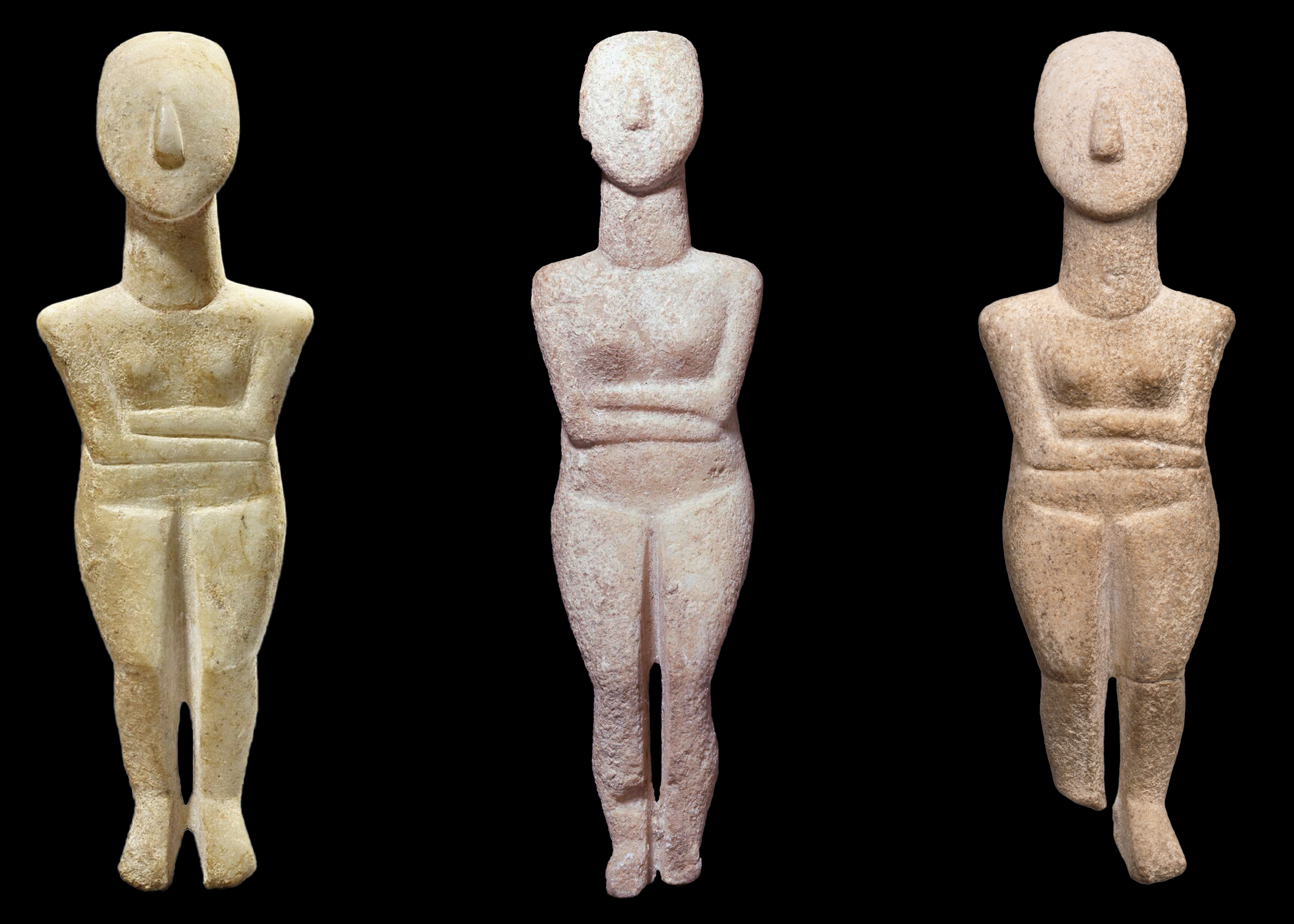
Left: The Bent Sculptor, Early Cycladic figurine, center: The Bent Sculptor, Early Cycladic Figurine, right: The Bent Sculptor, Early Cycladic Figurine
Left: The Bent Sculptor, Early Cycladic figurine, 2700–2500 B.C.E., marble, 17.1 x 5.7 x 2.9 cm (Musée du Louvre, Paris); center: The Bent Sculptor, Early Cycladic Figurine, 2700–2500 B.C.E., marble, 14.9 cm high (© The Trustees of the British Museum, London); right: The Bent Sculptor, Early Cycladic Figurine, 2700–2500 B.C.E., marble, 18 x 5.5 x 8.5 cm (Harvard Art Museums/Arthur M. Sackler Museum, Cambridge)

Cycladic sculptors made hundreds of folded-arm figurines between 2700 and 2300 B.C.E. [13] They are easily recognizable because of their basic shared characteristics, but they vary somewhat in their details and proportions. Our lack of understanding of these objects’ functions makes it difficult to explain these minor variations. However, some of these distinctive details may be the result of individual artisans’ preferences. In fact, some groups of folded-arm figurines are so similar to one another that art historians have proposed they are made by the same individual. One such craftsman has been named the Bent Sculptor after an archaeologist who worked in the Cyclades many years ago. [14] The Bent Sculptor’s folded-arm figurines are relatively stocky, with wide shoulders, narrow waists, and pointed chins. [15] While it is remarkable that we may be able to identify one person who made several Cycladic figures, the usefulness of this information is limited because we do not know where exactly the figures are from, and thus cannot determine where they were made or how they were used.

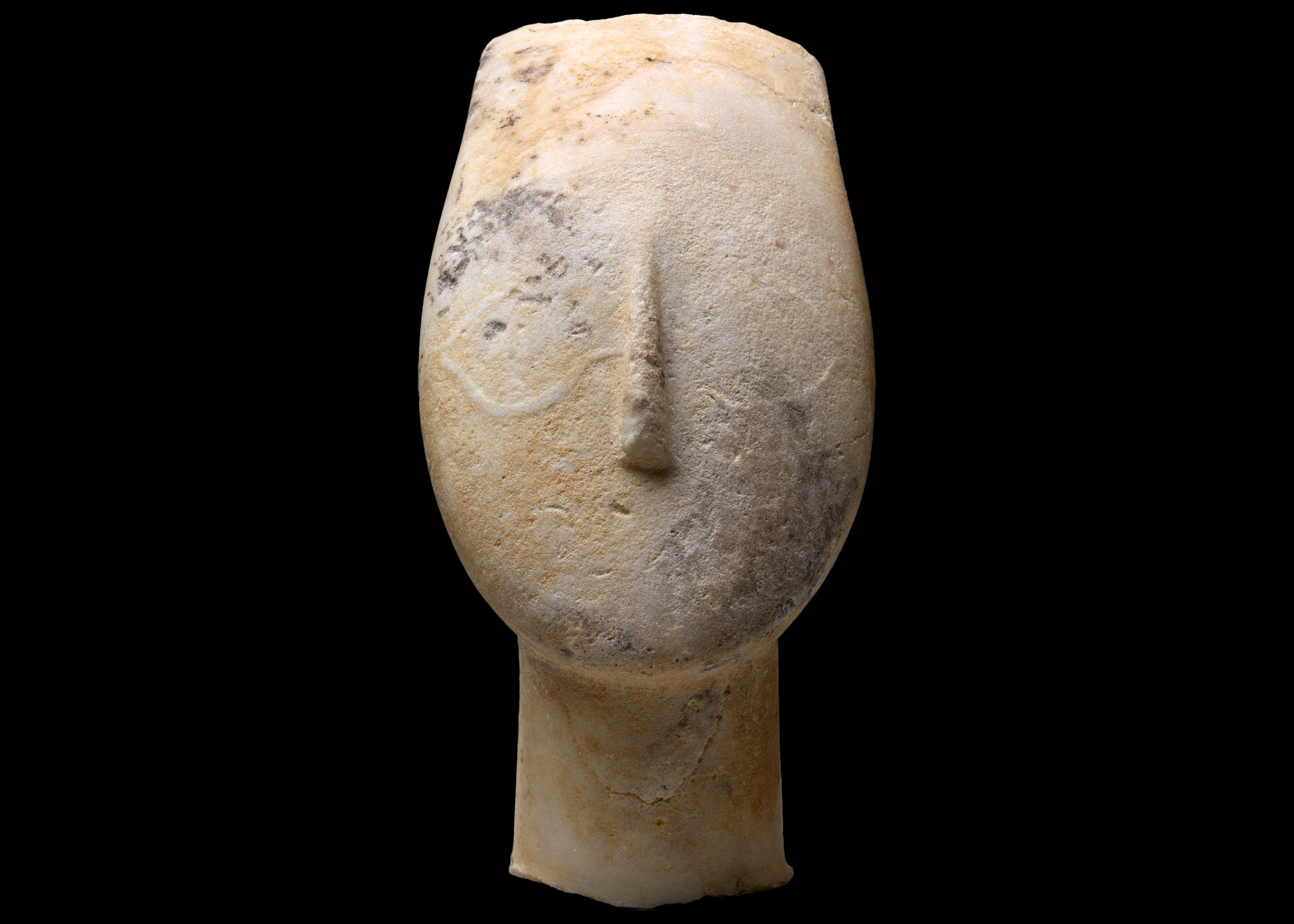
Head of an Early Cycladic figurine, 2700–2500 B.C.E., marble, 25.3 cm high (The Metropolitan Museum of Art, New York)

Painted people

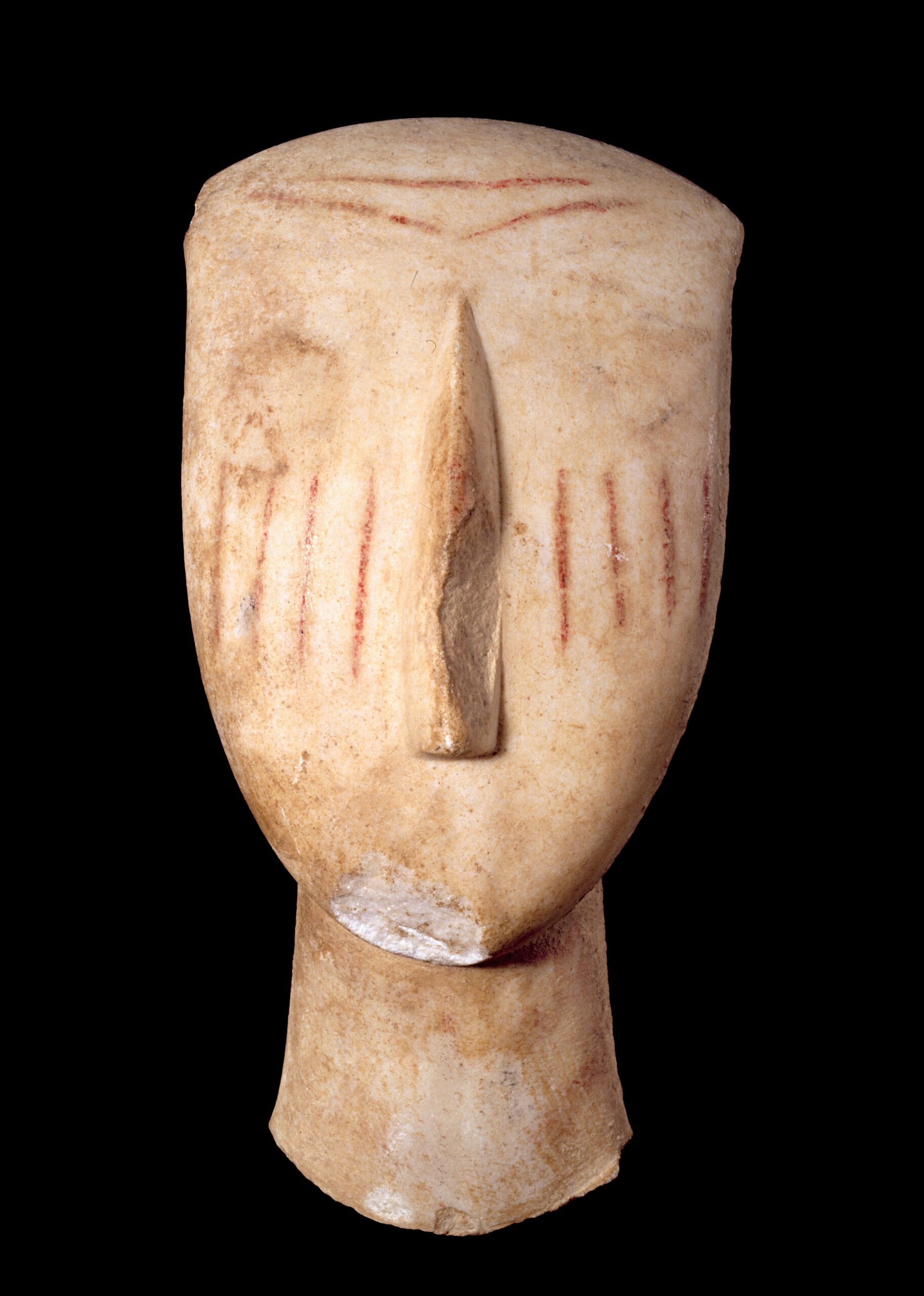
Although a lack of archaeological context makes it impossible to determine the original functions of most Cycladic figures, some of the statues provide tantalizing clues on their own surfaces. The seeming simplicity of the folded-arm figurines is partially deceptive: nearly all of the figures were originally painted, particularly on their faces. In the Early Cycladic period, these figures had eyes rendered with bright red and blue paints made from local minerals. These painted decorations are often only barely visible today. Sometimes, the areas that were once painted appear slightly raised above the stone around them because the painted portion was protected by the (now missing) paint. [16] Such raised traces, which are called “ghosts” by archaeologists, are visible on the head of one figurine that is now in New York. The curving lines of the figure’s eyes are visible on either side of its slender nose, revealing that it once fixed viewers with an attentive stare.

Head of an Early Cycladic figurine, 2600–2500 B.C.E., marble, 22.8 x 8.9 x 6.4 cm (The J. Paul Getty Museum, Los Angeles)
Head of an Early Cycladic figurine, 2700–2300 B.C.E., marble, 24.6 cm (National Museum of Denmark, Copenhagen)

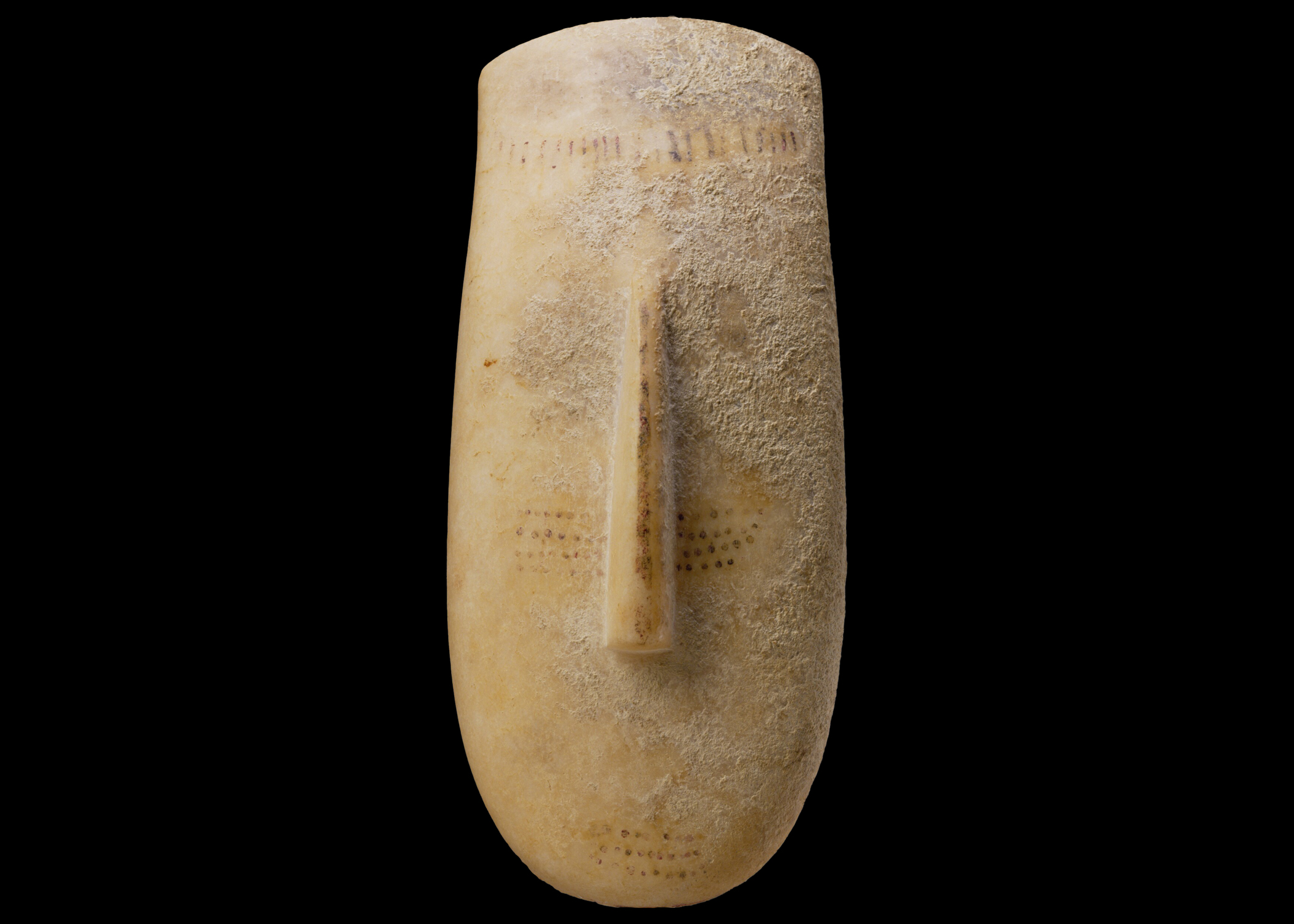
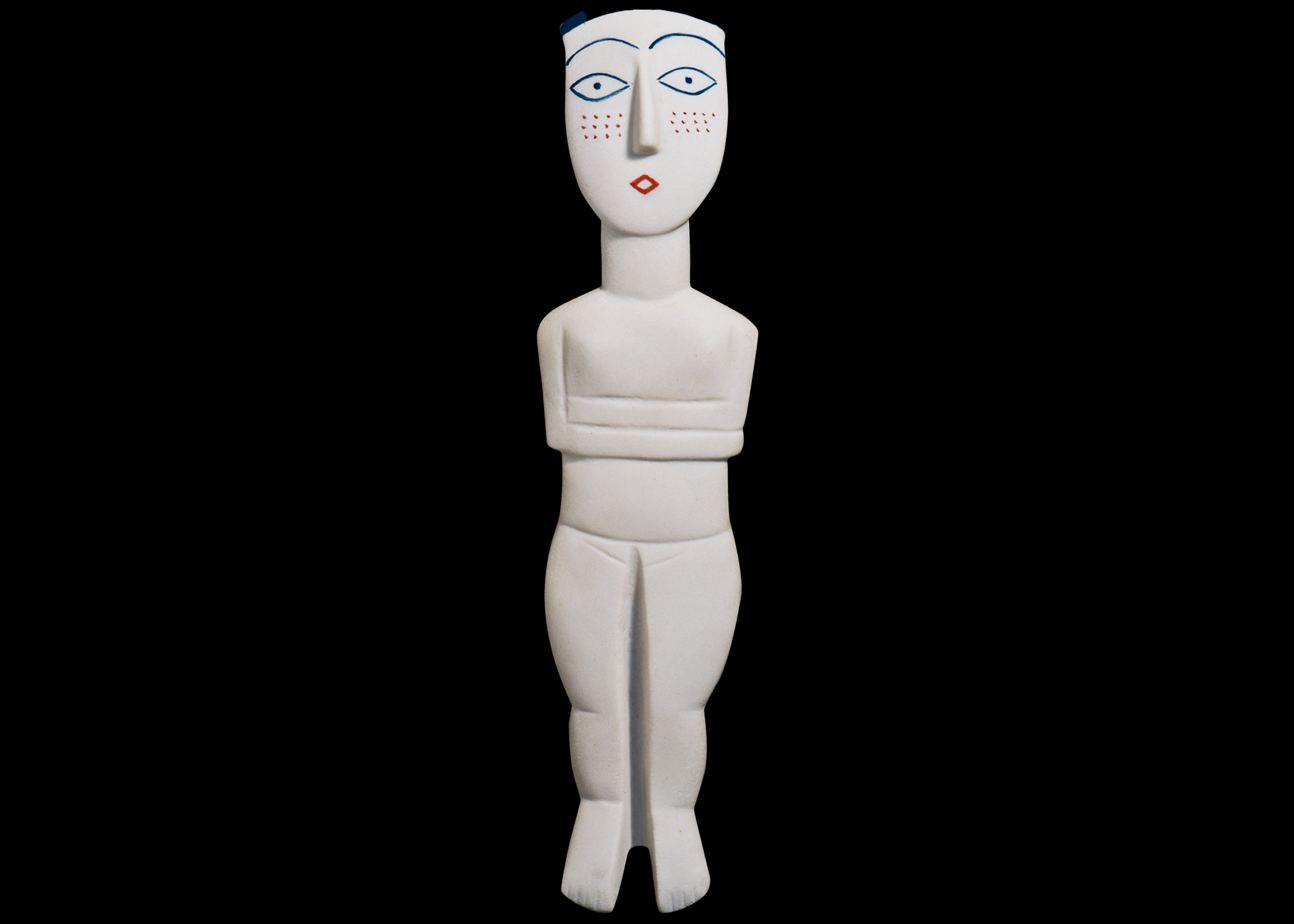
Many Cycladic figures have patterns painted on their faces. For example, a head that once belonged to an exceptionally large statue has a series of vertical red lines on its forehead, rows of red dots on its cheeks and chin, and a red stripe down its nose. These painted details do not correspond to facial features. They might instead relate to actual face painting rituals that may have been performed by Early Cycladic peoples during important life events. [17] In her groundbreaking interpretation of the paint on Cycladic figures, Gail Hoffman suggested that the statues were painted multiple times throughout their existence to reflect the changes their owners underwent. [18] A person might acquire a figure early in her life, painting its face with the markings she herself wore to her wedding when she got married, and later re-painting it with the patterns she wore during the dangerous time of childbirth.

Finally, when a person died, her figure might be repainted once more to depict a state of mourning. Several Cycladic figures with long vertical lines on their faces might reflect funerary rituals during which women lacerated their faces in anguish. [19] Other interpretations of the painting on Cycladic figures’ faces suggest that the markings reflect clan memberships. [20] Without written texts or more archaeological evidence, it is impossible to tell for sure what the markings mean.

Reconstruction of a Cycladic figurine with paint by Vinzenz Brinkmann and Ulrike Koch-Brinkmann (Polychromy Research Project, Liebieghaus, Frankfurt)

Context clues

The few Cycladic figures that were excavated by trained archaeologists were mostly found in graves. Given this clue, and the fact that a few have been found painted with facial markings that might relate to mourning, it seems possible that some of the statues served a funerary function. However, only some excavated Cycladic tombs have figurines, and some very rich burials lack marble statues. Not all deceased elites needed marble figures in their graves. [21]

Fragments of Early Cycladic figurines found on the island of Keros (Island of Broken Figurines, Keros Project, Cambridge University)

In recent years, excavations on the island of Keros have revealed evidence that the marble figurines were used in rituals. Archaeologists have discovered hundreds of fragments of Early Cycladic statues buried in two closely related deposits on Keros. While one of these deposits has been extensively looted and essentially destroyed, the other is partially preserved, allowing archaeologists to study it more carefully. [22] The fragments found here come from hundreds of different Early Cycladic figurines. There is no evidence that the statues were broken near the deposit where they were buried. Moreover, the many fragments of figurines do not join with one another: they all come from different figures. Keros is a small island that did not have a large population in the Early Cycladic period. As a result, archaeologists believe that these deposits on Keros were a destination for people throughout the Cyclades. They suggest that Early Cycladic peoples may have broken their figurines at home, on whichever island they inhabited, and then carried a single piece of their figurine to the large deposits on Keros, where they buried them together with the many other fragments that accumulated over the decades. [23]

For now, any conclusions we reach about the original functions of these statues remain unconfirmed. New excavations shed more light on the figures’ significance, but extensive looting has resulted in an irreversible loss of knowledge. We can still appreciate the accomplishments of the craftsmen who created Cycladic figures. Using sparse, simplified forms, they crafted easily recognizable human figures with locally available materials. Although the Early Cycladic figurines’ exact functions are unknown, the great number of surviving examples and their relatively wide distribution throughout the Cyclades suggests that they were important to the islands’ inhabitants. As Alexander Aston has recently proposed, we might best understand them as material links in an imaginary chain that connected Early Cycladic peoples across the sea that separated them. [24] Even while living on different islands miles away from one another, these individuals all shared the ability to understand the marble figurines that circulated amongst them. As Early Cycladic peoples decorated their statues, buried them in graves, or left them in communal deposits on Keros, they remained connected through their shared use of the small marble figurines. Until the Early Cycladic culture came to an abrupt end around 2000 B.C.E. under mysterious circumstances, these statues were an essential part of its identity.

See also:

Early Cycladic Art and Culture on the Metropolitan Museum of Art’s Heilbrunn Timeline of Art History

Lean more about the Keros Project

Learn more about the use of color in Cycladic art

Source: Dr. Monica Bulger, “Early Cycladic figurines,” in Smarthistory, March 22, 2024, accessed September 9, 2024, https://smarthistory.org/early-cycladic-figurines/.


Male Harp Player of the Early Spedos Type
Getty Conversations

A conversation with Nicole Budrovich, Curatorial Assistant, Getty Museum, and Beth Harris, Executive Director, Smarthistory, in front of Male Harp Player of the Early Spedos Type, Cyclades, 2700–2300 B.C.E, marble, 35.8 x 9.5 x 28.1 cm. Getty Museum, Los Angeles.   URL: https://youtu.be/679ruNAsPL8

Four thousand years ago, in the Cycladic Islands in the Aegean Sea, a sculptor carved this figure from a block of marble. The culture of this time and place had a strong oral tradition, and this sculpture begs one to wonder who this figure is, what he is singing, and who he is singing for.


Cite this page as: Nicole Budrovich and Dr. Beth Harris, “Male Harp Player of the Early Spedos Type Getty Conversations,” in Smarthistory, May 17, 2023, accessed September 11, 2023

Male Harp Player from Keros

Male Harp Player from Keros, c. 2600-2300 B.C.E., Early Cycladic period, marble, 22.5 cm high (National Archaeological Museum, Athens)

Video URL: https://youtu.be/7C7do85sfXA   For a Video Transcript go to https://smarthistory.org/male-harp-player-from-keros-early-cycladic-period/.

Source: Dr. Beth Harris and Dr. Steven Zucker, “Male Harp Player from Keros,” in Smarthistory, December 15, 2015, accessed September 9, 2024, https://smarthistory.org/male-harp-player-from-keros-early-cycladic-period/.

Akroteri, Thera 

Frescoes from Akrotiri, on the Cycladic island Thera (Santorini), Greece, 16th century B.C.E., Aegean Bronze Age (National Archaeological Museum, Athens)

For Video Transcript go to https://smarthistory.org/thera/   

Video URL: https://youtu.be/1gb7g9w6fxo

Source:  Steven Zucker and Beth Harris, “Akrotiri, Thera,” in Smarthistory, March 21, 2016, accessed September 9, 2024, https://smarthistory.org/thera/.

MINOAN ART

Minoan Art, an Introduction

Restoration vs. Conservation

Bull-leaping Fresco

La Parisienne

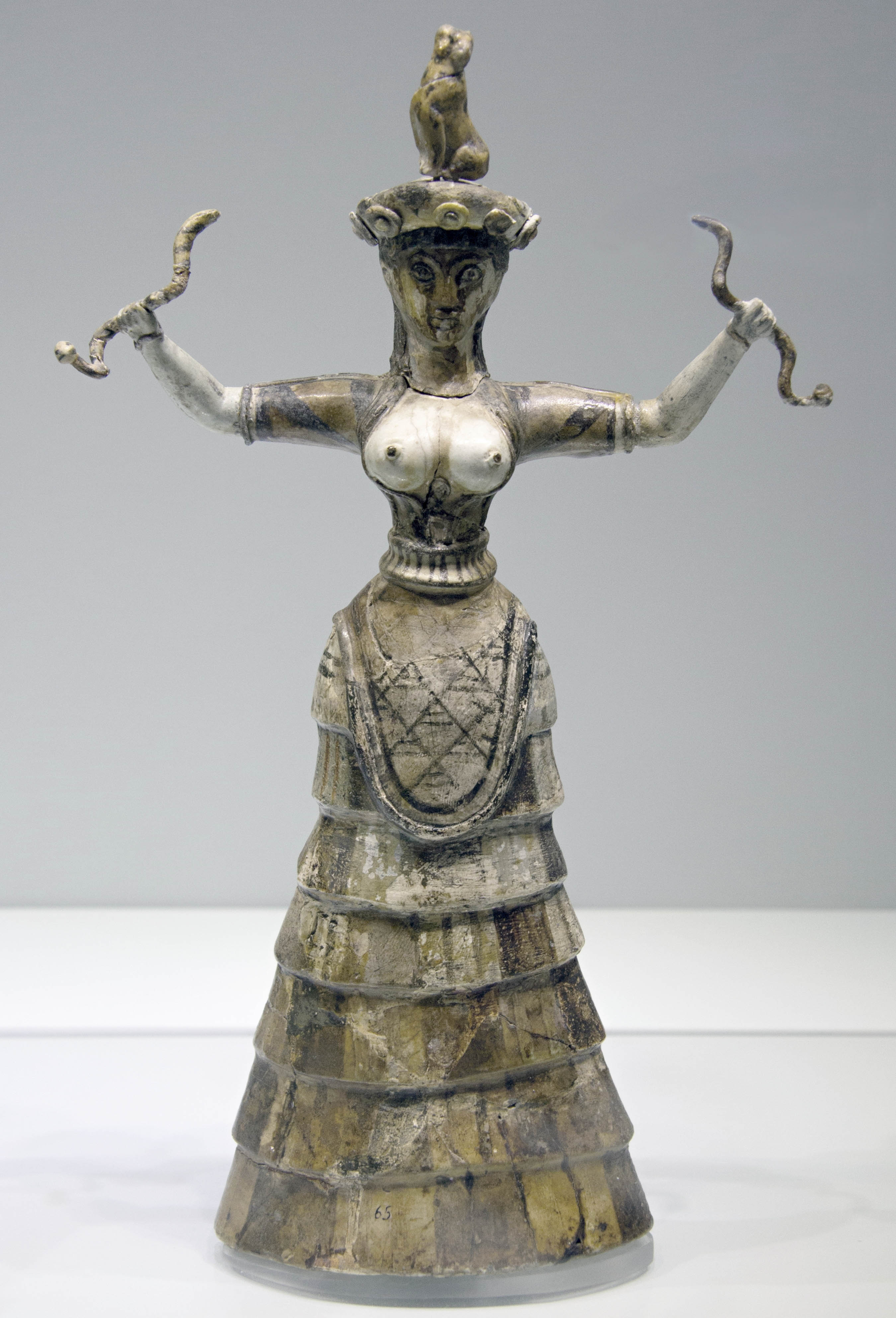
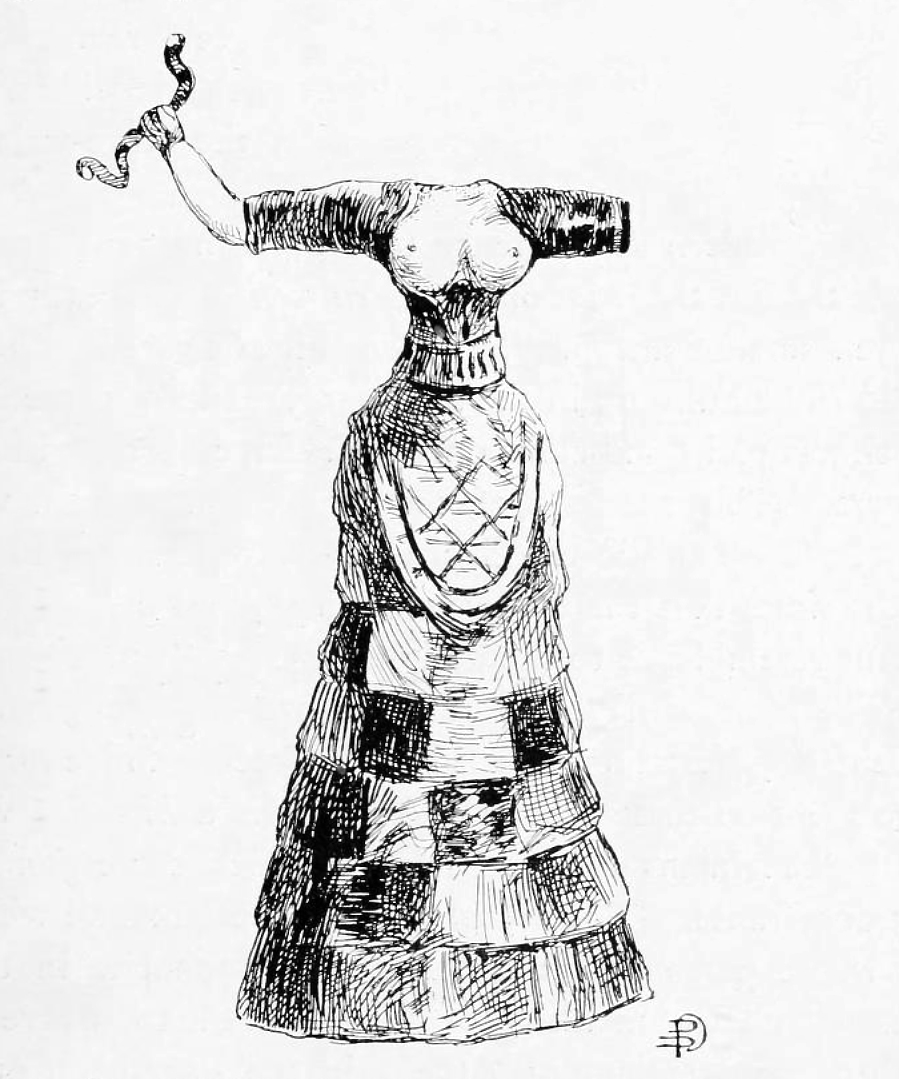
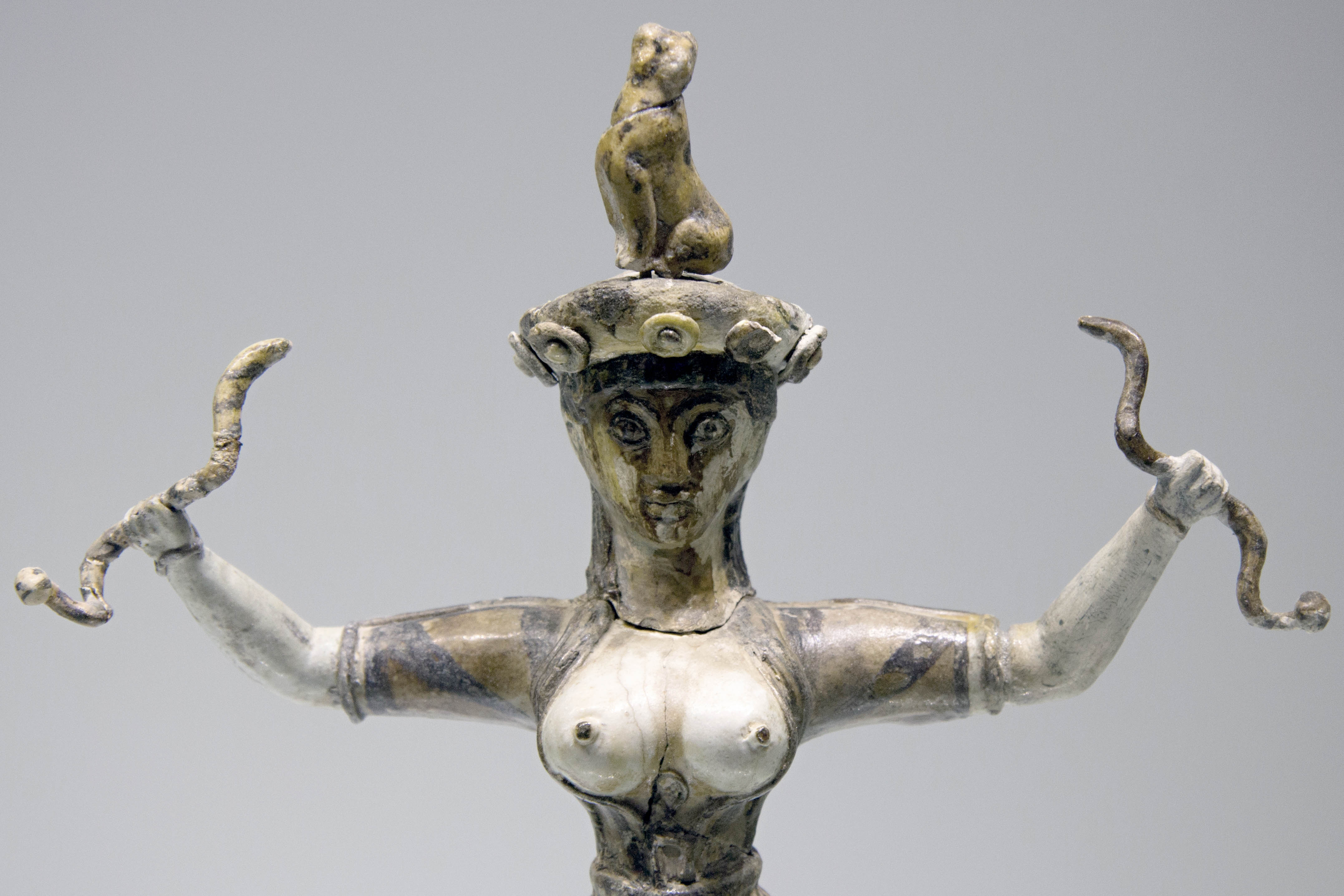
Snake Goddess

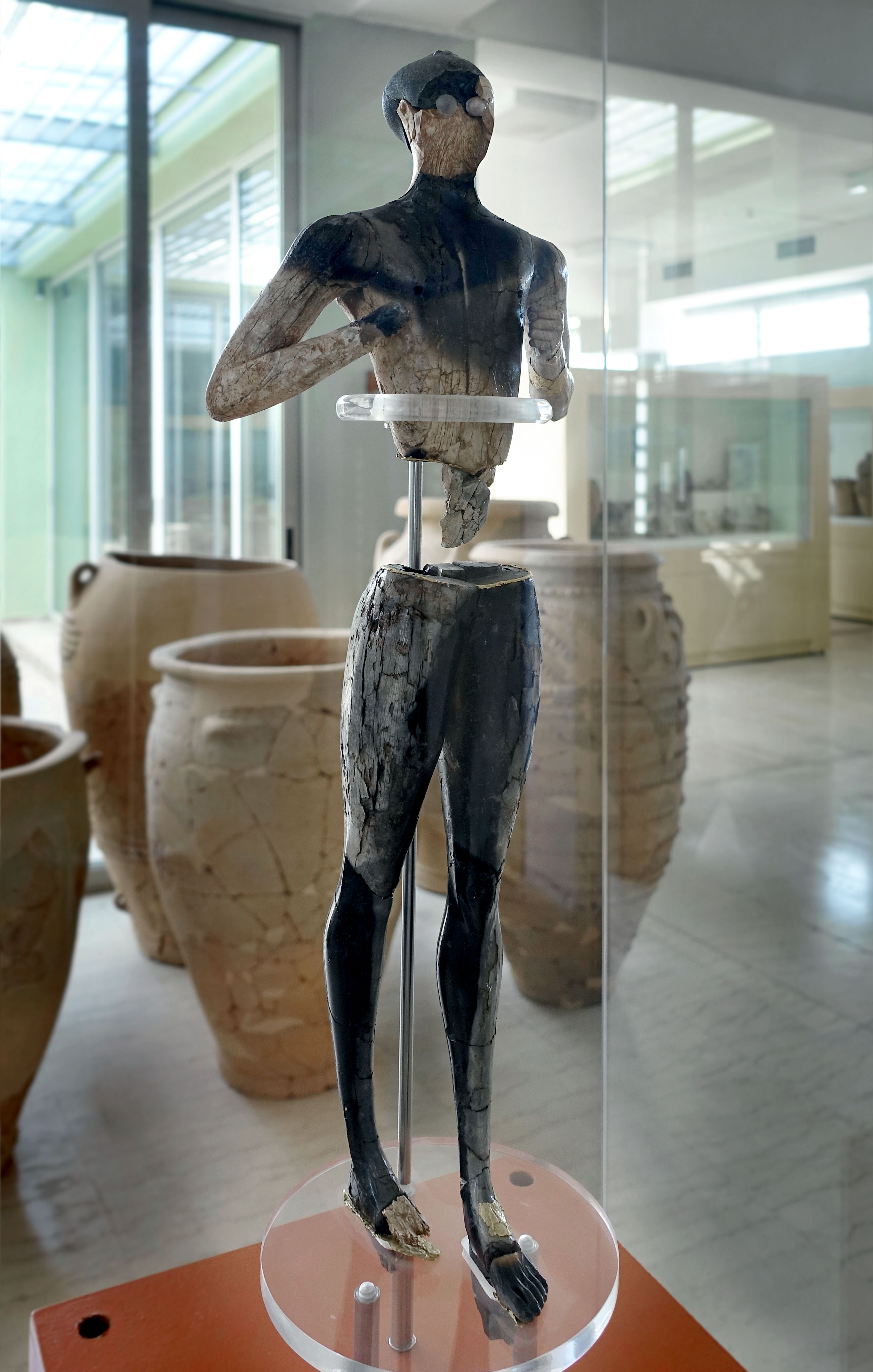
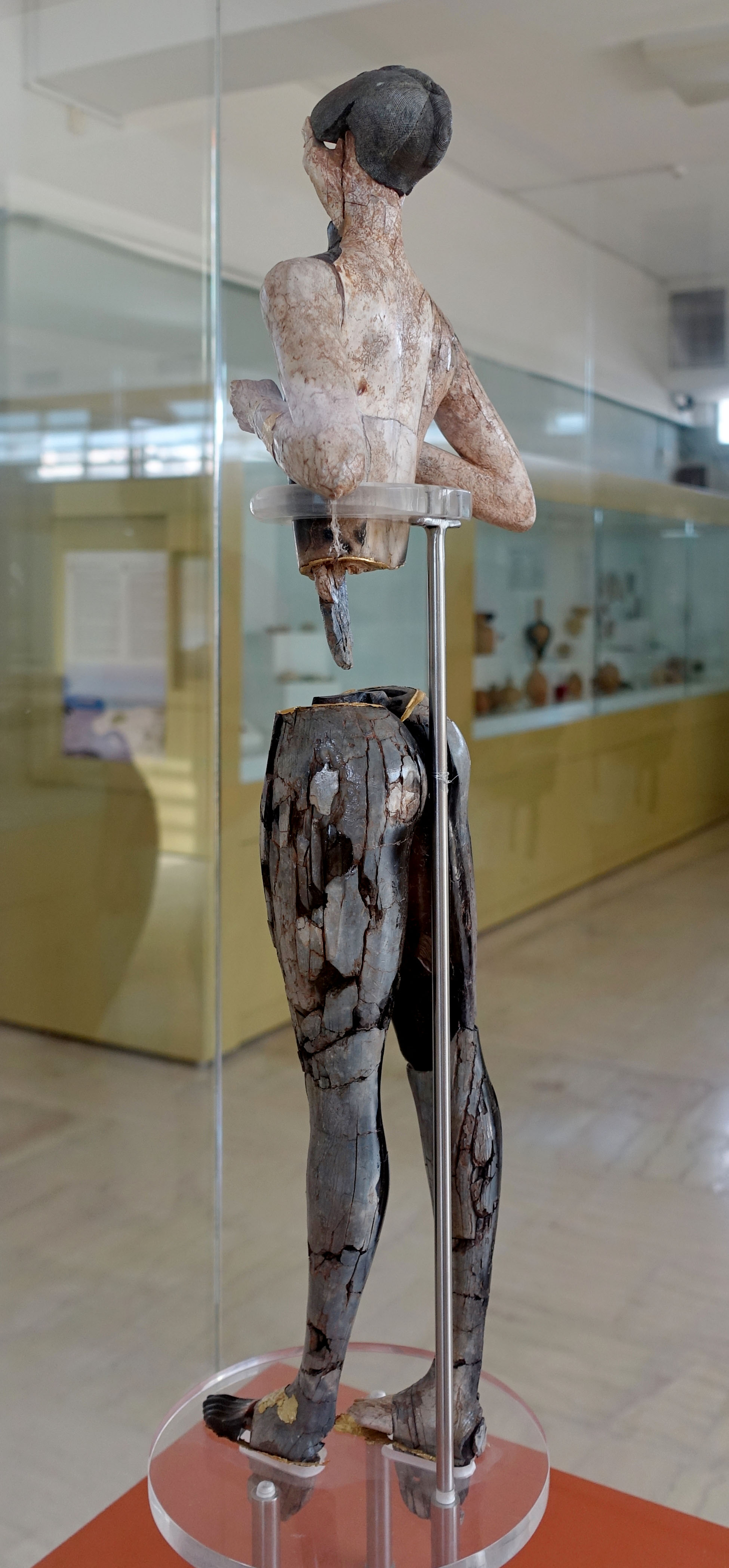
Palaikastro Kouros

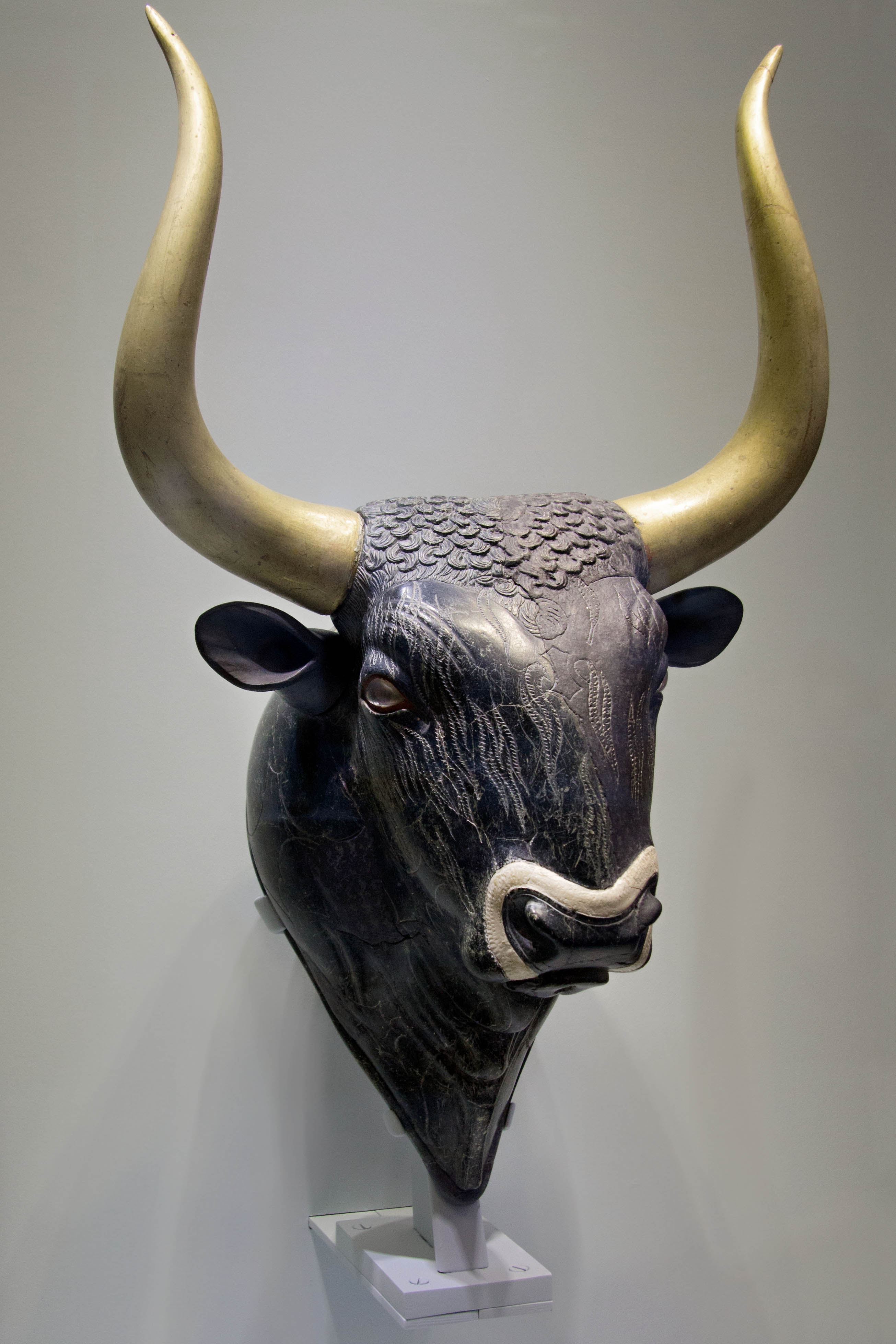
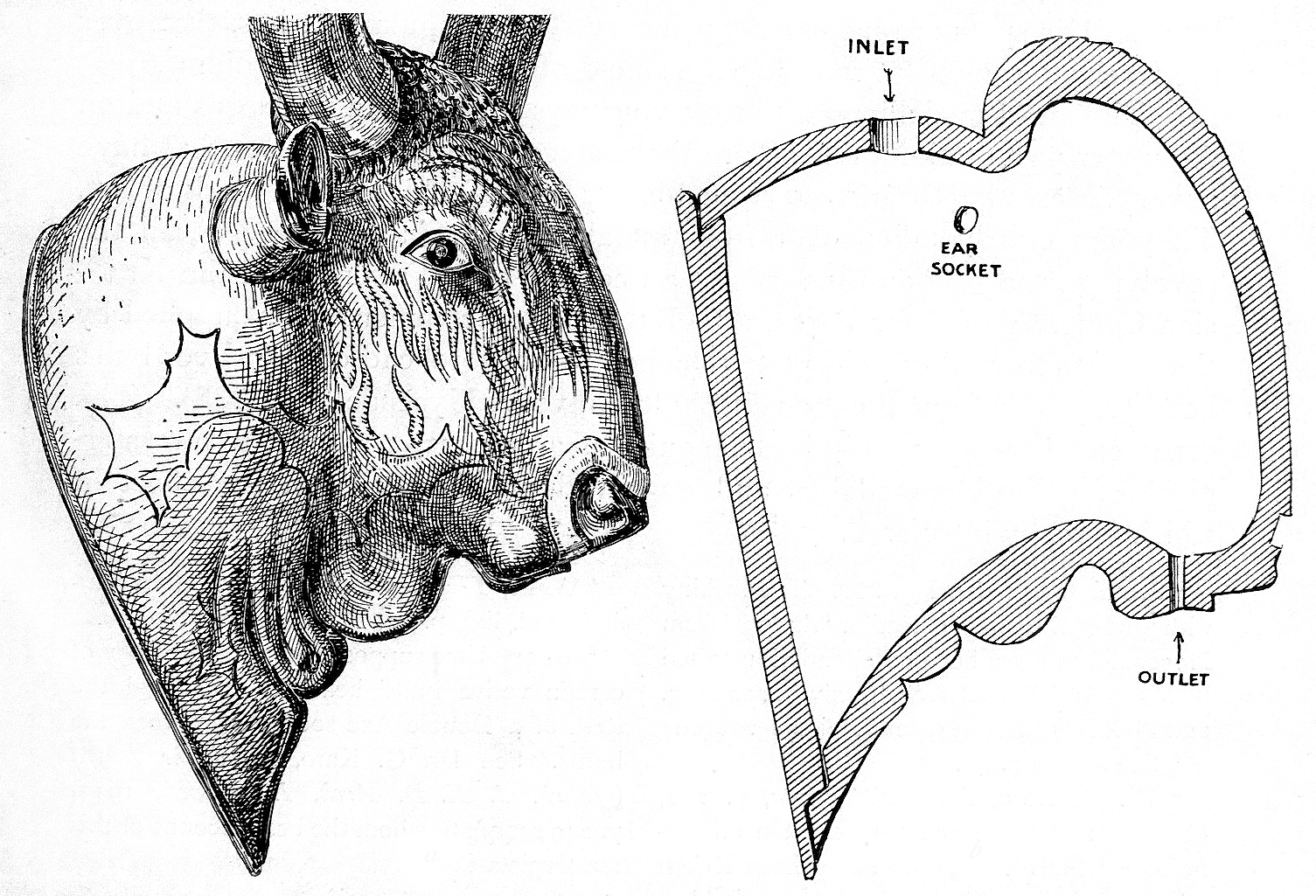
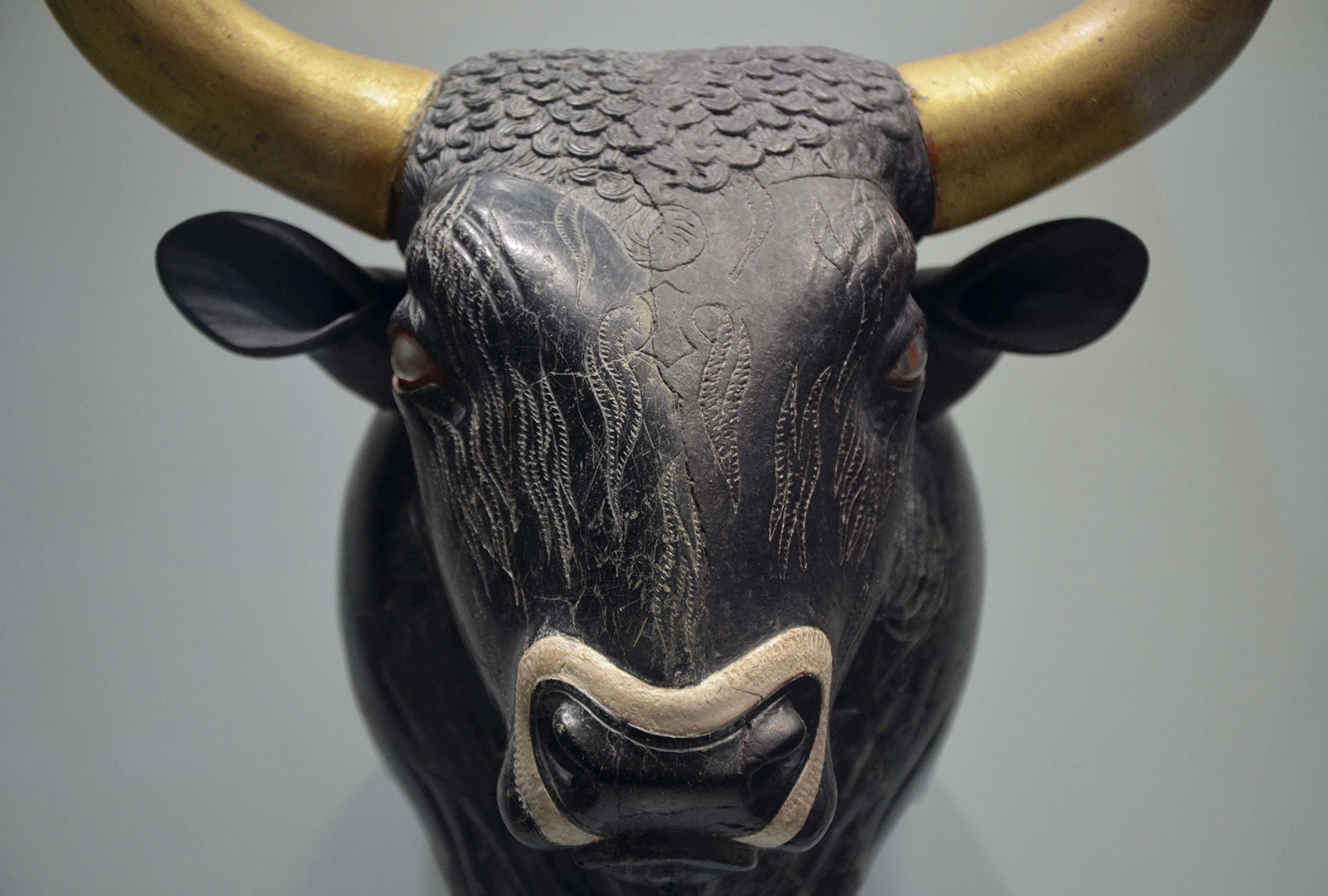
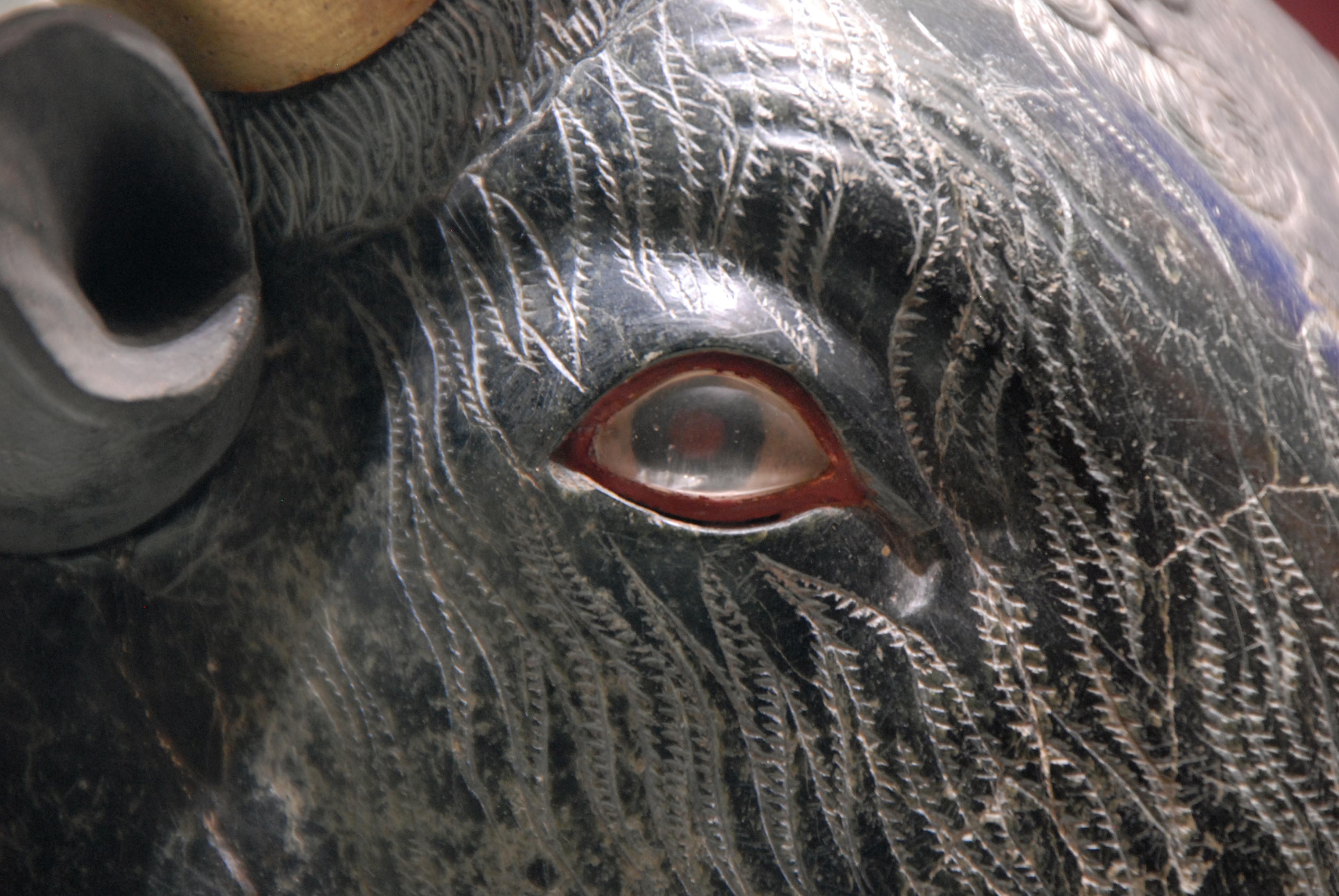
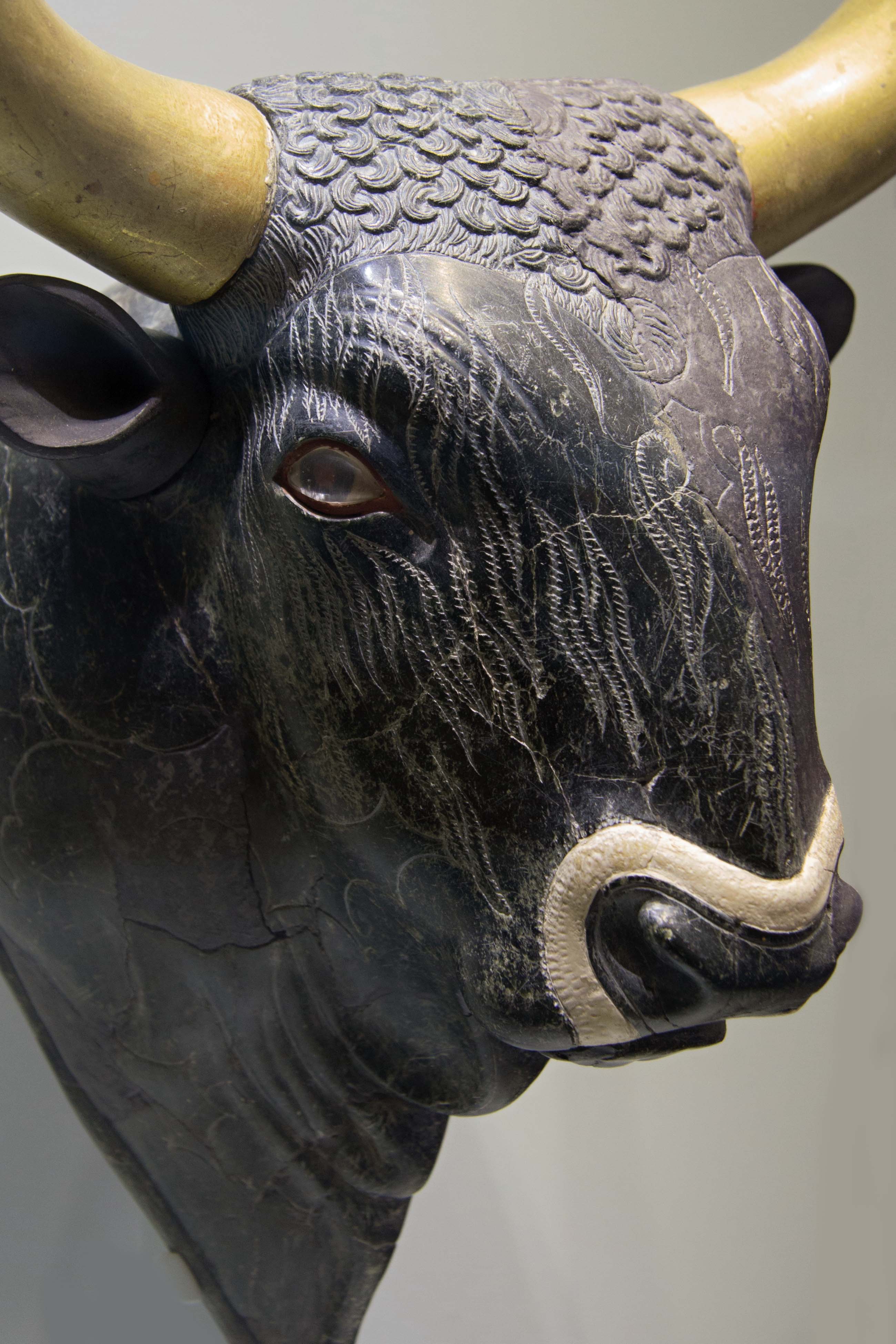
Bull’s Head rhyton

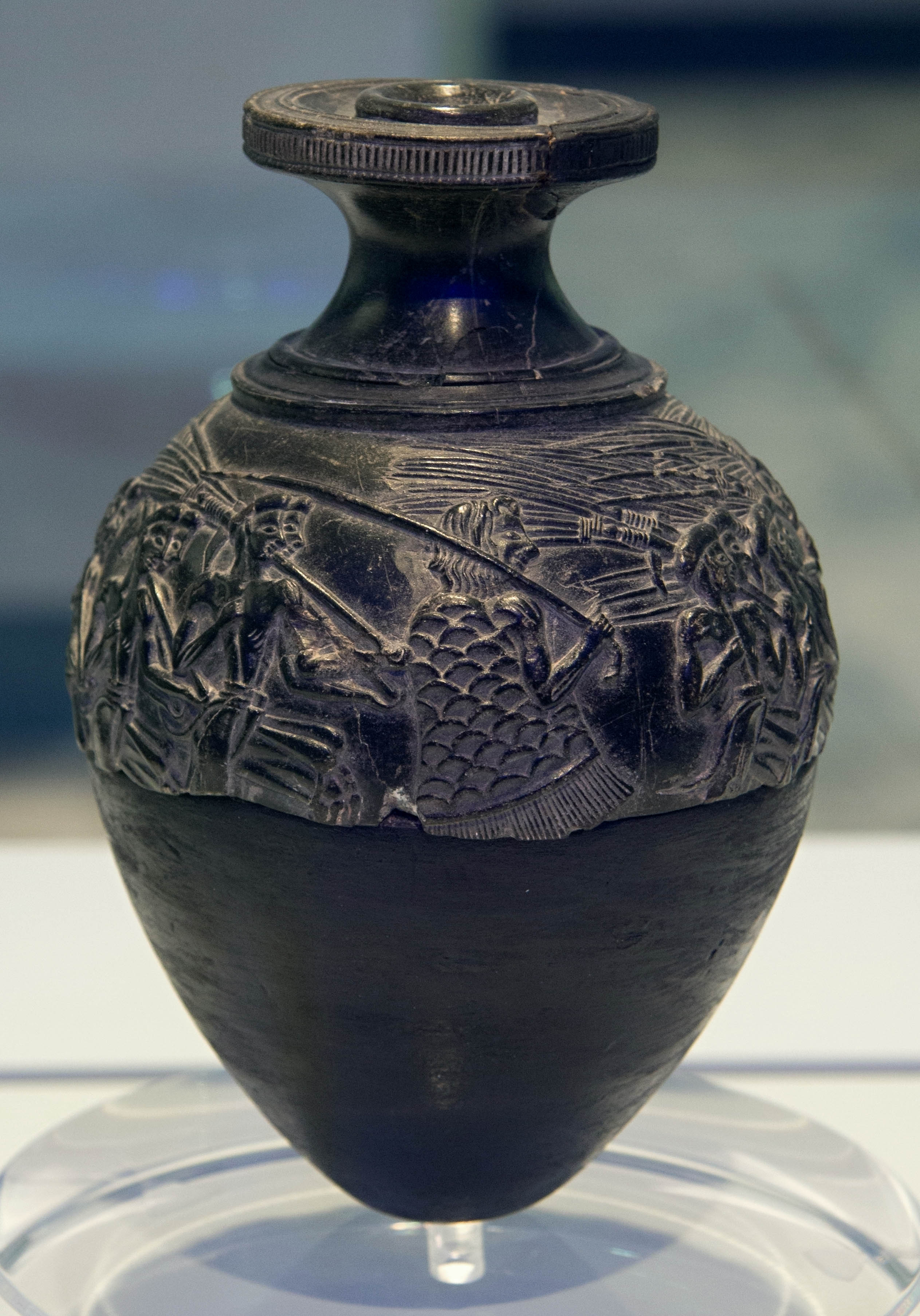
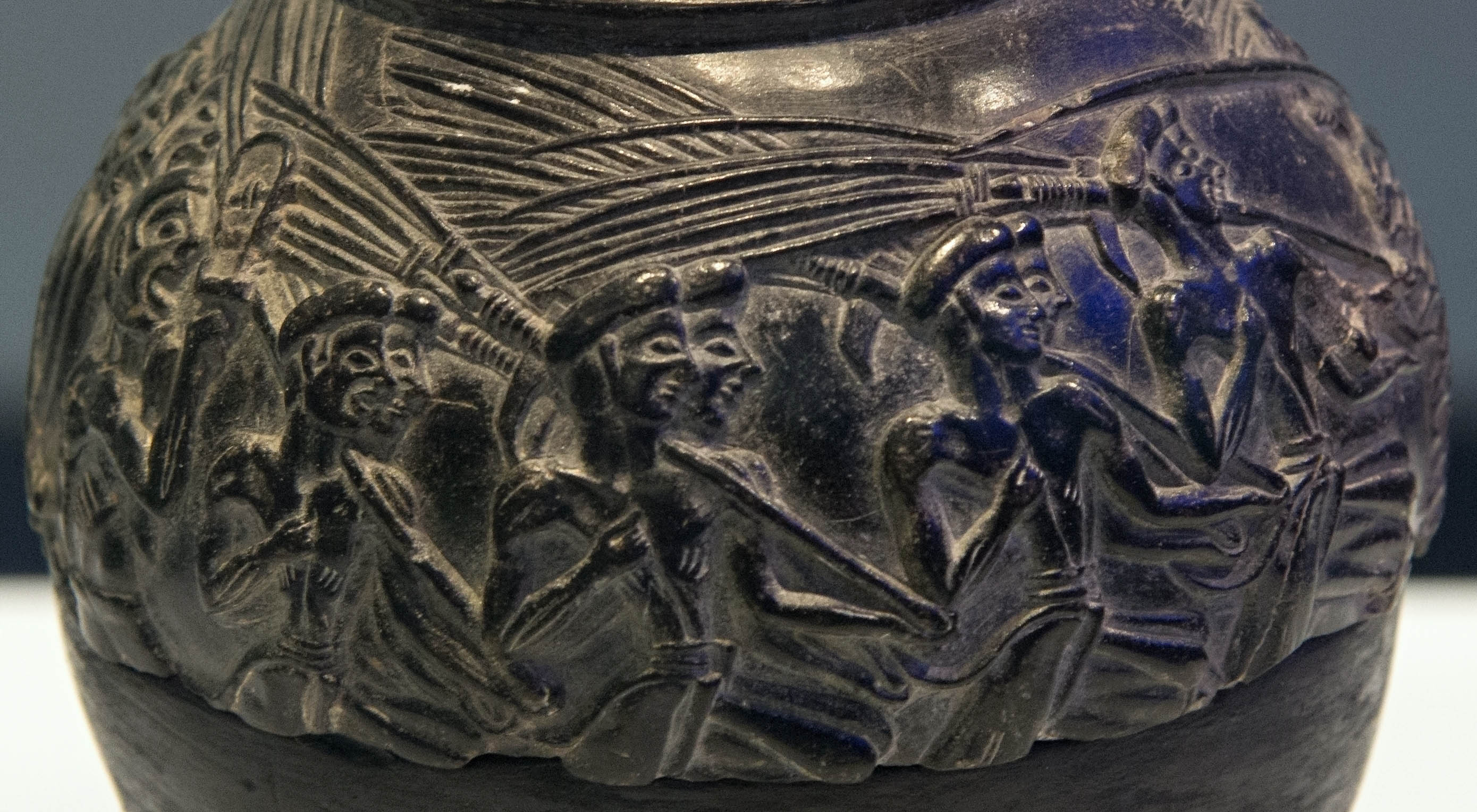
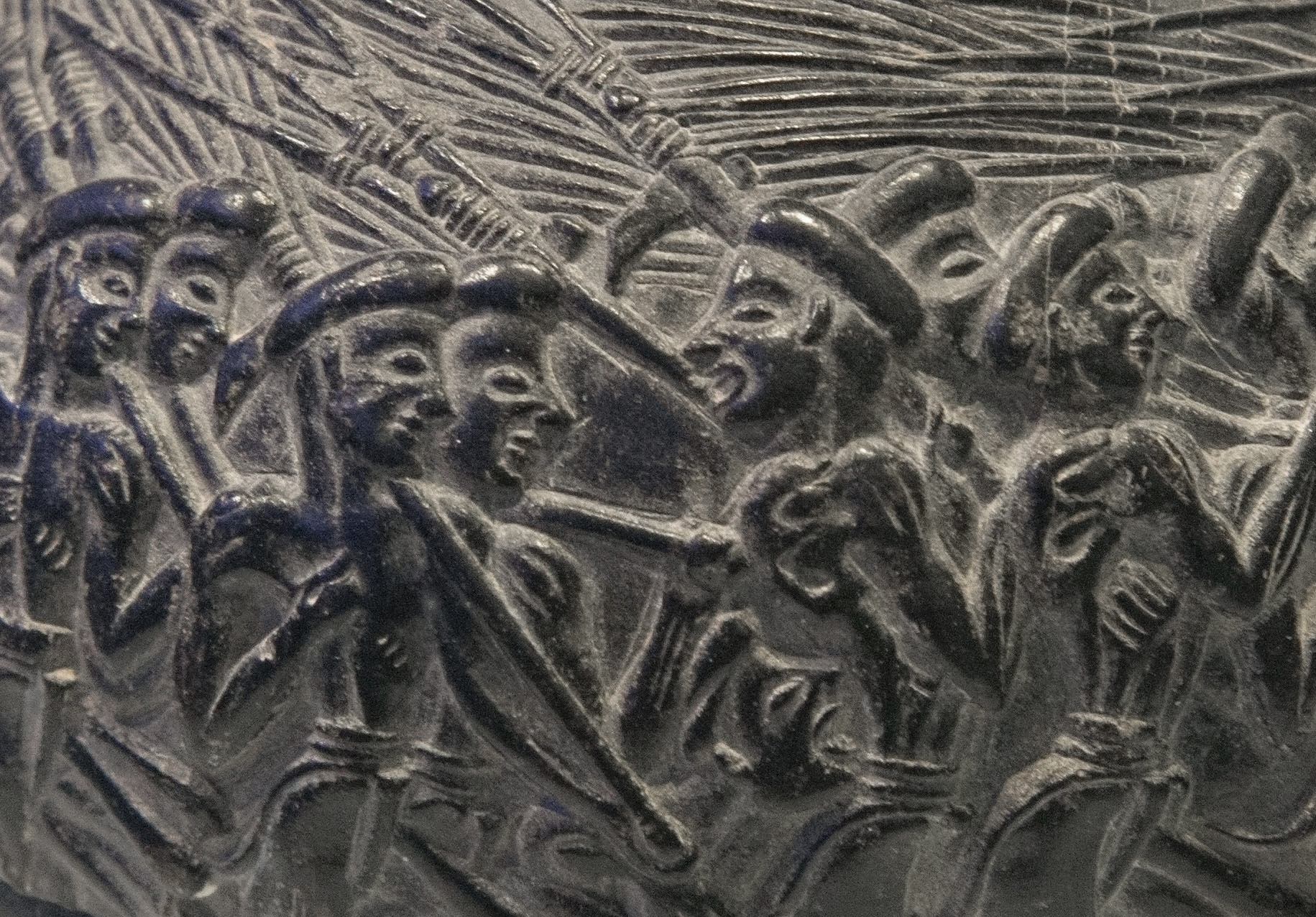
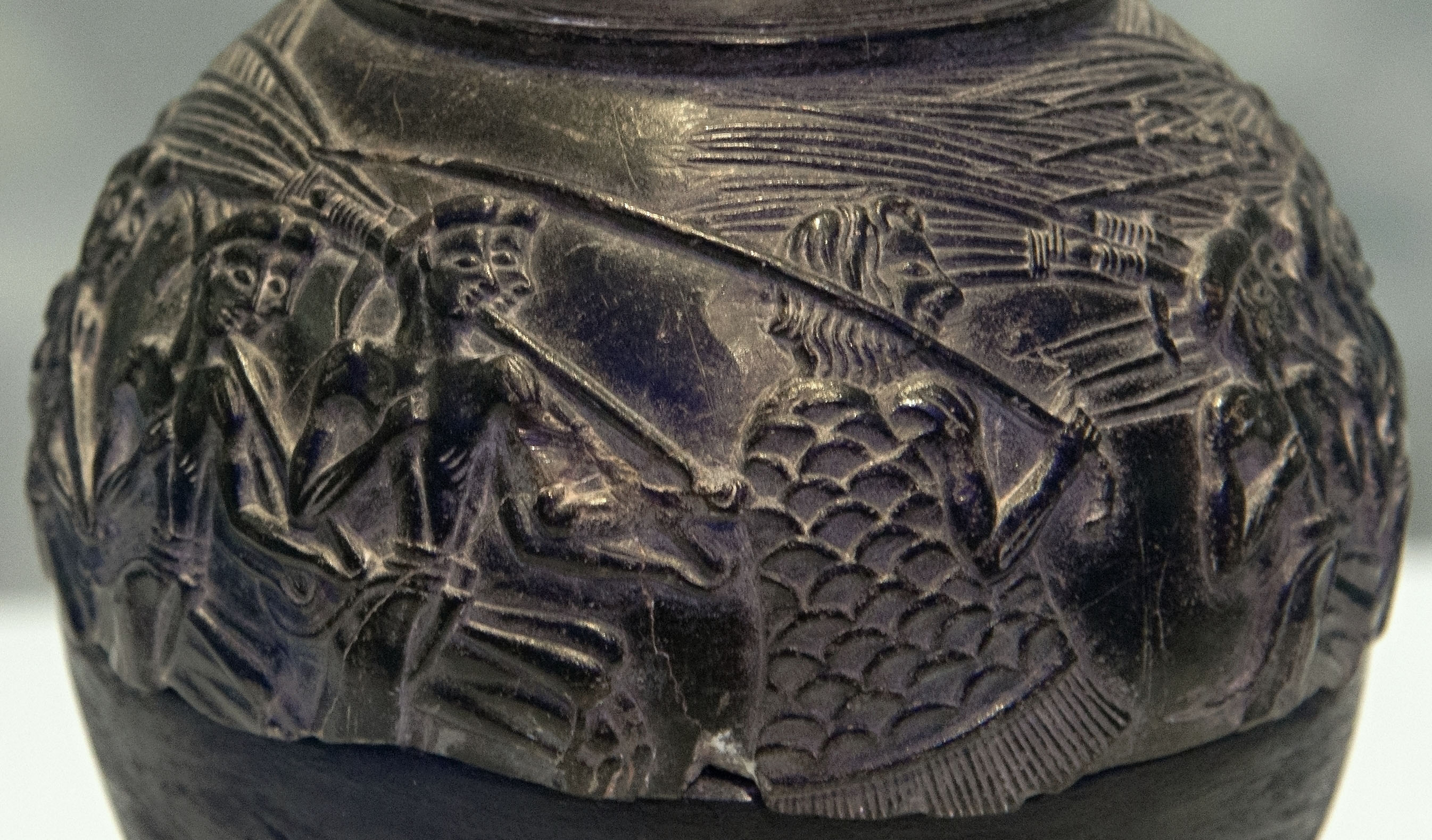
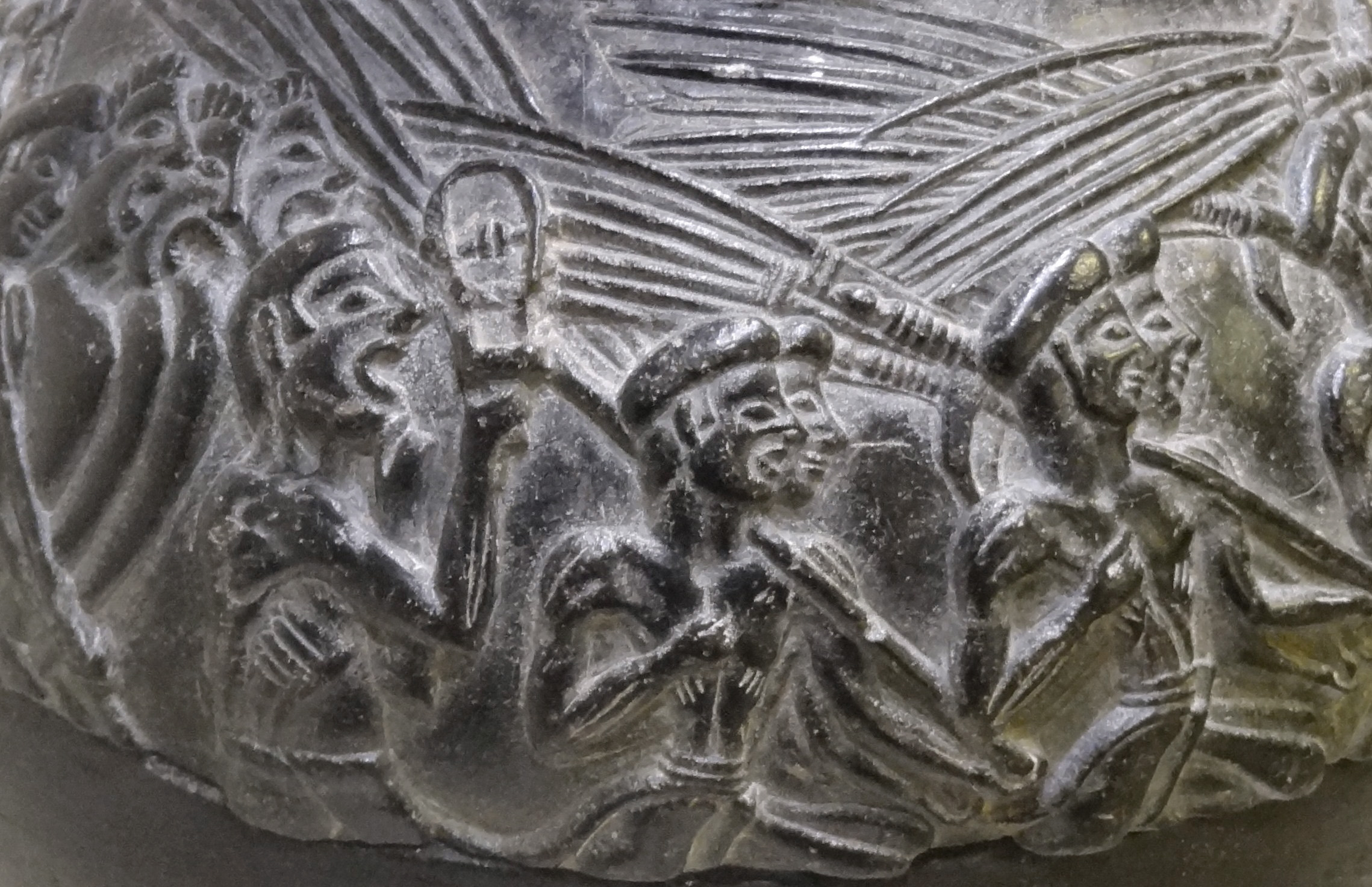
Harvester Vase

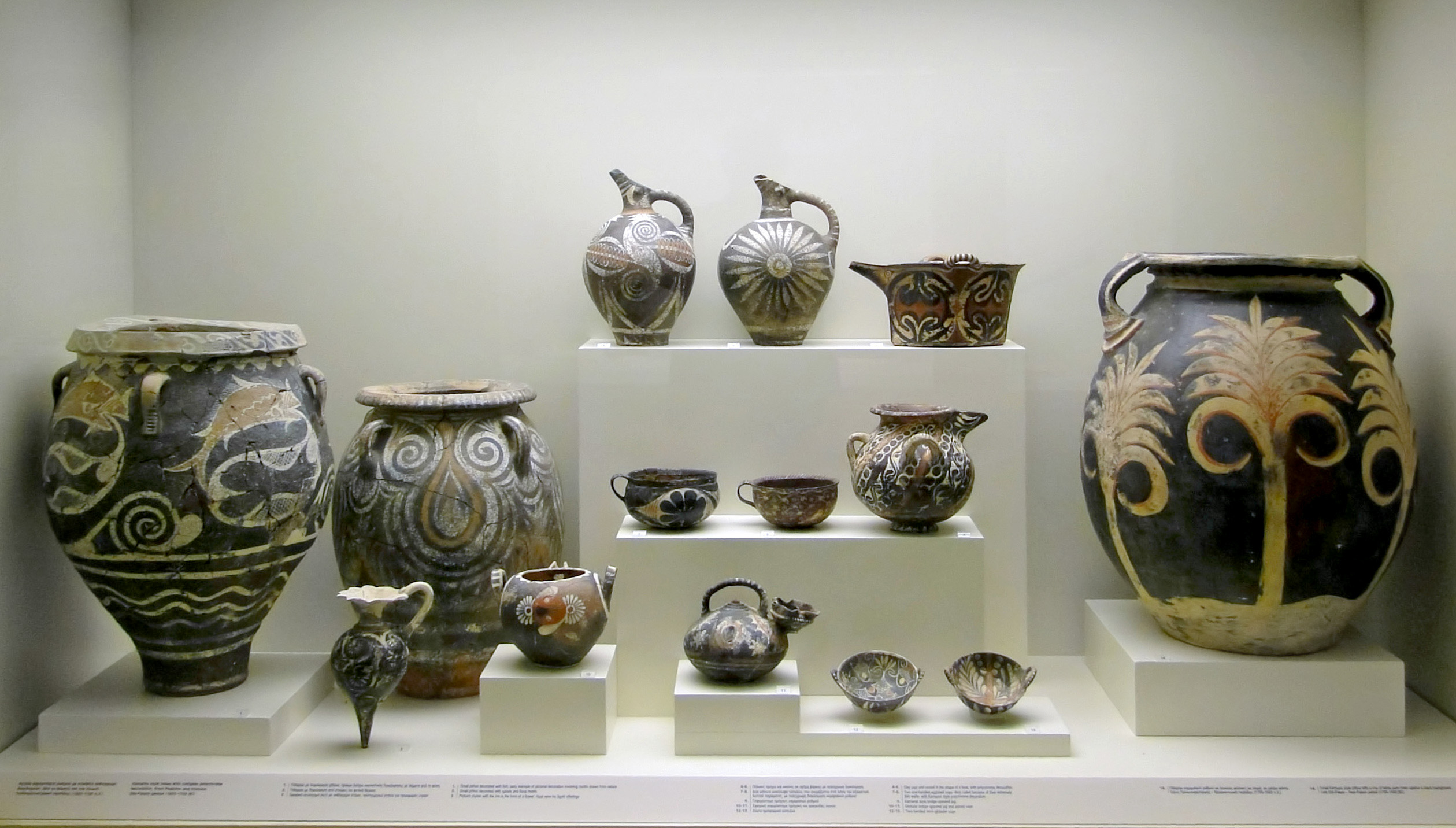
Kamares Ware

Octopus Vase

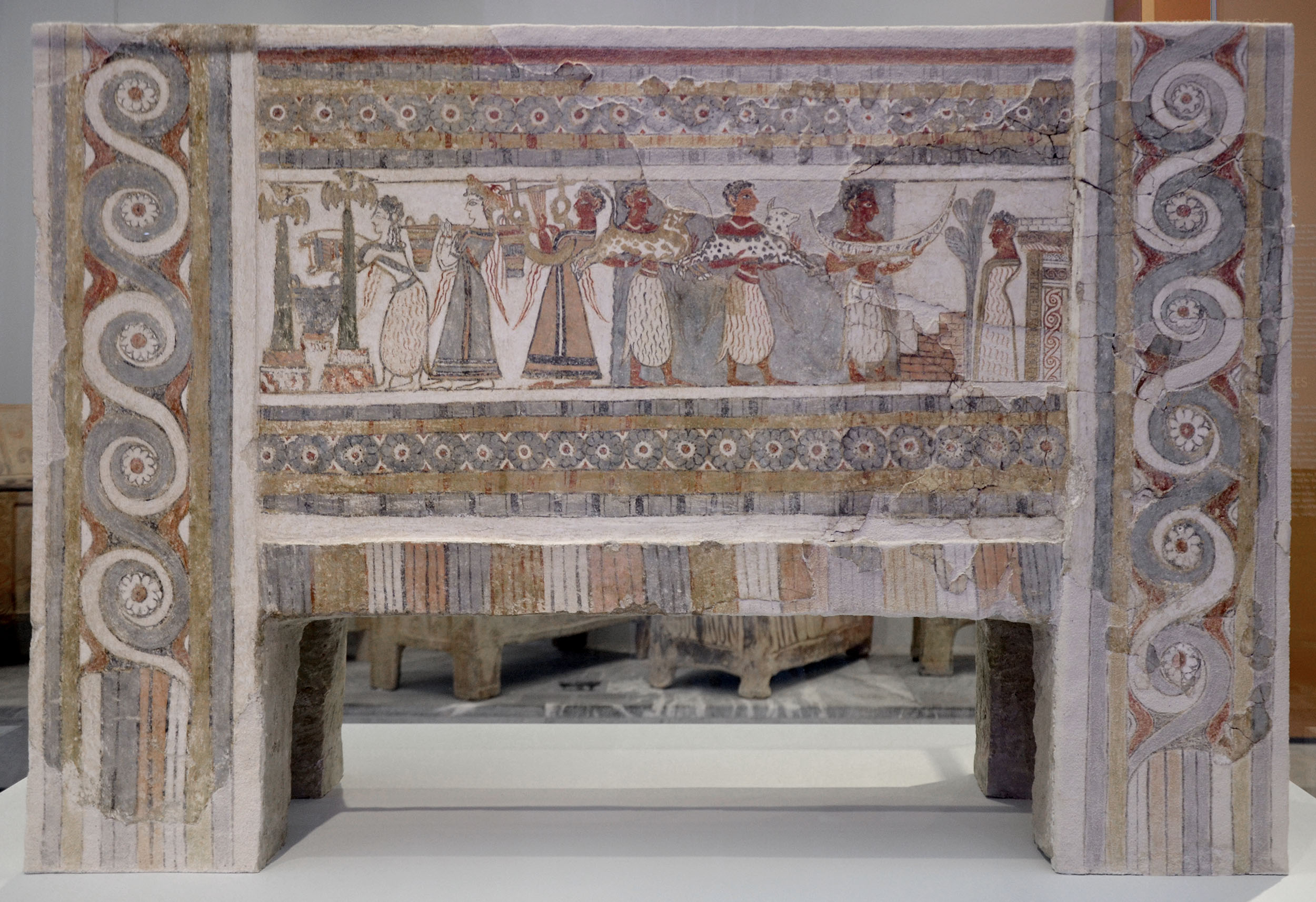
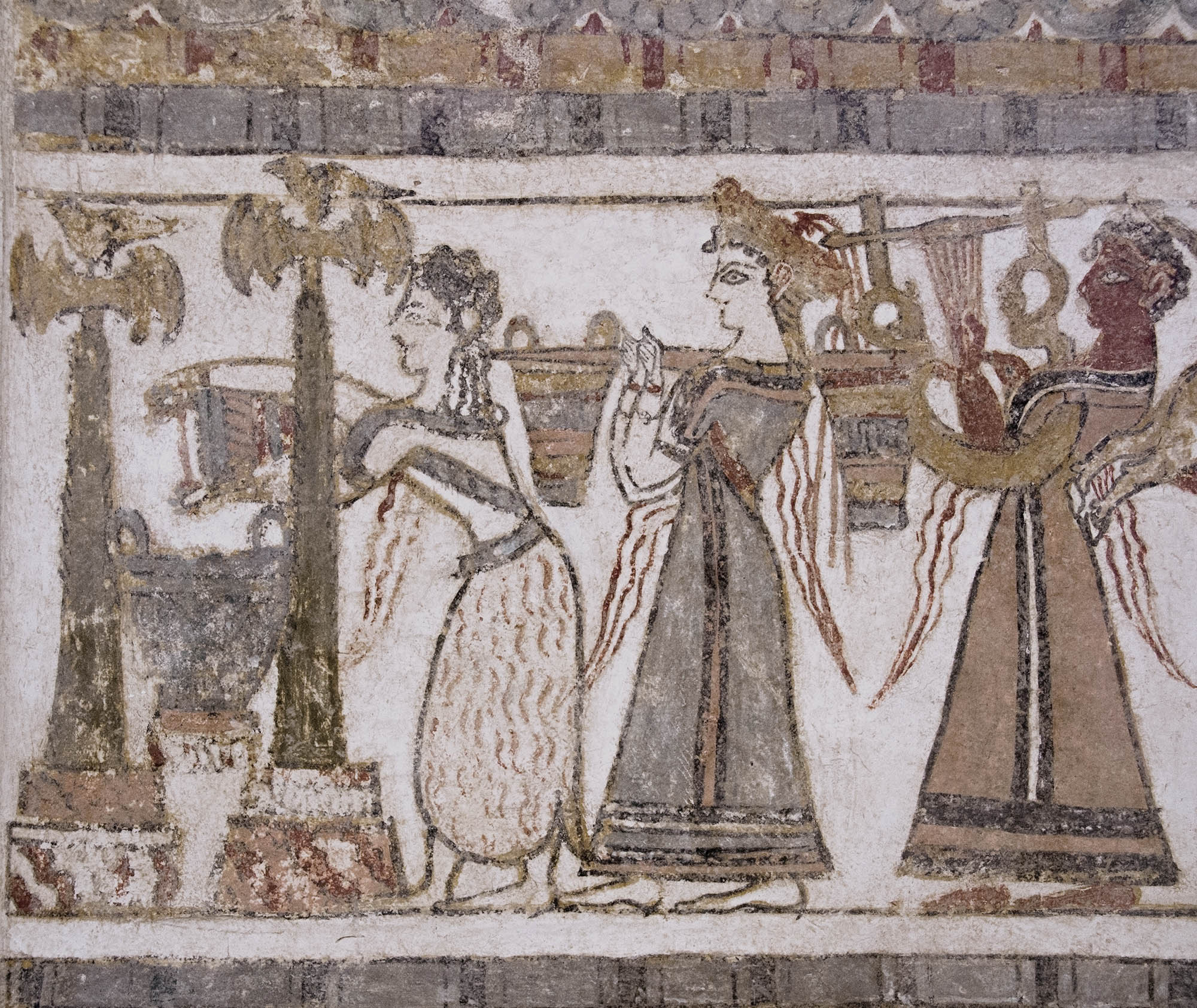
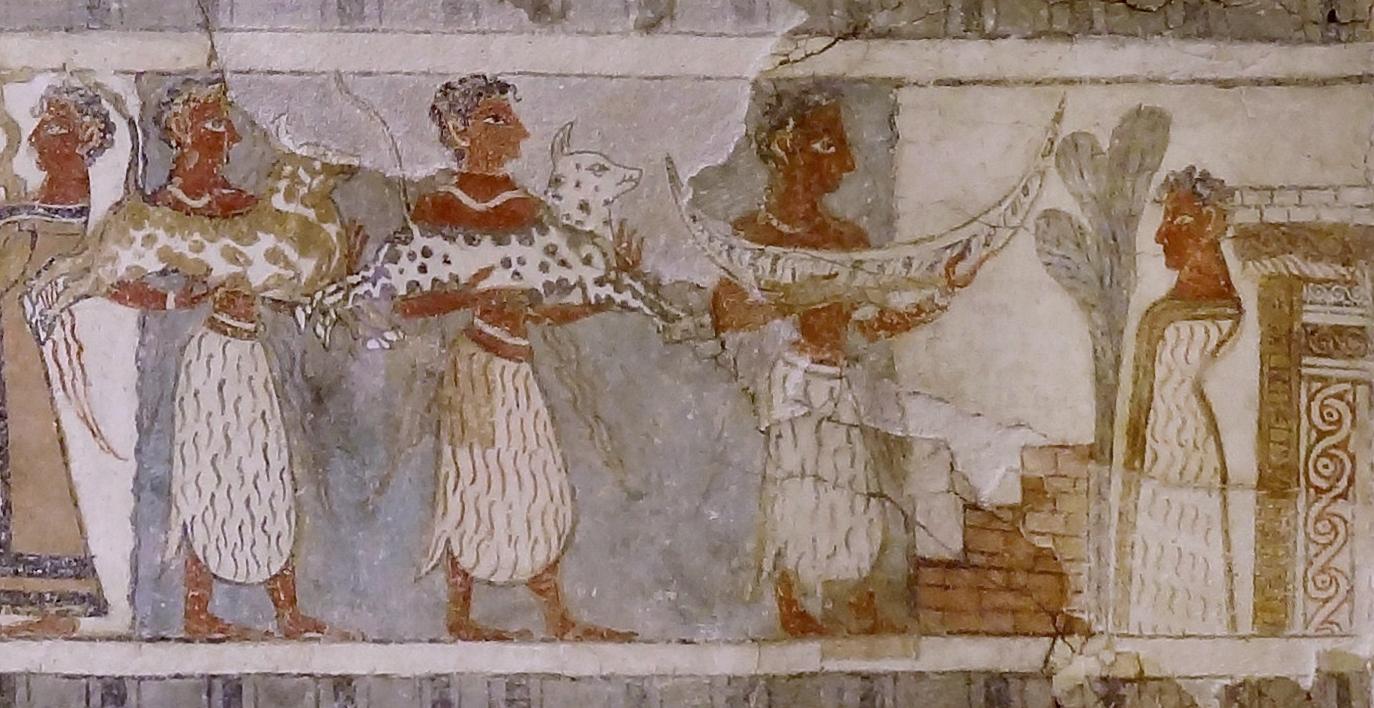
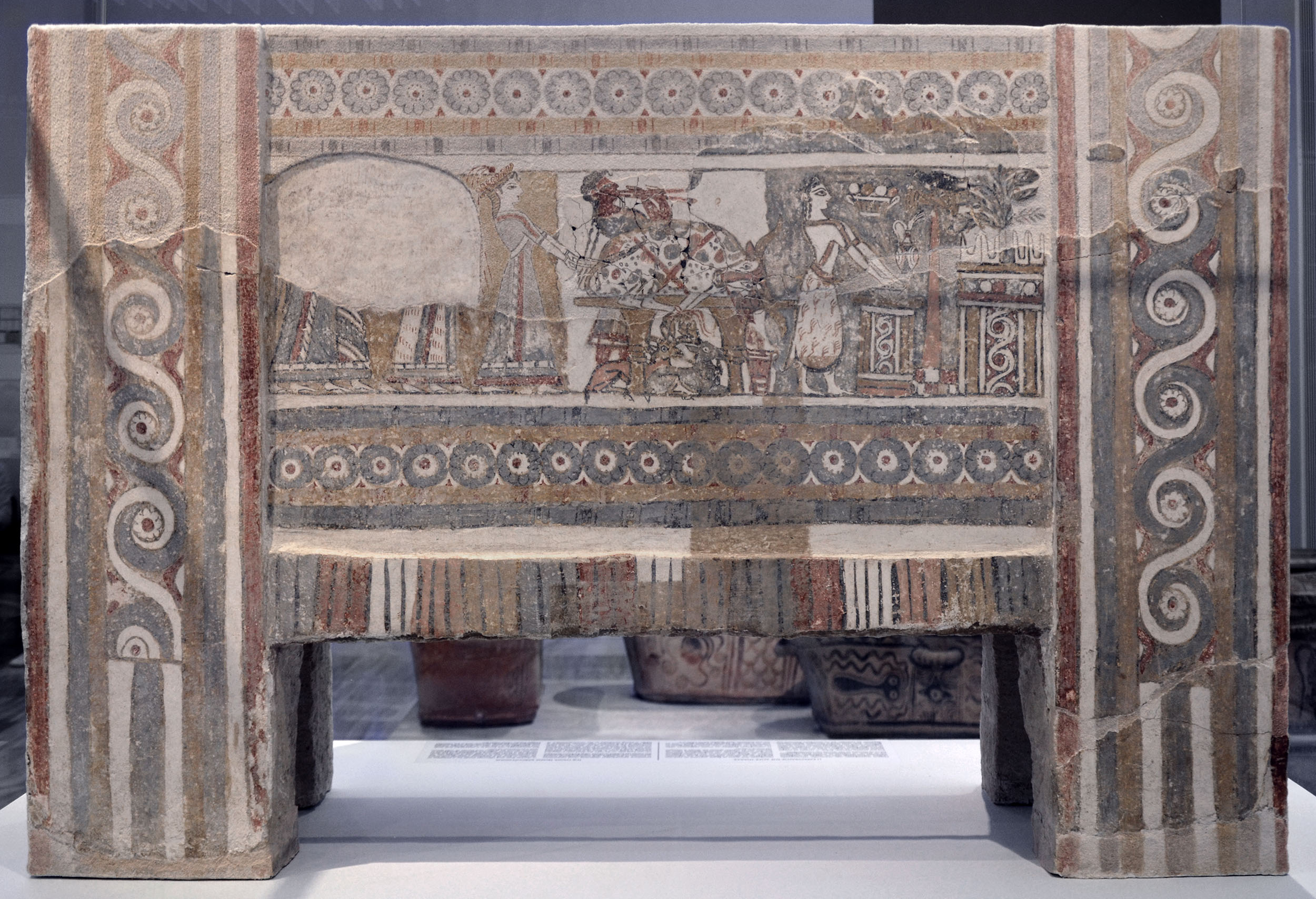
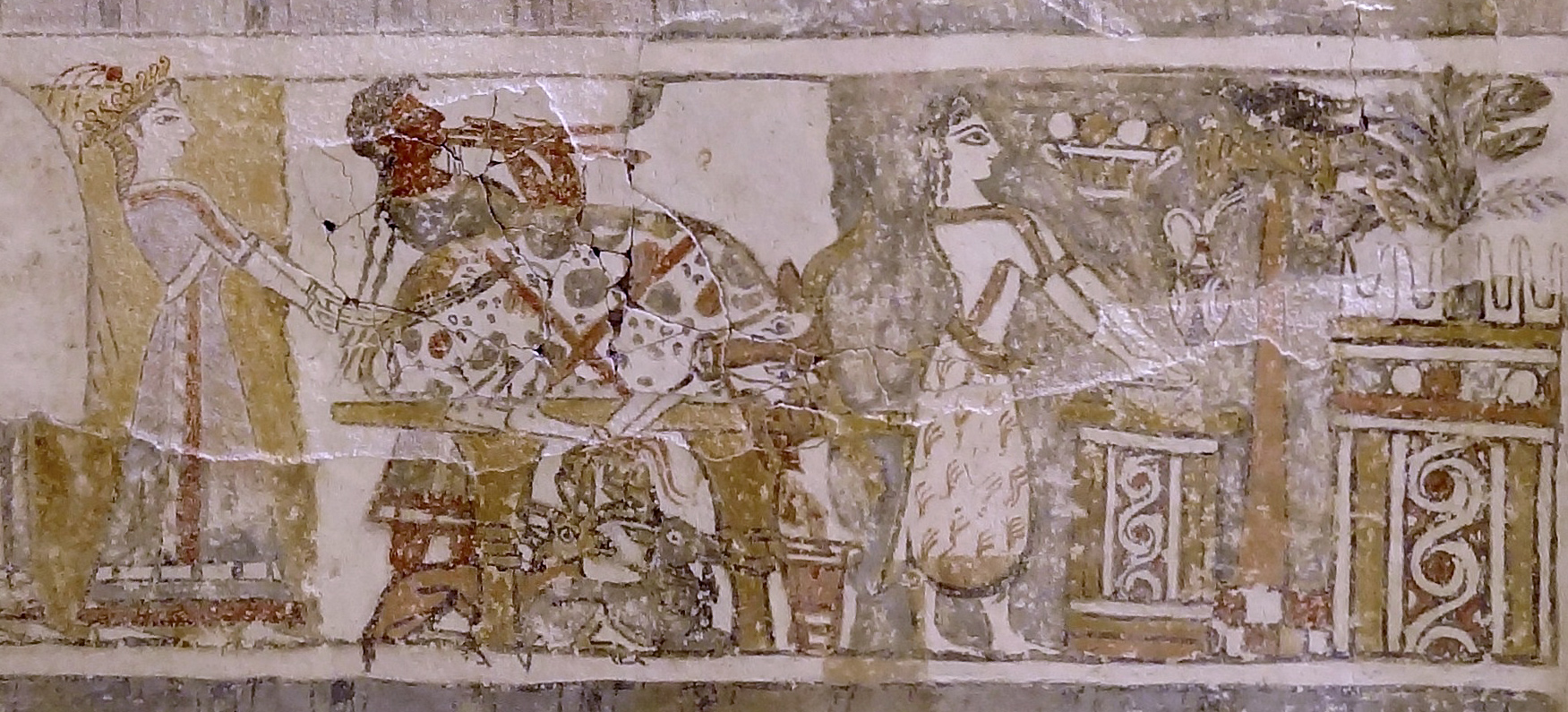
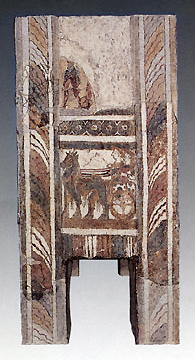
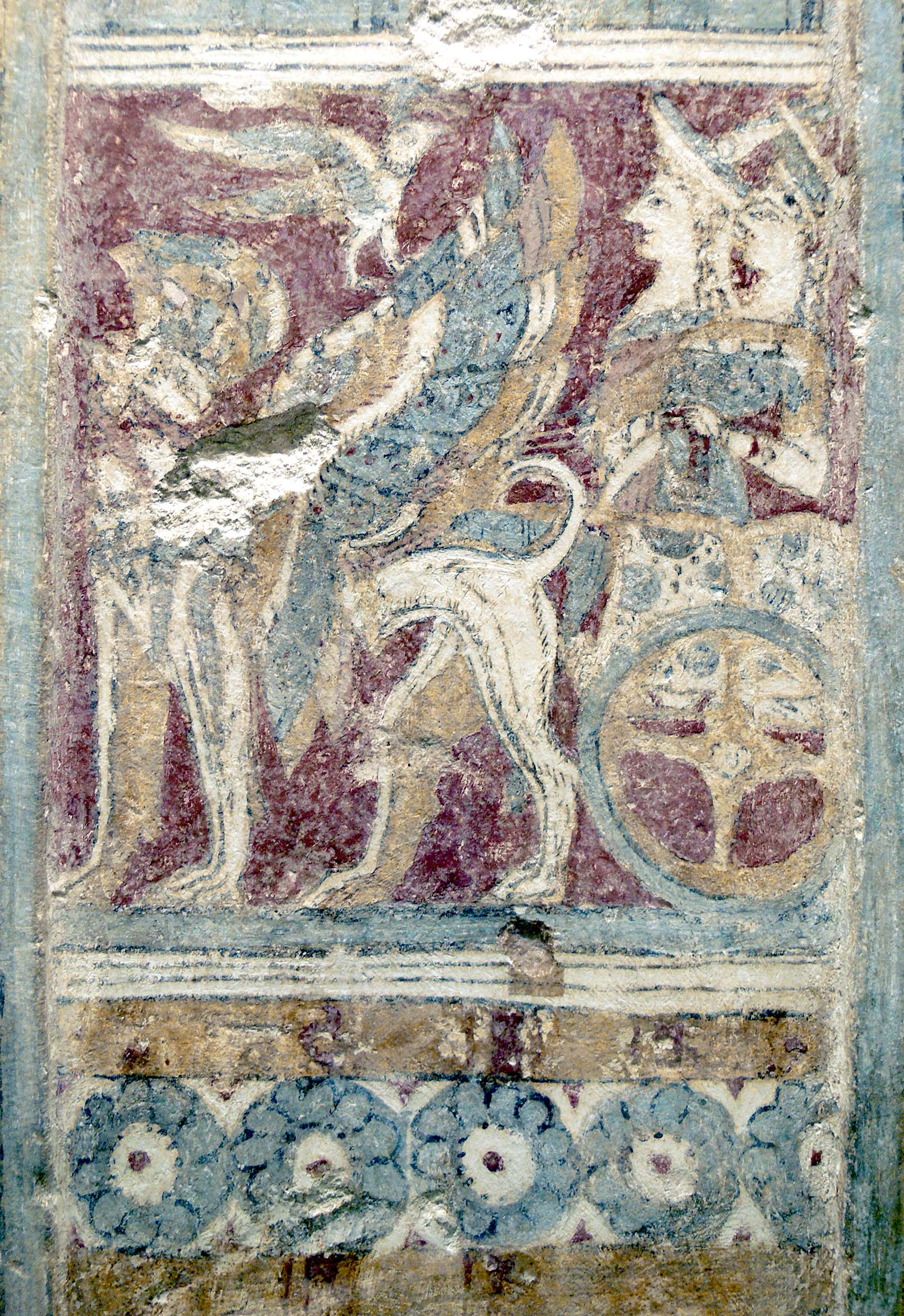
Hagia Triada sarcophagus


Minoan art, an introduction

Map showing Crete (© Google)

The Bronze Age culture of Crete, called Minoan, after King Minos of Crete from Greek mythology, is one of the most vibrant and admired in all of European prehistory.

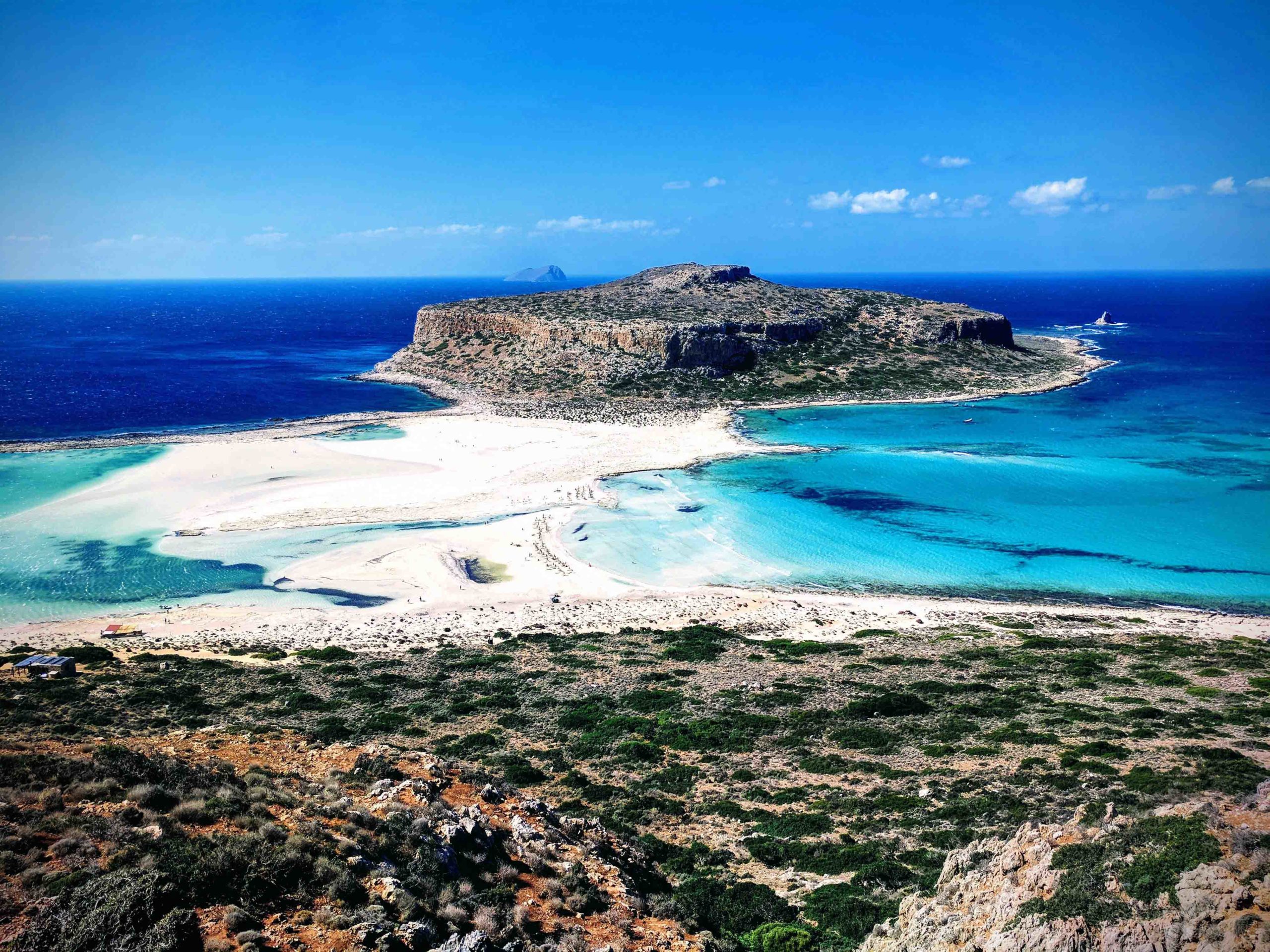
Coastline of Crete in 2017 (photo: belpo, CC BY-NC 2.0)
Coastline of Crete in 2017 (photo: belpo, CC BY-NC 2.0)

The island itself is no doubt part of the story; at the watery intersection of Asia, Europe, and Africa, including snow covered mountain tops, lush agricultural plains, sandy beaches and dramatic gorges, Crete is exceptional for its natural richness and variety.

The archaeological site at Knossos, with restored rooms in the background, Crete (photo: Jebulon, public domain)
The archaeological site at Knossos, with restored rooms in the background, Crete

The Bronze Age history of the island is one of development, increasing influence, and eventual destruction of a culture centered around sites that have traditionally been called palaces (the most famous and largest one of which was Knossos). Therefore, the historical periods of Bronze Age Crete are called the Pre-palatial, Old Palace (or Protopalatial), New Palace (or Neopalatial) and Post-palatial. Within these historical periods there are more specific designations, largely deriving from pottery studies, which use the terms Early, Middle, and Late Minoan. These then divided again into I, II and III and then into A, B and C.

Minoan Chronology

  • Pre-palatial period:  Early Minoan I – Middle Minoan IA (begins c. 3000 B.C.E.)
  • Old Palace or Protopalatial period:  Middle Minoan IB – Middle Minoan IIB (begins c. 1900 B.C.E.)
  • New Palace or Neopalatial period:  Middle Minoan IIIA – Late Minoan IB (begins after 1730 B.C.E.)
  • Post-palatial period: Late Minoan II-IIIC (begins after 1450 B.C.E.)

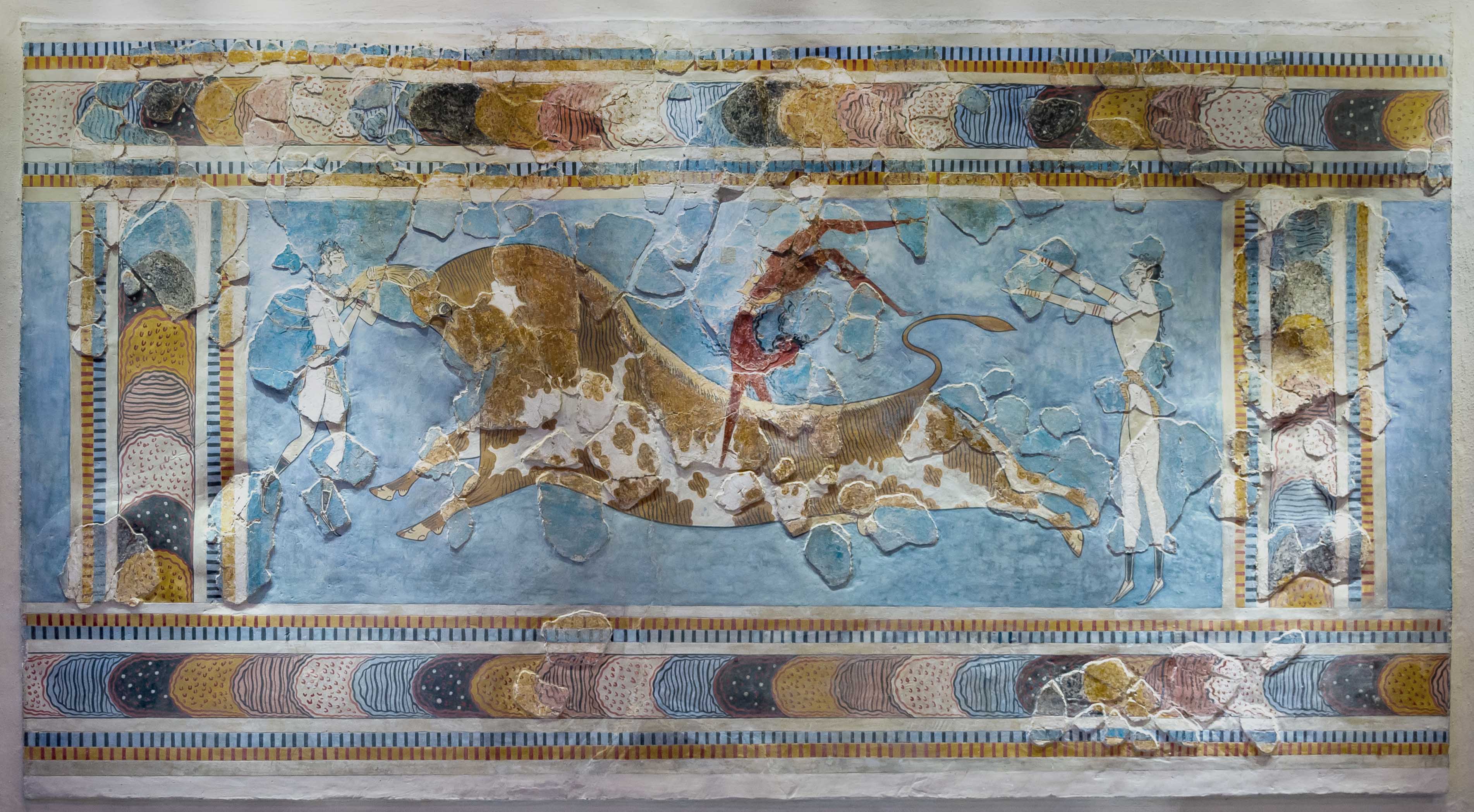
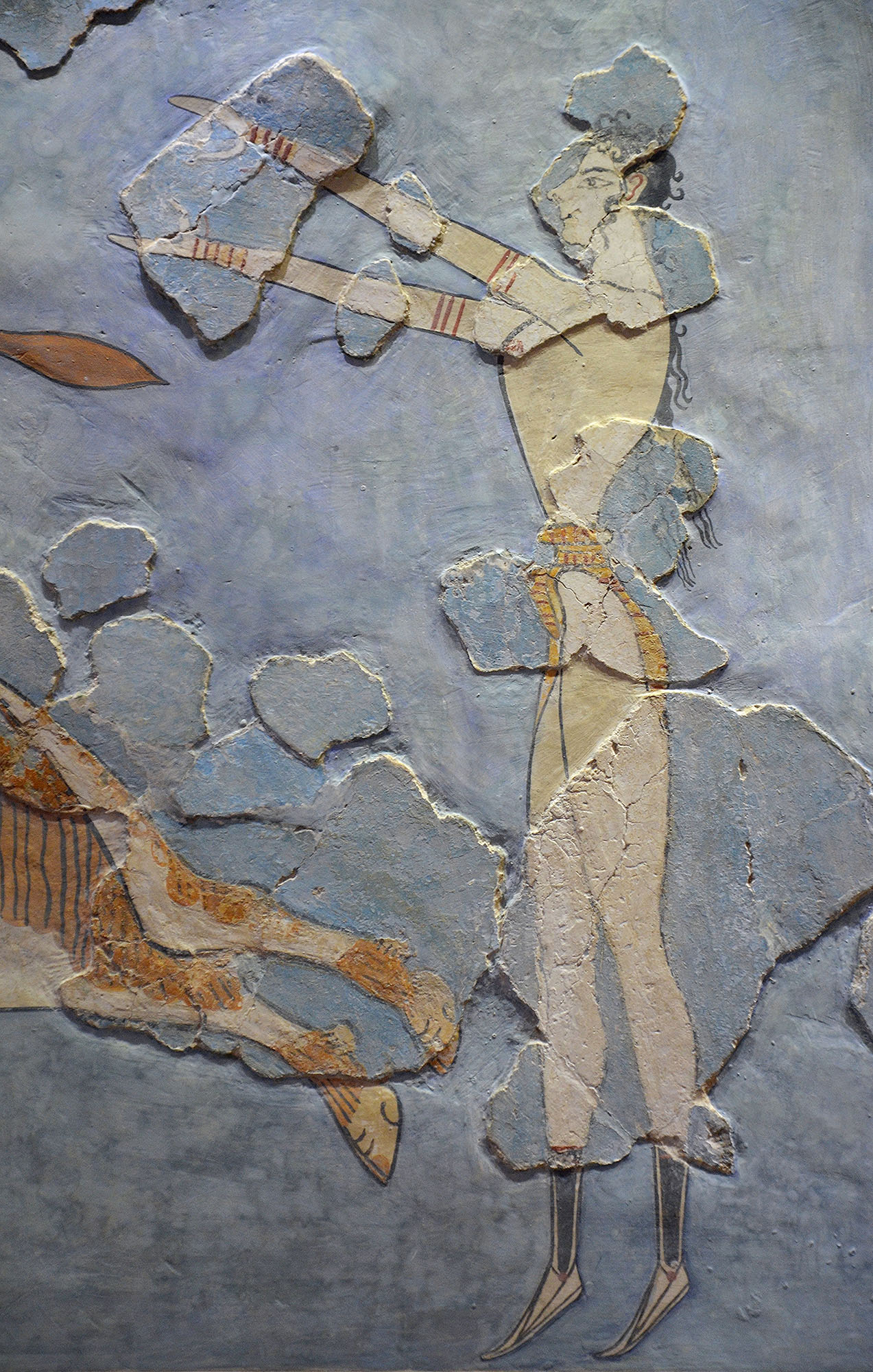
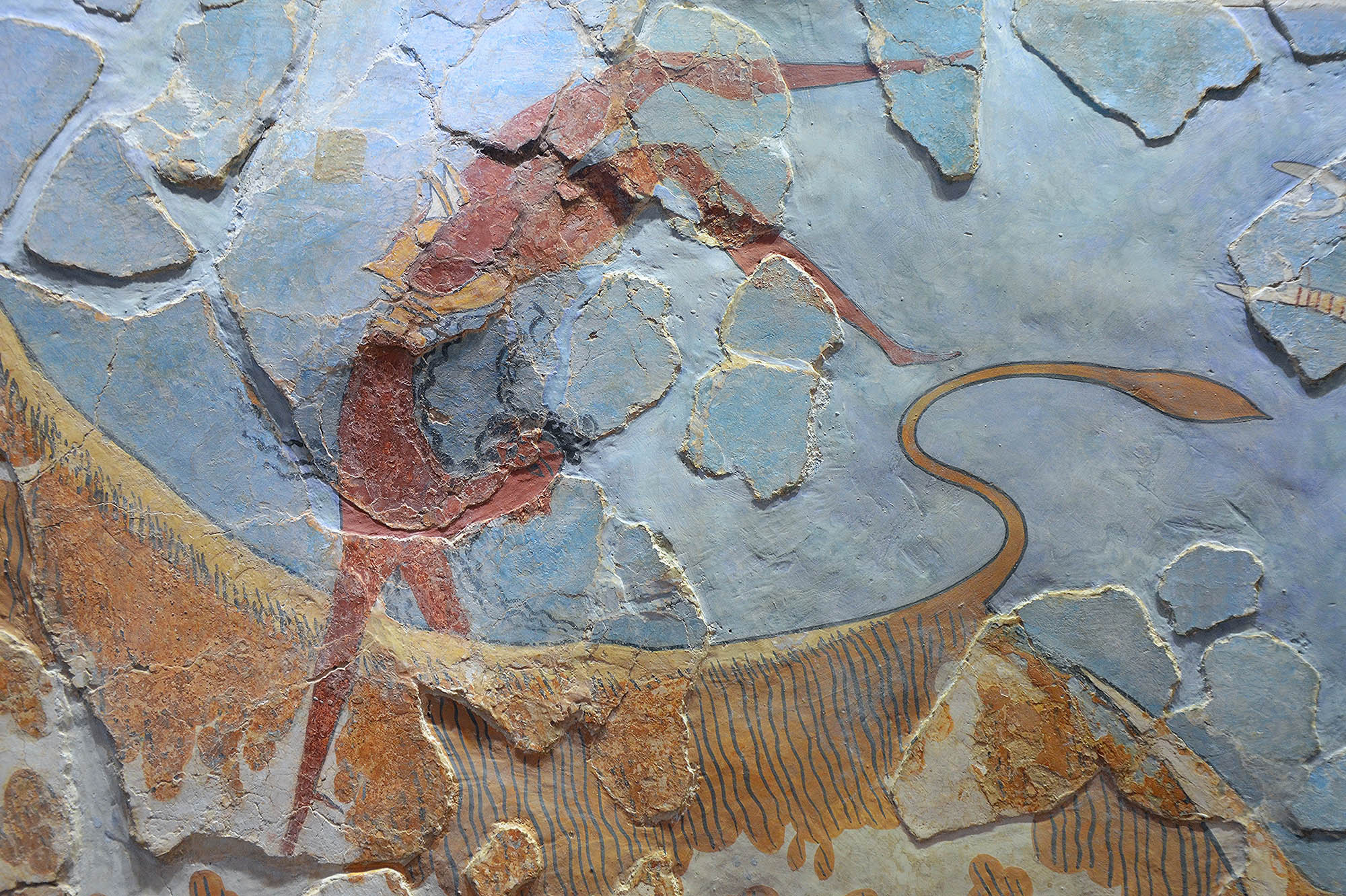
Bull-leaping fresco from the palace of Knossos

Bull-leaping fresco from the east wing of the palace of Knossos (reconstructed), c. 1400 B.C.E., fresco, 78 cm high (Archaeological Museum of Heraklion, photo: Jebulon, CC0)

scripts: hieroglyphic, Linear A, Linear B

Terms and Techniques – Minoan Crete 

  • Architectural and painting terms: dressed stone, ornamental facade, buon fresco, fresco secco , cushion capital
  • Pottery: potter’s wheel, Kamares Ware, Marine style, pithos
  • metalwork terms: lost-wax, inlay, filigree, granulation, gilding, gold leaf, niello, repoussé
  • other terms: “flying gallop” pose, sarcophagus, griffin, toreador, rhyton, faience

Legend of King Minos (Minotaur) – a Greek story told 1000 years later to explain ruins with bull imagery, Sir Arthur Evans (excavator)

Crete – Palaces:   Knossos (labrys – double axe) (maze, “Labyrinth”, “Hall of the Double Axe”), Phaestos, Zakro

Akrotiri, Thera (Santorini) – blew up in 1620s BC

Pre-palatial period

The early Bronze Age history of Crete, the pre-palatial era, began around 3000 B.C.E. This period is marked by large towns, evidence of foreign contacts through trade, as well as very elaborate burial practices: large above-ground multi-use tombs which seems to indicate the existence of elite families. During this period, the skill of Minoan goldsmiths and potters becomes well established, producing finely detailed jewelry and beautiful pottery.

Old Palace or Protopalatial period

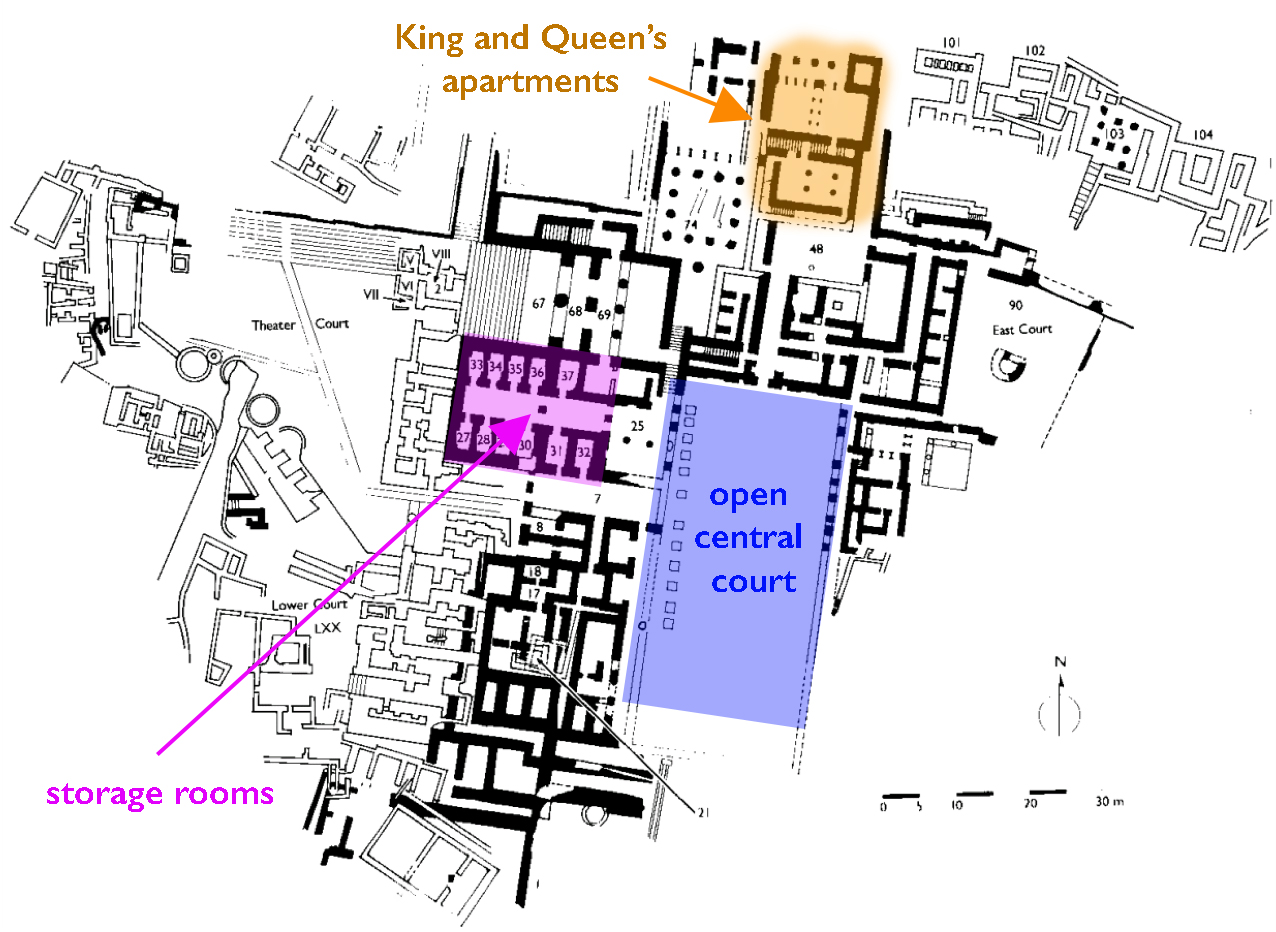
plan of phaistos
Plan of Phaistos, Protopalatial period, showing typical characteristics of this period (open central court, storage spaces, and elite domestic spaces)

By around 1900 B.C.E., at the beginning of the Old Palace or Protopalatial period, the Minoan palaces were established, first at Knossos followed by Phaistos, Mallia, and Chania. Archaeologists have also discovered other smaller palaces at Petras, Galatas, and Monastiraki, although presently these sites are less well excavated and understood. These early palaces are extraordinary not only for the complexity of their construction but their striking similarity to one another, certainly a sign of a central administration of some kind. Built with large cut limestone ashlar blocks, Minoan palaces of the Old Palace period include a large open central court oriented north-south, storage spaces in the west of the structure, and a complex of decorated domestic rooms to the east which often feature elite details such as wall painting and indoor plumbing.

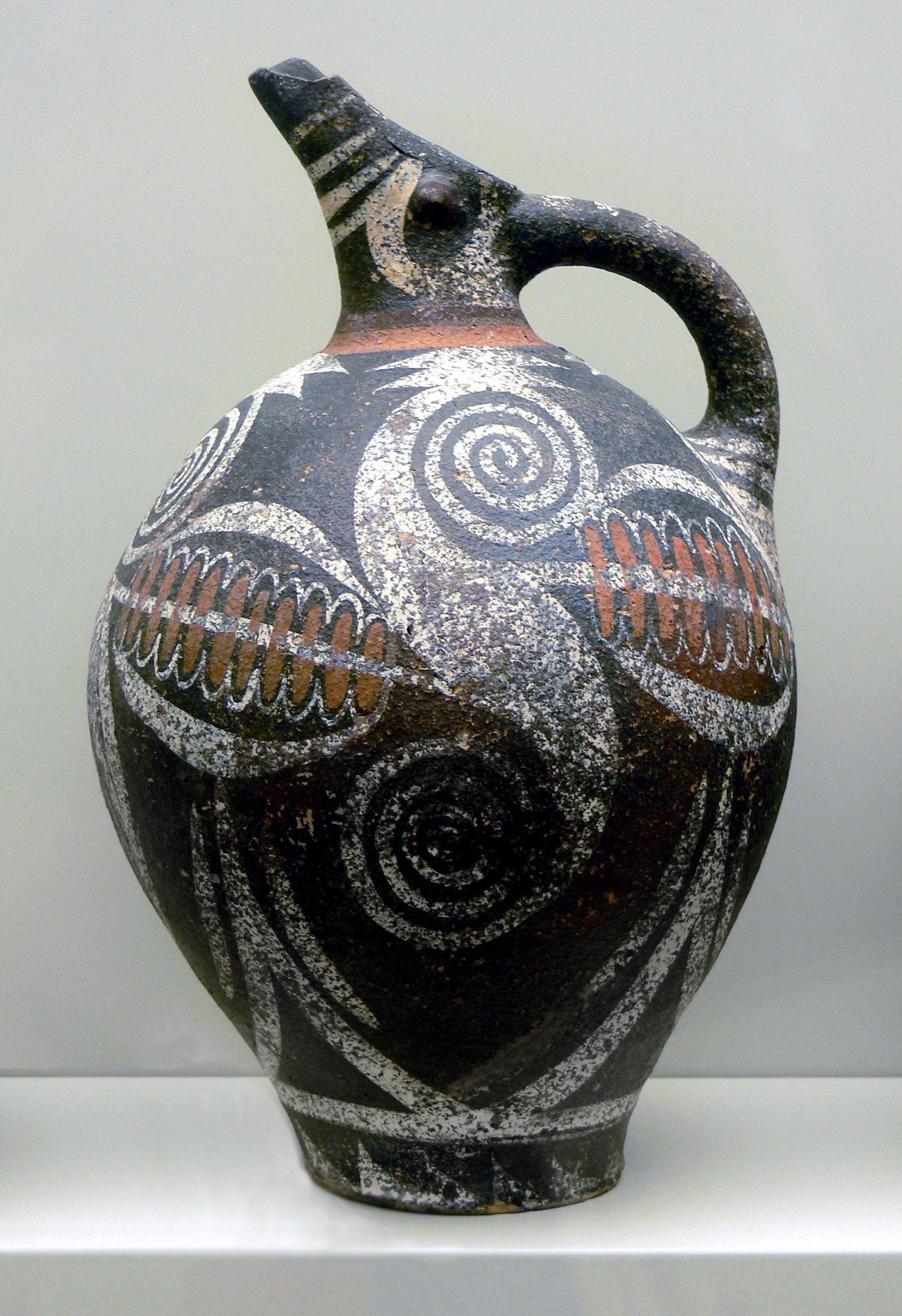
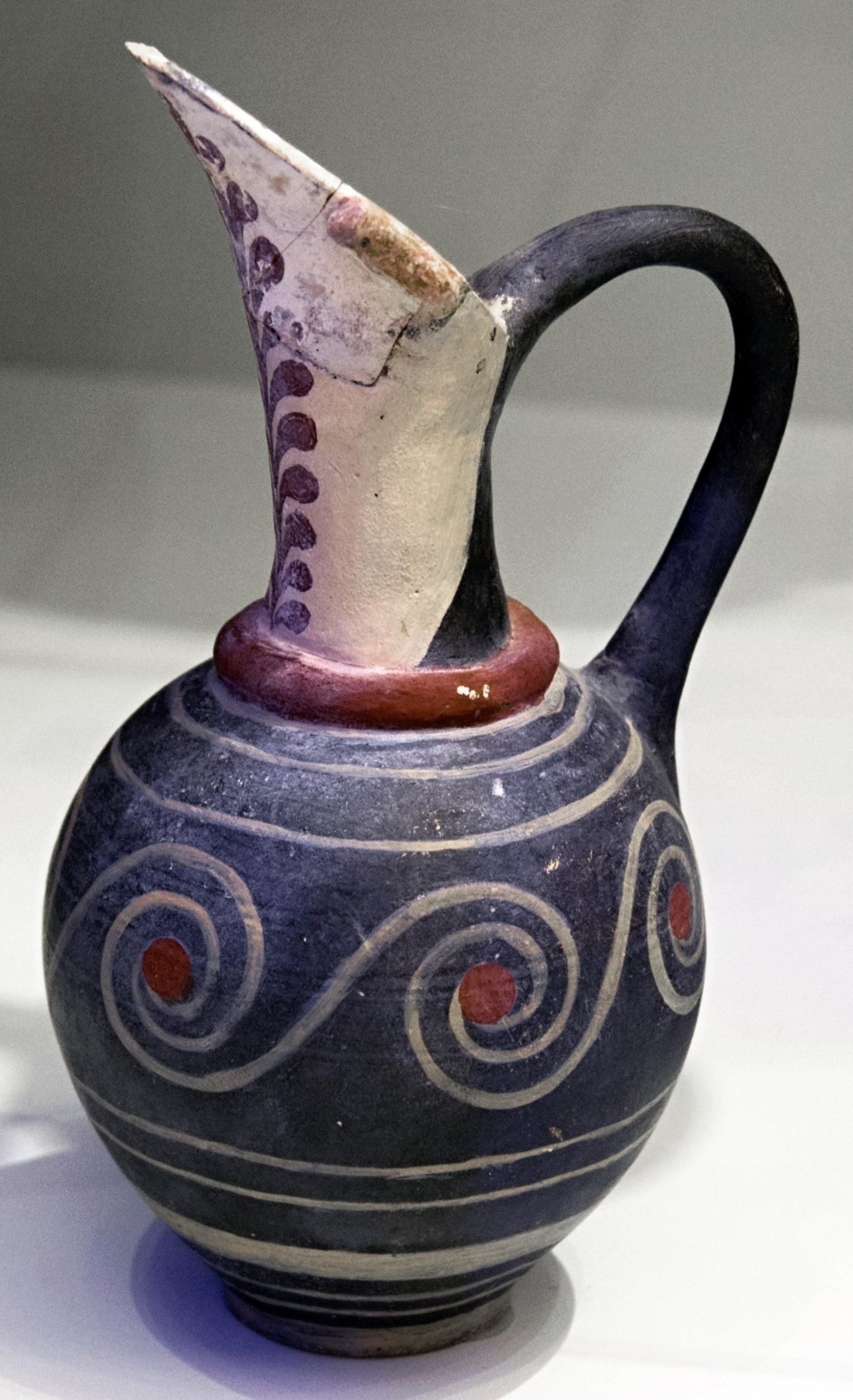
Kamares ware jug from Phaistos, c. 2000-1900 B.C.E., 27 cm (Archaeological Museum of Heraklion, photo: Wolfgang Sauber, CC BY-SA 3.0)
Kamares ware jug from Phaistos, c. 2000-1900 B.C.E., 27 cm (Archaeological Museum of Heraklion, photo: Wolfgang Sauber, CC BY-SA 3.0)

Minoan pottery of this period, Kamares ware, much of it produced in palace workshops, was widely traded and has been found in Kahun and Harageh in Egypt, Ras Shamra in Syria, and several sites on the island Cyprus.

New Palace or Neopalatial period

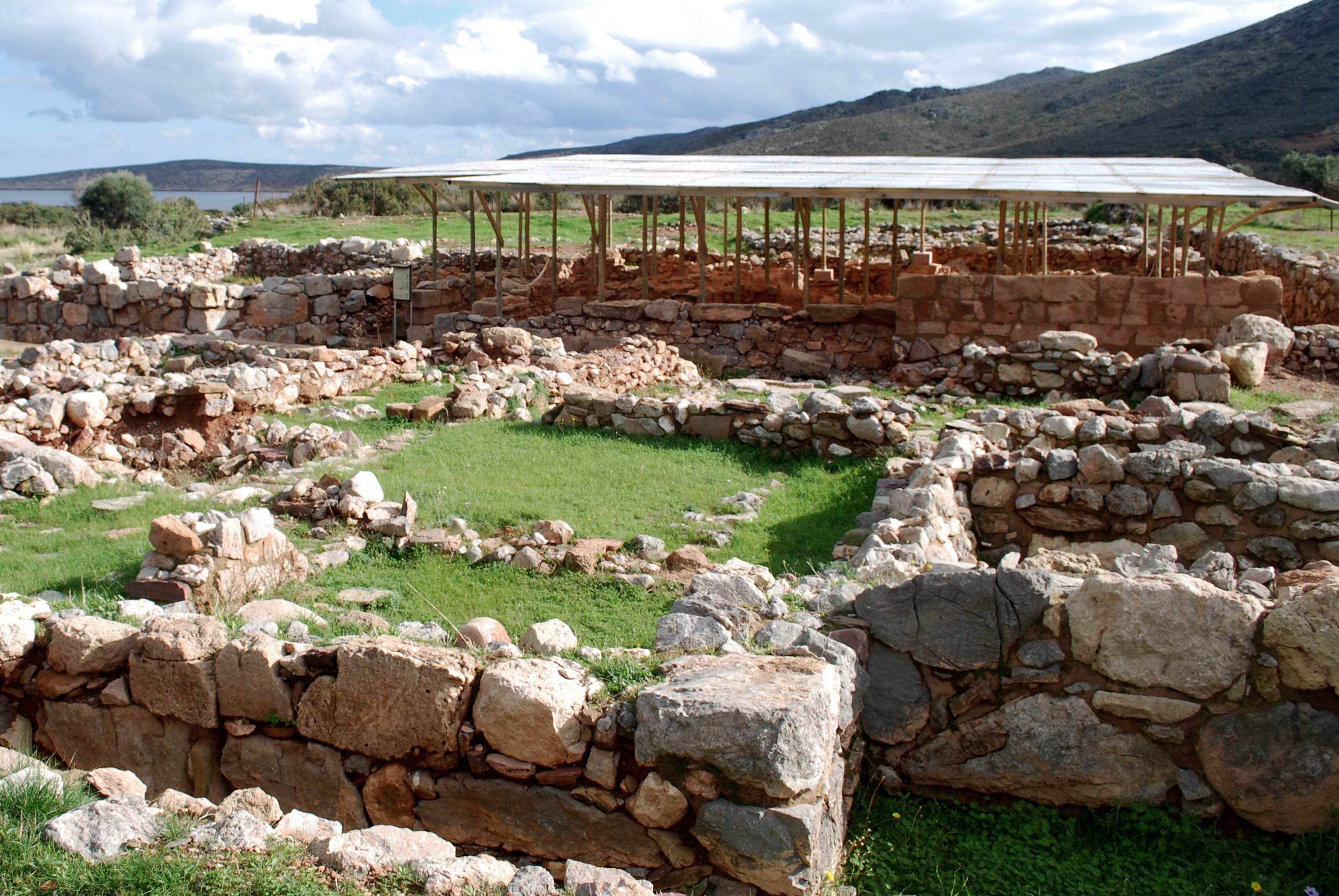
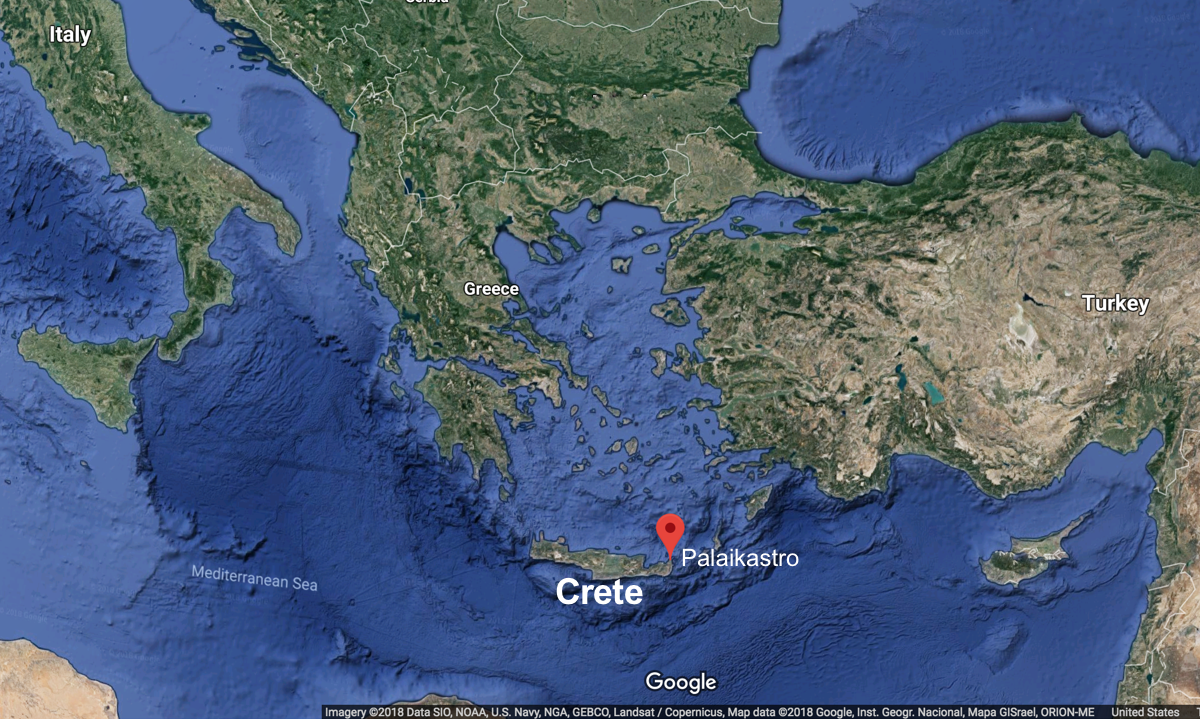
The ruins at Palaikastro (photo: Panegyrics of Granovetter, CC BY-SA 2.0)
The ruins at Palaikastro (photo: Panegyrics of Granovetter, CC BY-SA 2.0)

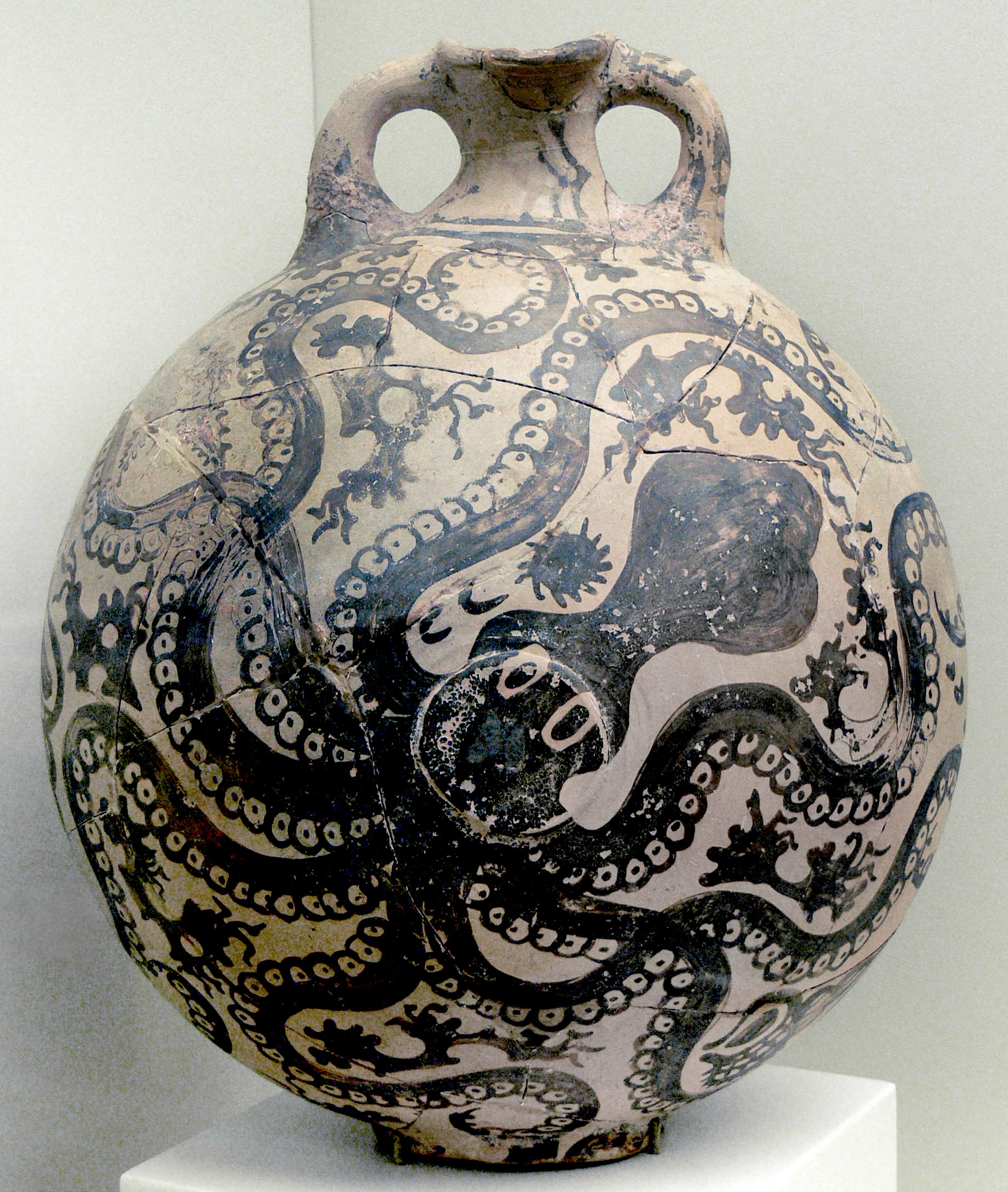
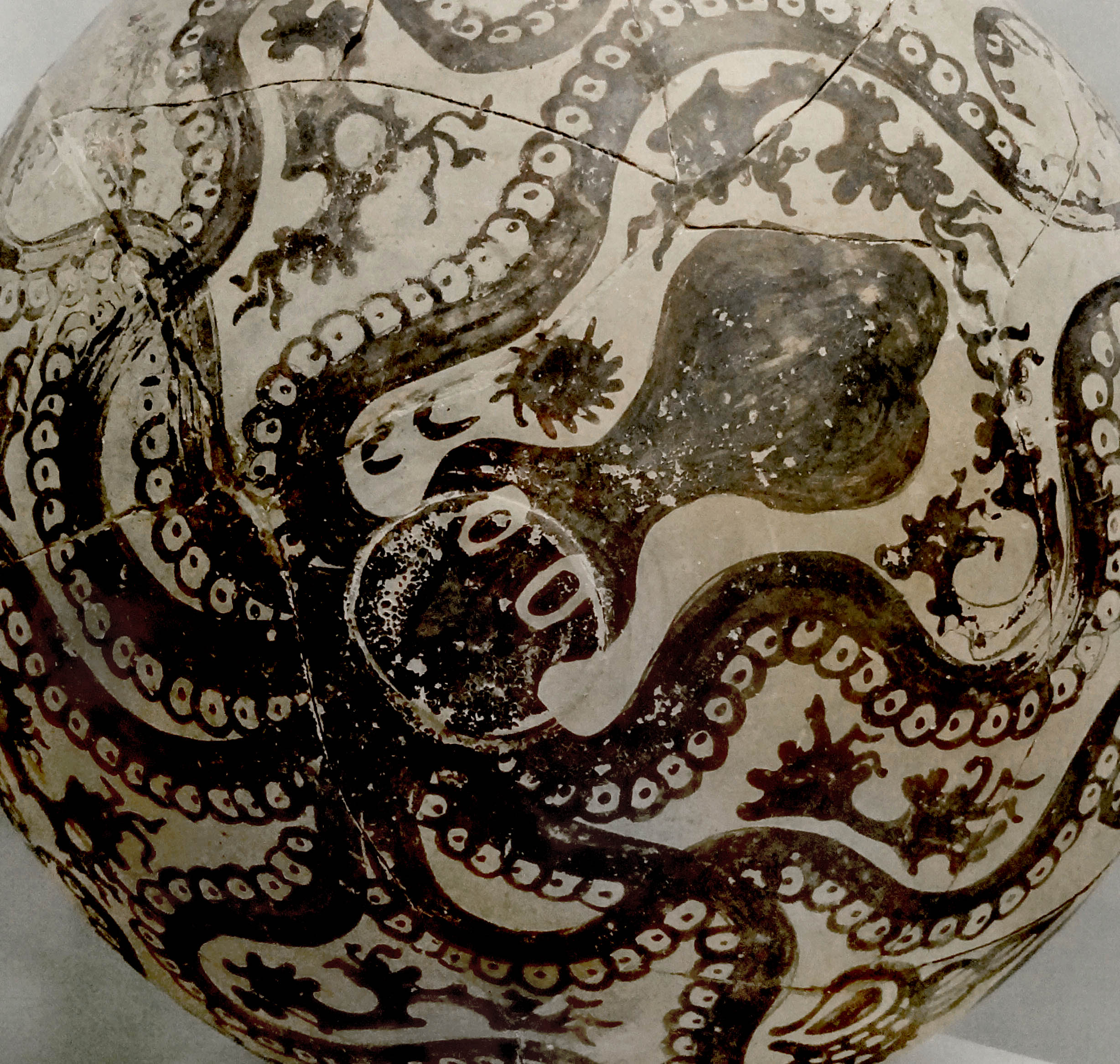
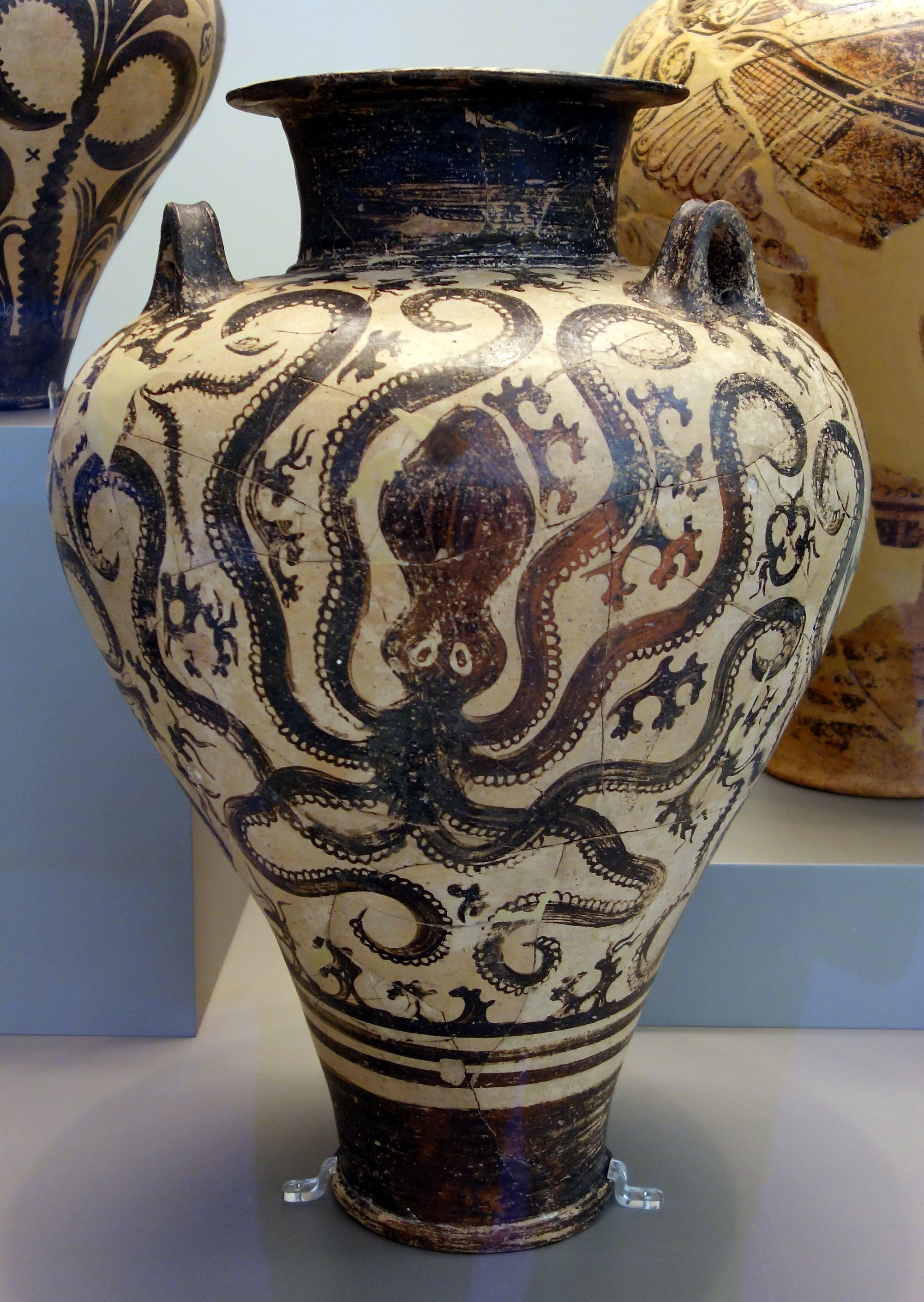
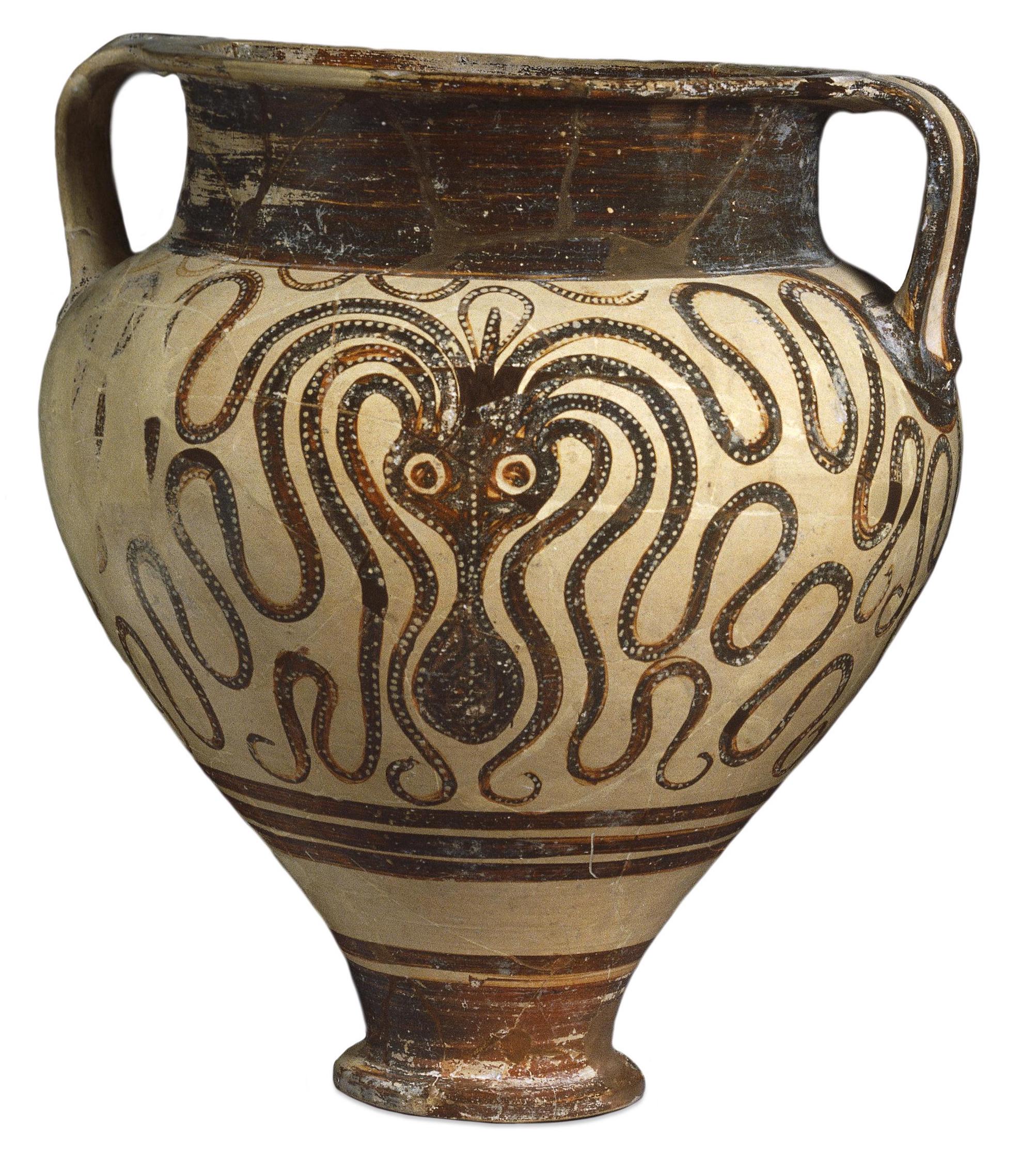
Octopus vase from Palaikastro, c. 1500 B.C.E., 27 cm high (Archaeological Museum of Heraklion, photo: Wolfgang Sauber, CC BY-SA 3.0)

The Old Palace or Protopalatial period of Minoan history ends in a dramatic event, an earthquake, around 1730 B.C.E., which was so severe that the palaces had to be rebuilt, which they were, in an even more grand manner (and a new palace is built at Zakros). This era is referred to as the New Palace or Neopalatial period. Lots of big settlement sites thrive during this era as well, such as Palaikastro, Gournia and Kommos, with close connections to nearby palaces. It is from this period that written documents survive. Clay tablets (marked in a script called Linear A) were used to keep administrative records at the palaces, recorded in a language which has yet to be fully deciphered. Pottery changes at this time as well, to feature marine animals, which perhaps reflects the sea power (thalassocracy) of the Minoans.

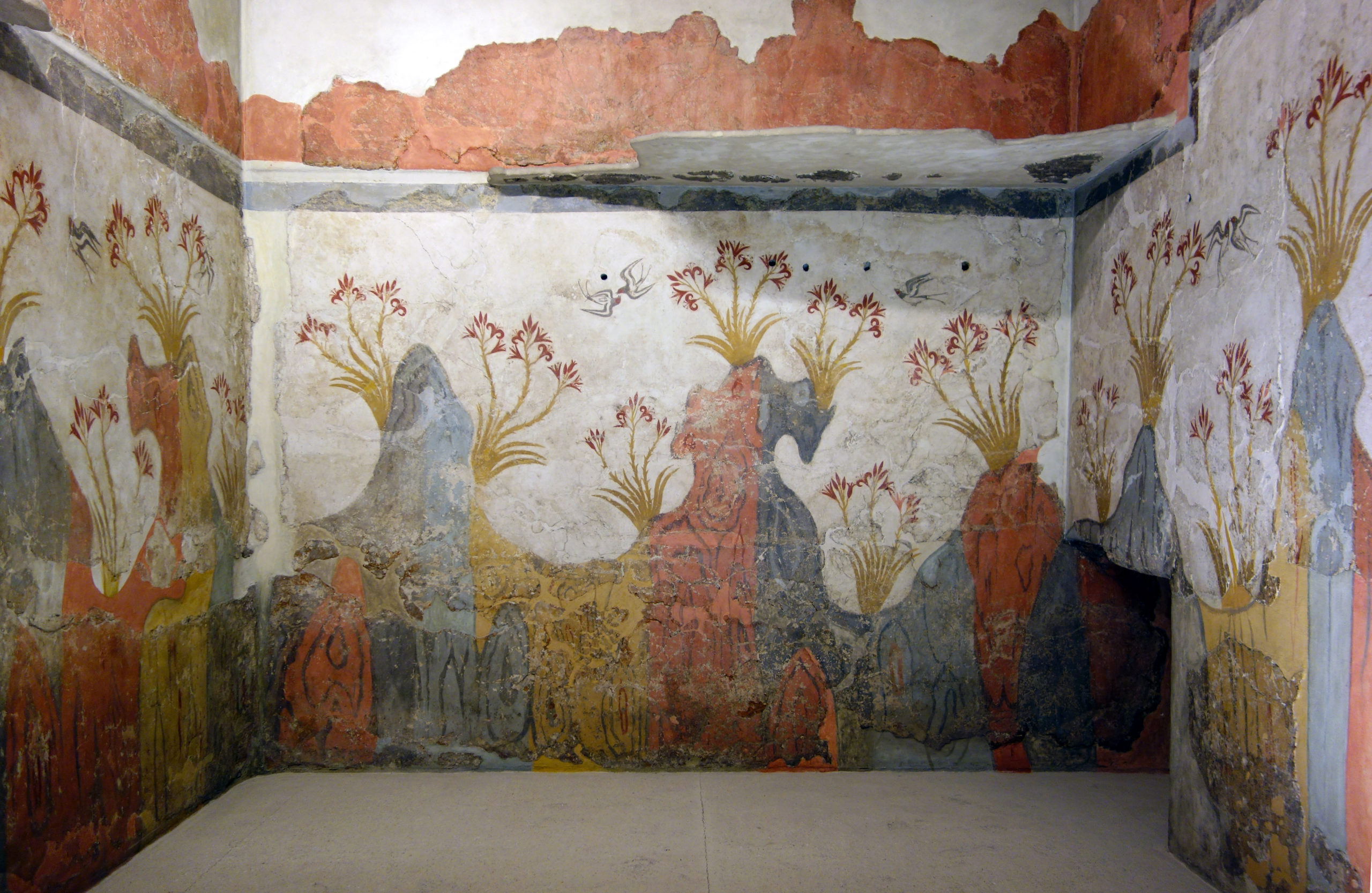
"Spring fresco," Building Complex Delta, room delta 2, west wall from Akrotiri, Thera (Santorini), Greece, 16th century B.C.E.
“Spring fresco,” Building Complex Delta, room delta 2, west wall from Akrotiri, Thera (Santorini), Greece, 16th century B.C.E. (National Archaeological Museum, Athens; photo: Steven Zucker, CC BY-NC-SA 2.0)

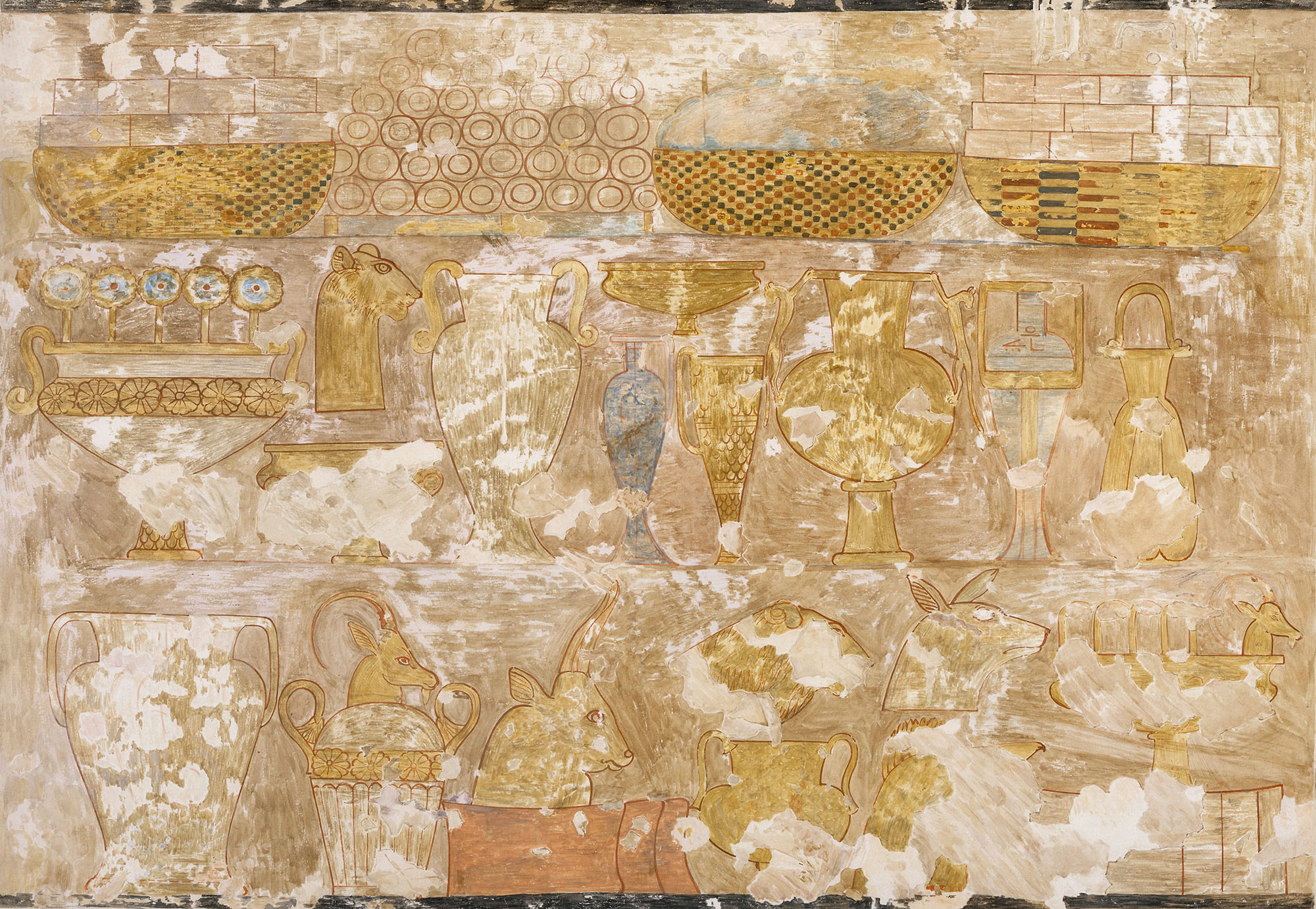
Dating to this period are some of the most remarkable figural frescos of the Aegean Bronze Age, including those from Santorini, an island, very much under Minoan influence. During this era, the Minoans were players in the international politics of the Eastern Mediterranean as recorded in Egyptian tomb paintings of the 18th Dynasty in Thebes, which show Minoans bearing gifts for the Pharaoh.

The New Palace or Neopalatial era flourishes for two centuries. Then, beginning around 1500 B.C.E., Crete saw increasing influence from the Mycenaean culture of mainland Greece. Around 1450 B.C.E., over a period of approximately 50 years, nearly all sites on the island are burned and/or abandoned, including all of the palaces. This dramatic end to such a prominent and dynamic culture is remarkable and still essentially mysterious; was it natural disaster, social upheaval, extended draught, or some combination?

Post-palatial period

Contemporary view of Knossos looking Southwest from the Monumental North Entrance, photo: Theofanis Ampatzidis (CC BY-SA 4.0)

The era following this turmoil on Crete is called the Post-palatial period, which has a distinctively Mycenaean flavor. Knossos and Chania are the only palace sites which are rebuilt although with new Mycenaean architectural forms; this is the period to which the famous throne room at Knossos dates, which looks a lot like the throne rooms at Mycenae, Pylos, and Tiryns on Mainland Greece.

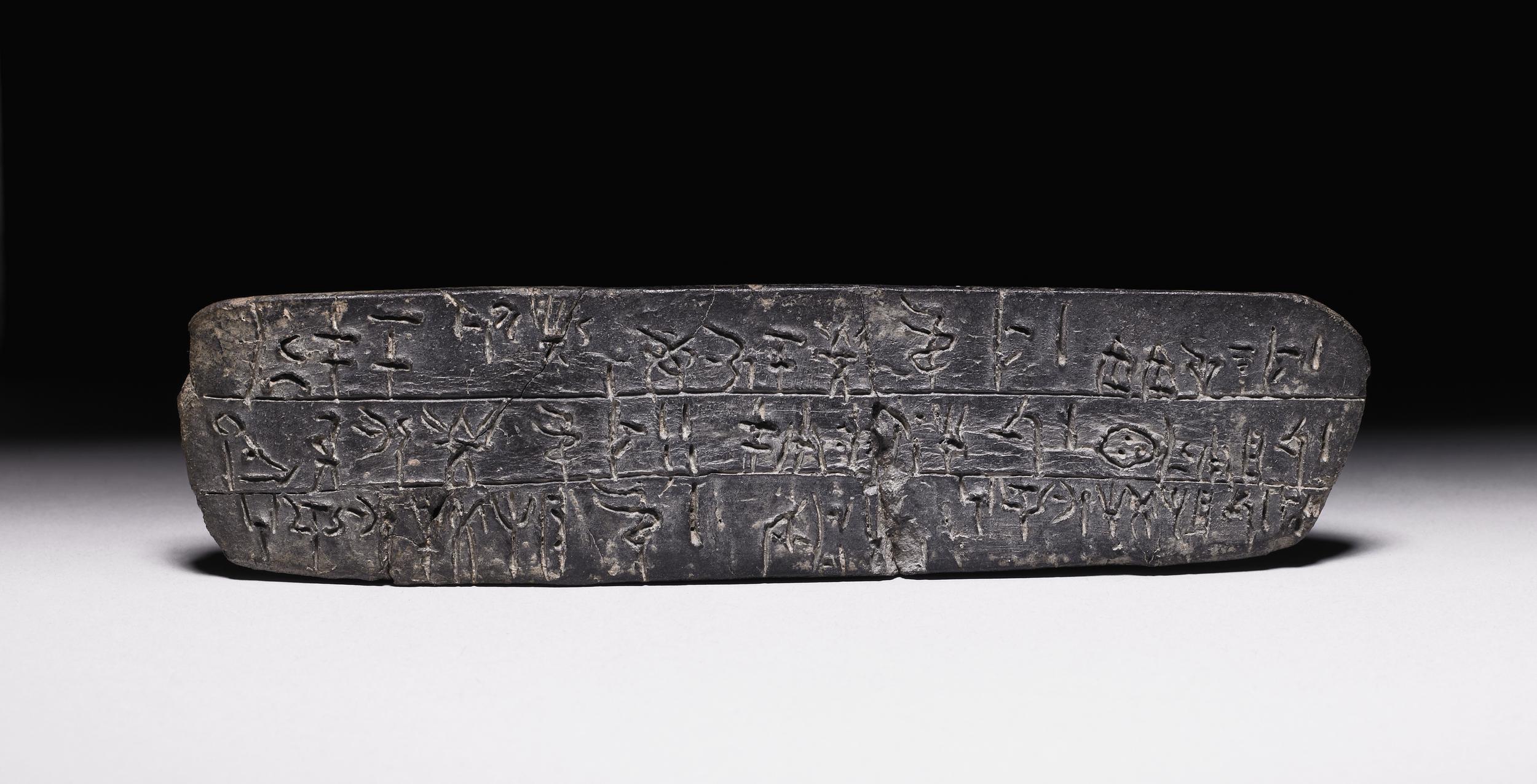
Most importantly in post-palatial Crete, a new script and language is used for administration, Linear B, which records an early form of the Classical Greek language, the same language and script which was used at Mycenaean sites on the mainland of Greece. What the texts describe is a theocratic society with a king (Wanax) and several high officials, priests, and priestesses who oversee religious ceremonies as well as the production of a massive and complex textile industry. This work employed over 700 shepherds harvesting between 50–75 tons of raw wool, woven by nearly 1,000 workers, men, women, and children, who produced some 20,000 individual textile pieces. New to Crete during this period is a warrior grave tradition. We find chamber tombs and shaft graves that include bronze vessels, swords, and daggers with the deceased interred on biers or in wooden coffins.

Tablet with Linear B script (describes oil offered to deities and religious officials), c. 1375 B.C.E.,
Tablet with Linear B script, c. 1375 B.C.E., Late Minoan IIIA, Knossos, Crete (The British Museum, photo: Trustees of the British Museum, CC BY-NC-SA 4.0) The British Museum translated the script as follows: “In the month of Lapatos: To *47-ku-to 1.6 litres oil, to Pipituna 1.6 litres, to Aurimos 6.4 litres oil, to all the gods 9.6 litres, to the augur 9.6 litres, to the priestess of the winds 28.8 litres oil, Itanos to the priestess of the winds 14.4 litres.”

This Mycenaean-influenced period of Crete comes to an end over a period of perhaps 100 years, during which sites are either burned or abandoned. By 1200 B.C.E., the island appears to be radically depopulated with only a very few small and simple settlements high in the mountains with no evidence of writing or even the use of the potter’s wheel.

Cite this page as: Dr. Senta German, “Minoan art, an introduction,” in Smarthistory, August 25, 2020, accessed September 11, 2023, https://smarthistory.org/intro-minoan-art/.
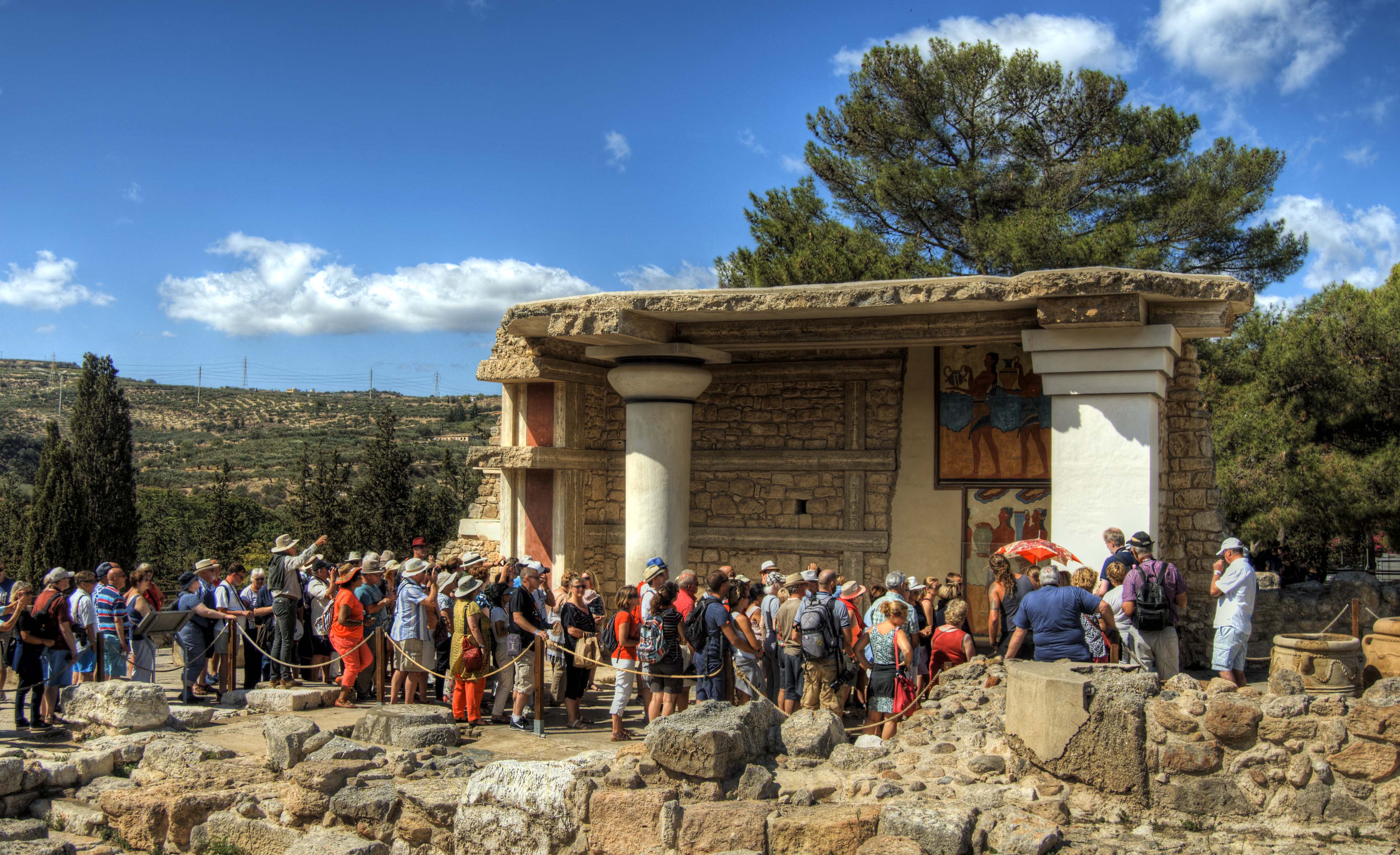
Visitors to Knossos, 2016, photo: Neil Howard, CC BY-NC 2.0
Visitors to Knossos, 2016, photo: Neil Howard, CC BY-NC 2.0

There aren’t many places in the world like Knossos. Situated 6km south of the sea, on the north central coast of Crete, several things make this archaeological site important: its great antiquity (it is 9,000 years old), many different cultural layers (Neolithic through Byzantine), its size (nearly 10 square Km) and its great popularity (the second most visited archaeological site in Greece after the Acropolis at Athens). Aside from these, however, Knossos is also exceptional because of its role in the writing of history. It is the type site for all of Minoan archaeology, was one of the first large-scale scientific excavations in Europe, and contains some of the most contentious restorations in the ancient Mediterranean. Because of all this, Knossos is a critical part of multiple discourses in the history and historiography of the ancient world. We can’t stop talking about Knossos.

Throne Room, Knossos (photo: Olaf Bausch, CC BY 3.0)
Throne Room, Knossos (photo: Olaf Bausch, CC BY 3.0)

A palace?

Bronze Age Knossos is traditionally called a palace, a description used by its most famous excavator, Sir Arthur Evans. Indeed, when Evans, just three weeks after beginning his work at the site, discovered a grandly paved and painted room with a large stone chair set in the wall he believed he had found the throne of Minos and the kings of Crete. This royal interpretation of the site of Knossos stuck. Although it is now clear that the role of Knossos was at least as religious and economic as it was political, it is still just called a palace.

The archaeological site at Knossos, with restored rooms in the background, Crete (photo: Jebulon, public domain)

Early Knossos

The site of Knossos was first inhabited around 7000 B.C.E. and was one of the earliest Neolithic sites in the Mediterranean, settled at a time when pottery had yet to be invented. It continued to be a well-populated site for successive Neolithic eras, one literally building upon another, eventually creating one of the only tell sites of the Aegean, nearly 100 meters above sea level. Unfortunately, not a lot is known about Neolithic Knossos as the Bronze Age inhabitants entirely covered over its remains with their own structures. However, limited excavations show that it was one of the oldest farming villages in Europe which had connections to even earlier Mesolithic inhabitants elsewhere on the island.

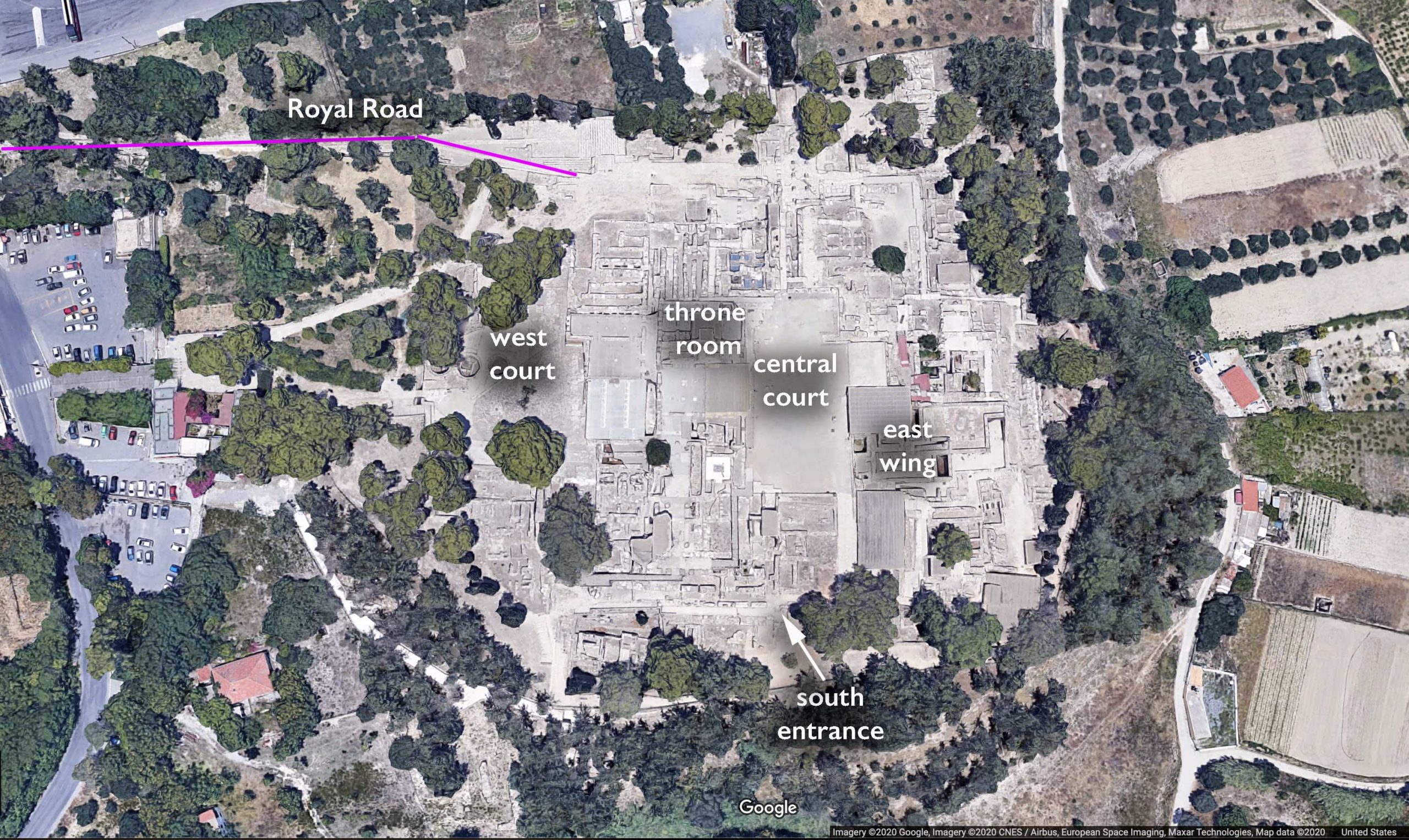
Aerial view of Knossos (underlying map © Google)
Aerial view of Knossos today (underlying map © Google)

Before the palace

The end of the 4th millennium B.C.E. is the beginning of the early Bronze Age at Knossos, a time when the inhabitants learned how to combine tin and copper to make bronze tools and weapons, far more durable than their stone predecessors. Although the palace structure is yet to come, already the buildings on the site have a north-south orientation, as the palace eventually will. Moreover, it appears that ceremonial activity was already common at this time, evidenced by so many specially made and decorated drinking cups. Approximately 1,000 years later, around the end of the 3rd millennium B.C.E., the first large-scale buildings were built at Knossos. The nature and shape of these structures are very difficult to ascertain because the later palace largely obscures them, but already the outline of the large (49 x 27m) rectangular open central court is established.

Standing in the central court today.      View on Google Maps


Protopalatial or Old Palace Knossos

Approximately two hundred years later, at the start of the 2nd millennium (around 1950–1800 B.C.E.) the outline and dimensions of the palace of Knossos emerges and begins what is called the Protopalatial or Old Palace period. The two most distinctive features of this earliest version of Knossos are the long, monumental, cut ashlar stone of the palace’s west façade and the central court, now squared off in the corners and paved. This court functioned as a grand performance space. In this period, a wide paved road, which Evans named the Royal Road, is built. The road connects Knossos to the adjacent town to the west. An entrance system of raised walkways is also built at this time.

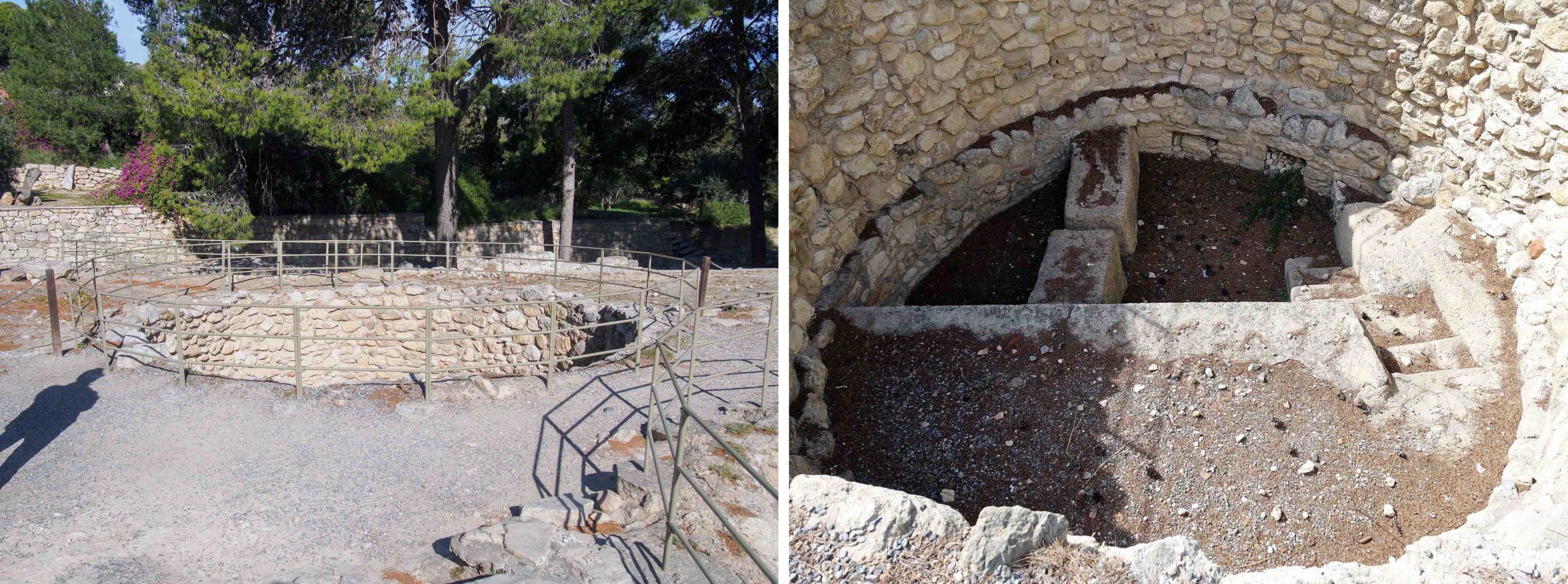
Kouloures, Knossos
Kouloures, or circular stone-lined and plastered pits, Protopalatial Knossos (left photo: C messier, CC BY-SA 4.0; right photo: Olaf Tausch, CC BY 3.0)

Kamares Ware vessels from Knossos, 1800–1700 B.C.E. (Archaeological Museum of Heraklion; photo: Zde)
Kamares Ware vessel from Knossos, 1800–1700 B.C.E. (Archaeological Museum of Heraklion; photo: Zde)

It is clear that, like contemporary ancient Near Eastern temples, storage was an important aspect of Protopalatial Knossos. Long thin storage rooms to the west of the central court are built at this time. In addition, sunk into the open court to the west of the palace were large, deep, circular pits lined with plastered stone, called Kouloures, which archaeologist believe stored grain.

Protopalatial Knossos stored more that raw materials, it also produced finished goods. There is evidence of seal stone carving, weaving, and pottery production (especially Kamares Ware) and likely gold working as well. In this busy place, a written script, Cretan Hieroglyphic, was used to keep records, written on clay tablets and nodules which were attached to containers of goods.  As of yet, the language this script recorded has not been translated.

South Propylaeum, Knossos (photo: Stegop, CC BY-SA 4.0)
South Propylaeum, Knossos (photo: Stegop, CC BY-SA 4.0)

Neopalatial or New Palace Knossos

Around 1700 B.C.E. major renovations are undertaken at Knossos, likely the result of a destructive event, possibly an earthquake. These renovations mark the beginning of the Neopalatial or New Palace period and result in the most characteristic elements of Knossos: the West Court is paved (made by filling in the Protopalatial Kouloures) to be used for public ceremonies, the monumental south entrance (or South Propylaeum) is added to impress visitors.

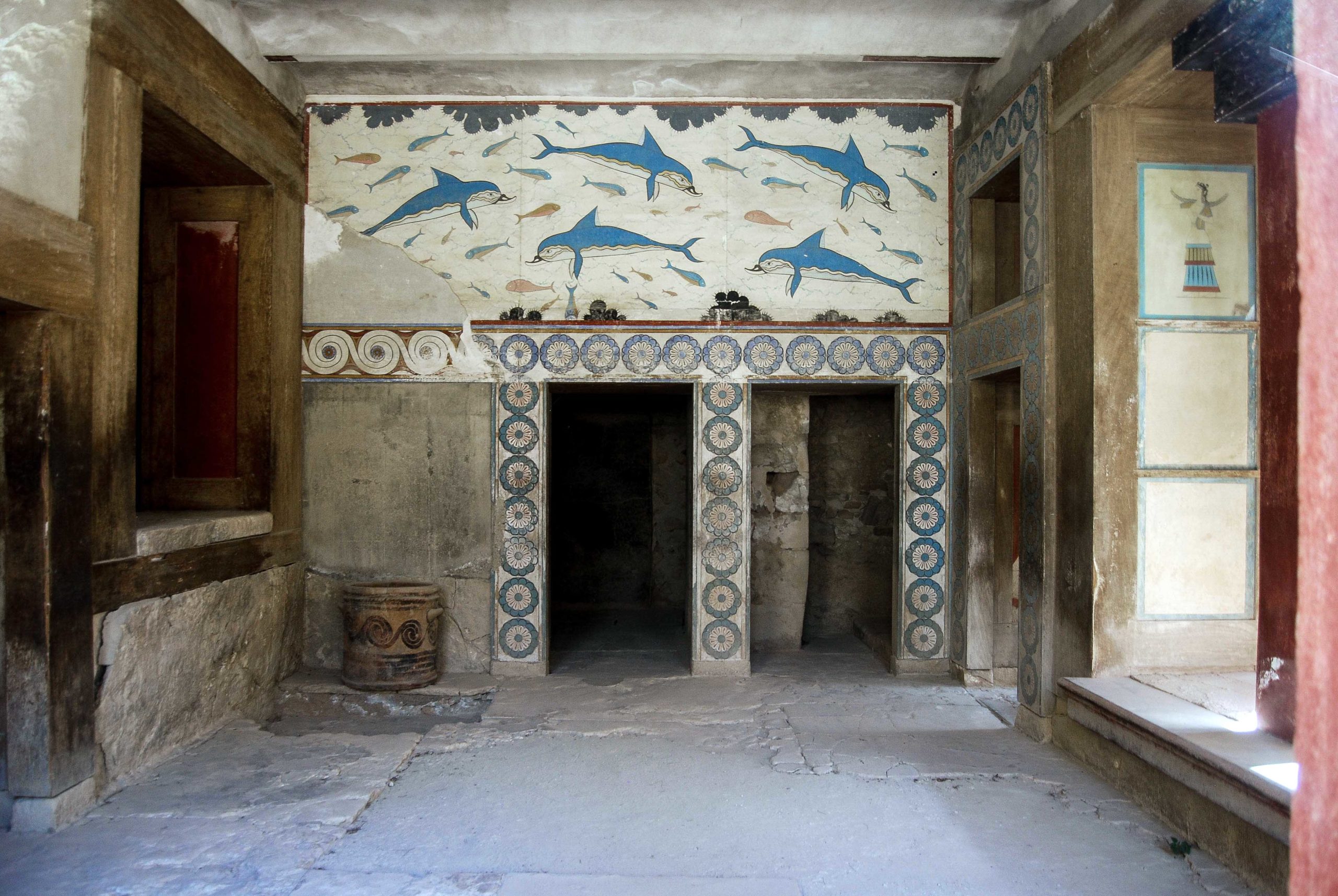
"Queen's megaron," east wing, Knossos (Andy Montgomery, CC BY-SA 2.0)
“Queen’s megaron,” East Wing, Knossos (photo: Andy Montgomery, CC BY-SA 2.0)

The Throne Room with its lustral basin or light well is built to comfortably accommodate the leadership of the palace, and the elegant spaces of the East Wing or Domestic Quarter are constructed, where Evans believed the queen of Knossos passed her time.

Blue monkeys, Knossos
Blue monkey frieze, c. 1580–1530 B.C.E, fresco, found in the House of the Frescoes, room D (today in the Heraklion, Archaeological Museum, Crete; photo: ArchaiOptix)

These new spaces were replete with innovative architectural details including colonnaded staircases, light wells, pier and door partitions, and wall and floor paintings. This was a grand era for painting at Knossos. There were beautiful scenes of the natural world, such as in the Blue Monkey or Partridge Frieze frescoes, as well as miniature scale works such as the Grandstand Fresco, which seems to represent group performances in the West Court.

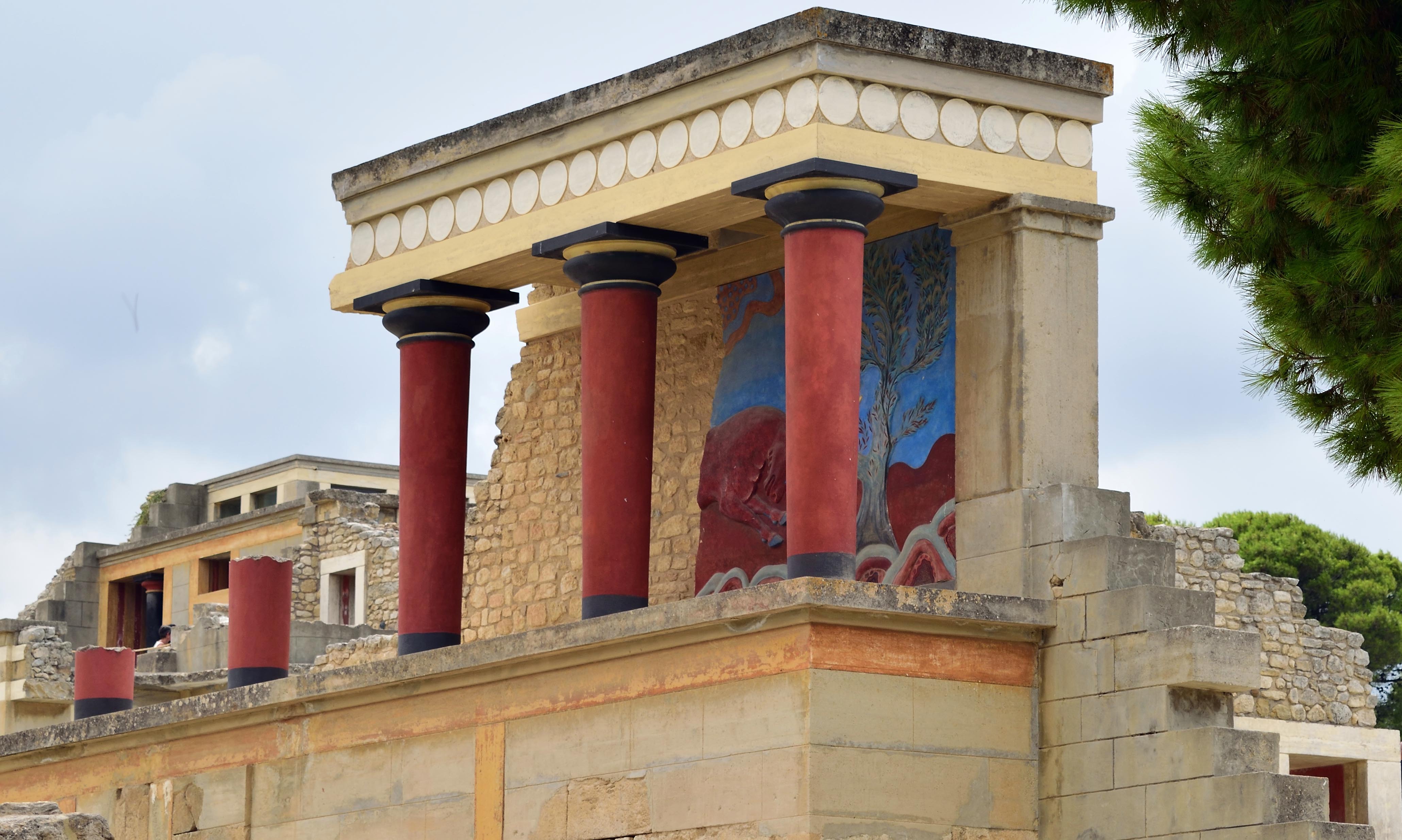
Contemporary view of Knossos looking southwest from the Monumental North Entrance (photo: Theofanis Ampatzidis, CC BY-SA 4.0)
Contemporary view of Knossos looking southwest from the Monumental North Entrance (photo: Theofanis Ampatzidis, CC BY-SA 4.0)
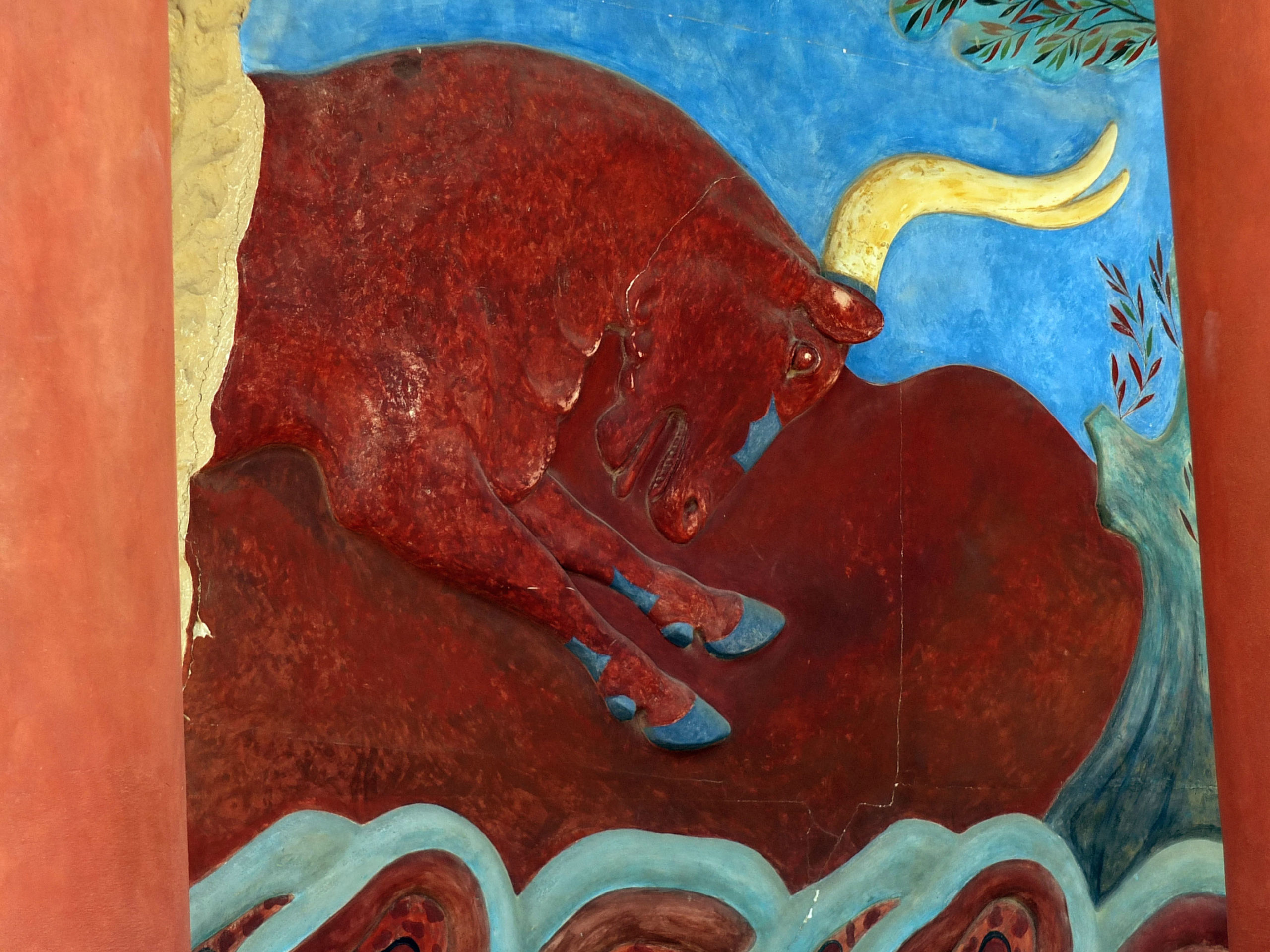
Raging bull, Knossos (photo: Hanes Hiller, CC BY 2.0)
Raging bull, Monumental North Entrance, Knossos (photo: Hannes Hiller, CC BY 2.0)

The monumental North Entrance passage was rebuilt in the Neopalatial period and decorated with a relief wall painting of a raging bull, an image which becomes emblematic of Knossos and Minoan Crete. Pottery production reaches new heights, most famously in the delightful marine style, which some archaeologists believe is a reflection of a Minoan thalassocracy (sea power).

Innovation in the Neopalatial period extends to writing as well: a new script, in addition to Cretan Hieroglyphic, is used at Neopalatial Knossos, Linear A. Although this script also remains largely unreadable, it is clear that it was used for accounting and administration, noting the movement of materials and people between the palace and sites across the island. It also reflects the way in which Knossos and a number of other smaller sites which look very similar to Knossos, and are also called palaces (Malia, Phaistos, Zakros, Monastiraki, Petras, Chania and Galatas) were a focal point for much of the population and labour on Crete at the time. This palatial network not only connected Cretan communities but also maintained trading ties with the Eastern Mediterranean.


Contemporary view of Knossos looking Southwest from the Monumental North Entrance, photo: Theofanis Ampatzidis (CC BY-SA 4.0)
Throne Room with griffins in the frescos on the wall, Knossos (photo: Olaf Bausch, CC BY 3.0)

Postpalatial or Final Palatial Knossos

There are signs that the palace suffered a series of destructions around 1450 B.C.E., at the same time that there are widespread destructions and abandonment of Minoan sites all over Crete. These events begin what is called the Postpalatial or Final Palatial period, which lasts approximately 150 years. Knossos is rebuilt after these destructions but differently. For instance, no more lavish limestone ashlar masonry was cut for the exterior of the palace and new interior walls were erected to change the flow of movement, seemingly to cut off certain areas, such as the West magazines (storage areas), presumably for security. Most importantly, the Throne Room was redesigned in this era to include the griffins seen in the archaeological reconstruction and possibly for the installation of the throne itself.

Bull-leaping fresco from the east wing of the palace of Knossos (reconstructed), c. 1400 B.C.E.
Bull-leaping fresco from the east wing of the palace of Knossos (reconstructed), c. 1400 B.C.E., fresco, 78 cm high (Archaeological Museum of Heraklion, photo: Jebulon, CC0)

Much of the palace interior was repainted in this Postpalatial era and this includes many of the most famous wall paintings from Knossos: the bull leaping or Toreador fresco, the Procession fresco, and the Camp Stool fresco. Pottery produced at Postpalatial Knossos is called Palace Style and is based on Neopalatial predecessors but with a quirky kind of stylization which renders subjects less naturalistic and more pattern-like. Some new pottery shapes are created which appear in imitation of mainland Mycenaean pieces.

Tablet with Linear B script (describes oil offered to deities and religious officials), c. 1375 B.C.E., Late Minoan IIIA, Knossos, Crete
Tablet with Linear B script (describes oil offered to deities and religious officials), c. 1375 B.C.E., Late Minoan IIIA, Knossos, Crete (The British Museum, photo: Trustees of the British Museum, CC BY-NC-SA 4.0)

Postpalatial Knossos is still a place of very complex administration as is described by the hundreds of clay tablets discovered. However, the Linear A script is no longer used; it is replaced by Linear B, which can be read, and records a very early form of Classical Greek, the language of the contemporary Mycenaeans of mainland Greece. The social order described in these tablets is that of a Wanax as the leader of Knossos and a deep administration concerned with land tenure, religious activities, and a massive textile industry which employed over 700 shepherds harvesting between 50–75 tons of raw wool, woven by nearly 1,000 workers, men, women, and children, capable of producing some 20,000 individual textile pieces.

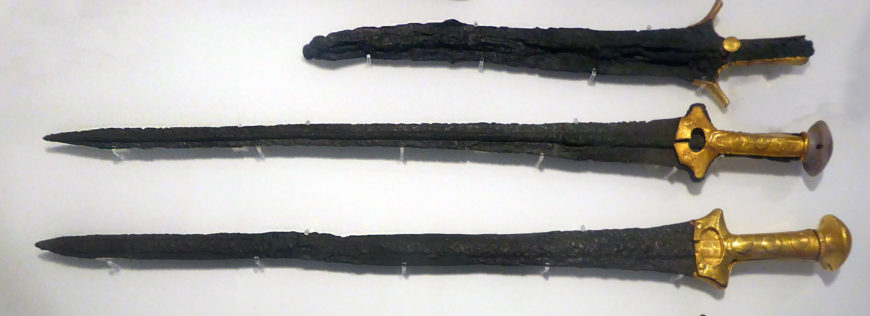
Swords (Archaeological Museum of Heraklion; photo: Hyspaosines, CC BY-SA 2.0)

Knossos was clearly a prosperous city in this period and this can also be seen through a new type of burial at the site: warrior graves. These, sometimes extravagantly constructed, tombs of men and women feature a range of fighting weapons such as swords and thrusting daggers, as well as valuable metal vessels and elegant pottery. These sorts of very rich, well-constructed graves are a tradition which is associated with the mainland of Greece.

Cretan and mainland cultures

A lot about Postpalatial Knossos has a distinct Mycenaean flavor and this fact has led many archaeologists to conclude that the destructions at the beginning of the period were actually the Mycenaeans invading the island. However, many Minoan elements remain in Postpalatial culture, and obvious signs of warfare which would have resulted from a large-scale invasion have yet to be found. Therefore, we now like to think of the Postpalatial period at Knossos as one of a hybrid, between Cretan and Mainland cultures, likely created by a local elite who wished to maintain status in both spheres. As to who exactly these local elite were, we have some information. Those buried in warrior graves in the Postpalatial cemeteries around Knossos were born in the region, as recent analysis of skeletal materials has shown. The new Knossian elite did not come from the Mycenaean mainland.

Knossos collapses . . . and rises again

Towards the end of the Postpalatial period Knossos’ status relative to other sites (especially to the south and west) on the island seems to wane. Eventually there is a massive destruction, collapse, and fire at the palace around 1300 B.C.E. From that point there is little reoccupation within the most important parts of the palace, although there is some small-scale reoccupation around its periphery.

Knossos wasn’t down for long. Rapidly after the late Bronze Age collapse a large Early Iron Age settlement emerged north of the palace and was clearly cosmopolitan as it was the only site of the period in Greece with imports ranging from the Middle East to Sardinia. This area eventually develops into a Classical Greek polis (city-state) and in the 1st century B.C.E. suffers Roman conquest. Beautiful mosaics survive from a 2nd century C.E. Roman home, the Villa Dionysos, evidence of the thriving Roman city at the site. A large Christian church is built at the north edge of the site in the 6th century, witness to the Byzantine history of Knossos.

Additional resources

Knossos at UNESCO

Minoan Crete from The Metropolitan Museum of Art’s Helbrunn Timeline of Art History

Arthur Evans archive (Oxford University)

Source: Dr. Senta German, “Knossos,” in Smarthistory, September 19, 2020, accessed September 9, 2024, https://smarthistory.org/knossos/.

Restoration versus conservation: the Palace at Knossos (Crete)

by Dr. Senta German
“Palace” at Knossos, Crete (photo: Jebulon, public domain)
The archaeological site at Knossos, with restored rooms in the background, Crete (photo: Jebulon, public domain)

Restoration versus conservation

What happens to an archaeological site after the archaeologist’s work is completed? Should the site (or parts of it) be restoredto what we believe (based on evidence) it once looked like? Or should the site be protected through conservation and left as is? A visit to an unrestored archaeological site can be uninspiring—even the most lavish ancient sites can appear to be piles of unorganized stones framed by broken columns and other fragments. And while modern conservation principles insist on the reversibility of any treatment (in case better treatments are discovered in the future), in the past, conservators didn’t have the resources or science that is available today.
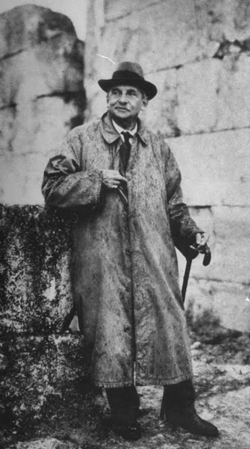
Sir Arthur Evans, 1911

Knossos

The archaeological site of Knossos (on the island of Crete) —traditionally called a palace—is the second most popular tourist attraction in all of Greece (after the Acropolis in Athens), hosting hundreds of thousands of tourists a year. But its primary attraction is not so much the authentic Bronze Age remains (which are more than three thousand years old) but rather the extensive early 20th century restorations installed by the site’s excavator, Sir Arthur Evans, in the early twentieth century.

Archaeological restorations offer important information about the history of a site and Knossos doesn’t disappoint—one can see the earliest throne room in Europe, walk through the monumental Northern entrance to the palace, marvel at colorful wall paintings and enjoy the elegance of a queen’s apartments. All these spaces, however, are the result of extensive, contentious and, in some cases, damaging restoration. Knossos asks us to consider how we can preserve an archaeological site, while at the same time providing a valuable, educational experience for visitors that nonetheless remains true to the remains.

Considering Evans’ reconstructions

The Evans restoration at Knossos are important for several reasons:

1. If Evans hadn’t worked to preserve and restore so much of Knossos beginning in 1901, it would have undoubtedly been largely lost.

2. The restoration of the site undertaken by Evans, with its elegantly painted Throne Room (below) makes very real our historical understanding, originally revealed by Homer, of the power and prestige of the kings of Crete.

3. The beautiful, although sometimes inaccurate, restorations of architecture and wall paintings by Evans evoke the elegance and skill of Minoan architects and painters.

These are the undeniable benefits of Evans’s restorations and among the aspects of a visit to Knossos that everyone values. It is the smooth corniced walls, bright paintings, and whole passages stepped with balustrades at Knossos that the post cards, camera snaps, and human memory preserve, and that has translated into important support for the site—intellectually, politically, and financially.
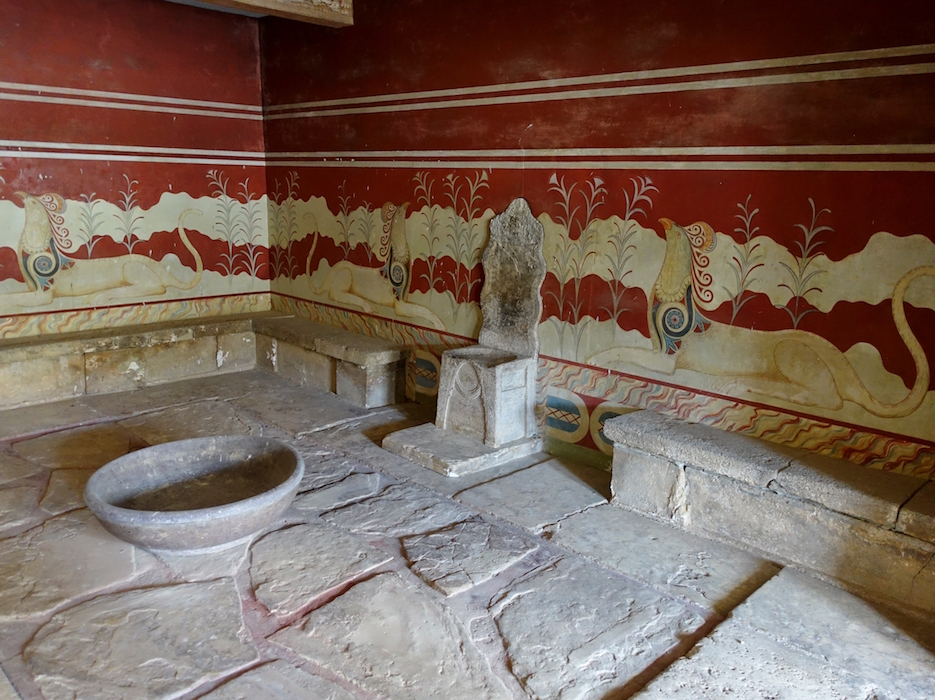
Throne Room, Knossos (photo: Olaf Bausch, CC BY 3.0)
Throne Room, Knossos (photo: Olaf Bausch, CC BY 3.0)

At the same time, the Evans restorations are problematic. In some cases, what is restored does not accurately reflect what was found. Instead, a grander, and more complete, experience is presented. For example, when you visit Knossos, because of the way it is reconstructed, it is very easy to believe that all that was ever found there was a Late Bronze Age palace.
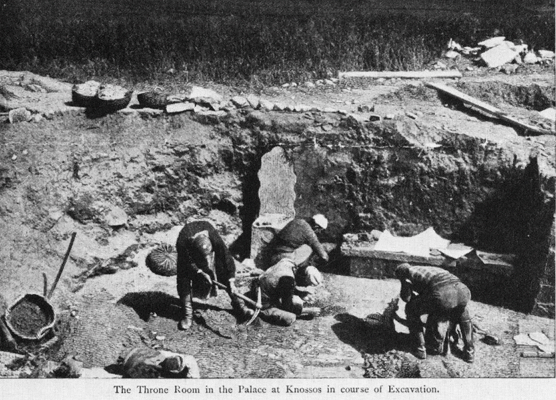
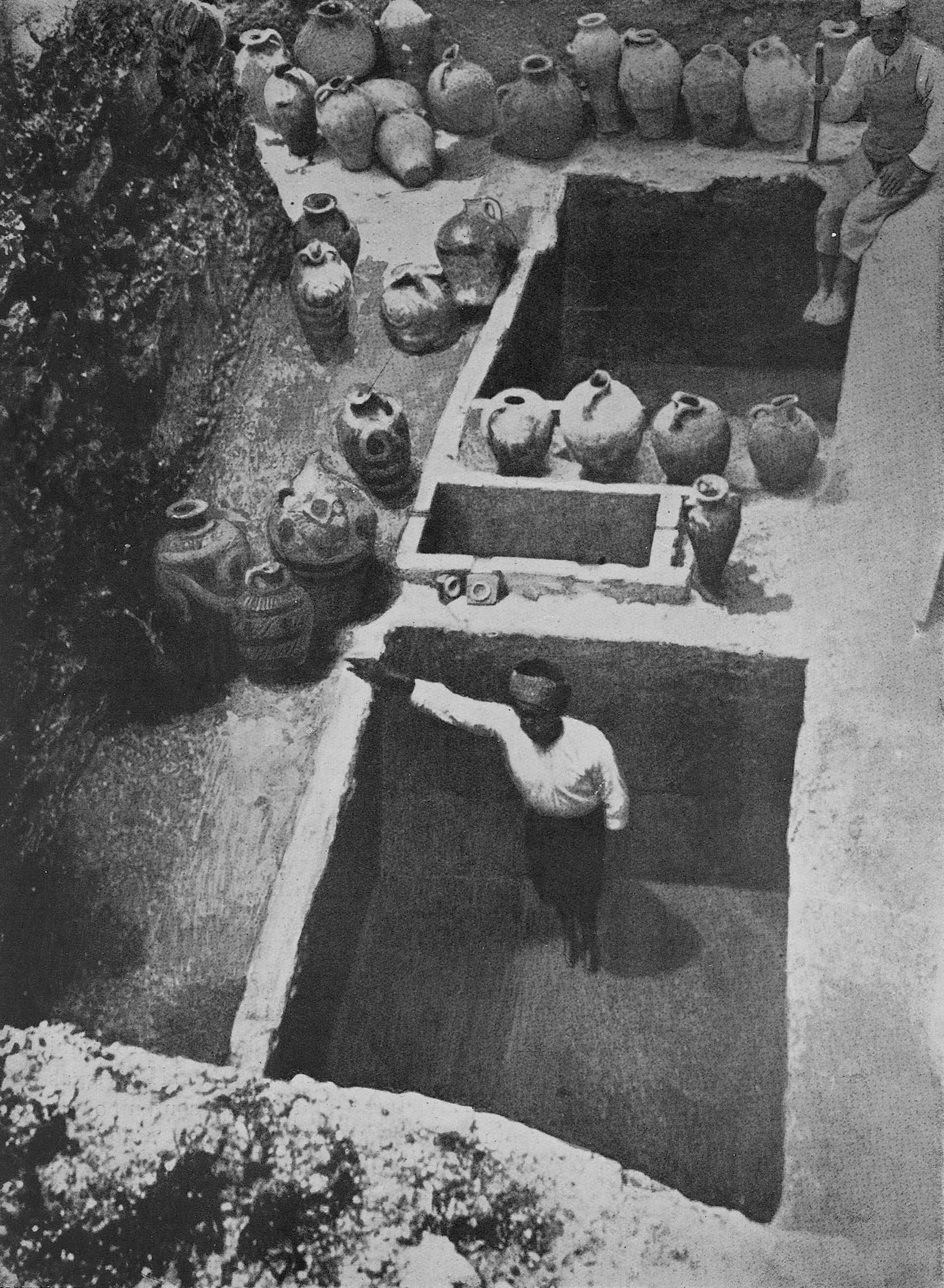
Excavating the floor of the Throne Room, image from the title-page of the brochure, issued by the Cretan Exploration fund in 1900, appealing for funds
Throne Room excavations at Knossos, from the title page of a brochure appealing for support issued by the Cretan Exploration Fund (1900)

Evans’s restoration of the Throne Room (and much else at the site) privileges the Late Bronze Age period of its history. The typical visitor likely won’t grasp that the Throne Room dates to the latest phase of Knossos—the end of the 2nd millennium B.C.E., though the site was occupied nearly continuously from the Neolithic to the Roman era (from the 8th millennium B.C.E. to at least the 5th century C.E.).

The power of Evans’s interpretation and reconstruction of the site as purely Minoan—the product of the indigenous culture of that island—is very much still with us despite the fact that much has changed about how art historians and archaeologists understand the different periods of construction at Knossos. Today, much of its final plan and form, which Evans reconstructed (including the Throne Room and most of the frescos), are understood as being of Mycenaean construction (not Minoan). Although this information is noted in texts mounted at the site, it is too often overlooked by visitors.
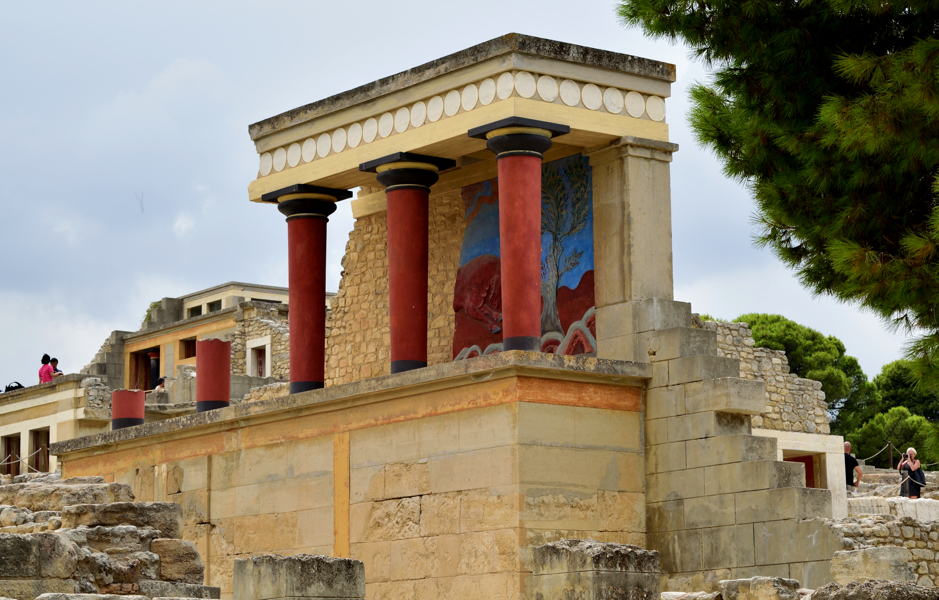
Contemporary view of Knossos looking Southwest from the Monumental North Entrance
Contemporary view of Knossos looking southwest from the Monumental North Entrance (photo: Theofanis Ampatzidis, CC BY-SA 4.0)

What is archaeological restoration?

When archaeological remains are revealed through excavation, they are often delicate and cannot survive long unprotected. Some archaeologists backfill their trenches (refill the excavated holes with the material that was removed) to help preserve remains. In other instances, architecture, graves, or the impressions left from ephemeral building materials (such as wood) are sometimes left exposed, and when this happens some sort of conservation should occur. By definition, any sort of conservation is restoration when the modern materials are layered on the ancient and made to look harmonious in form, color and/or texture. As a result, restorations are sometimes nearly indistinguishable from authentic materials, and this is where things get tricky—such as the situation at Knossos.

Before making an archaeological restoration, three essential issues must be examined:

  1. What specific point in a site or monument’s history will be the subject of the restoration? Many (most!) archaeological sites reflect a long occupation or use, and within that timeframe things change, are repaired, or rebuilt. What era of the site will be privileged by the restoration—and in turn, which eras of the site’s history will become harder to see and understand?
  2. How will future changes in the interpretation and knowledge about a site or monument be accommodated by restorations? Archaeological interpretations of sites evolve all the time, often through new discoveries elsewhere. Restorations, in order to remain accurate, need to take into account potential new scholarship that can change the history or meaning of a site or monument.
  3. Lastly and most importantly, restorations must be non-destructive and reversible. The first role of restoration is conservation. Therefore, the original remains must be entirely safe and not harmed in any way by restoration methods and materials. The reversibility of restorations not only has to do with the accommodation of changes in interpretation made above, but also with the need to leave the way open for less invasive, more gentle restoration methods in the future.

Restoration at Knossos

Aside from some gaps (for instance, during the First World War) Evans excavated at the site of Knossos each year from 1900 to 1930. Restoration of the architectural finds began almost immediately and can be divided into three phases, each characterized by the architect Evans hired to do the work. These three men, Theodore Fyfe, Christian Doll, and Piet De Jong, each had very different restoration philosophies.

Phase 1: Theodore Fyfe

From 1901 to 1904, a young architect by the name of Theodore Fyfe was charged with the restorations at Knossos. It is likely that Evans hired him because the winter of 1900/01 had damaged the newly exposed Throne Room—the most important space excavated during that first season at the site.

Fyfe’s work at Knossos can be characterized by two things. First of all, he was devoted to the concept of minimal intervention. Second, when intervention was necessary, he made great efforts to use materials authentic to the Bronze Age structure (wood, limestone, rubble masonry) and even to use Bronze Age construction techniques, which he was able to glean from his onsite work. Clearly Fyfe was highly concerned about the truthfulness of his interventions and reconstructions; the only exception to this was his construction of modern-style pitched roofs to protect the Throne Room and the Shrine of the Double Axes.

Phase 2: Christian Doll

The second phase of restoration work at Knossos dates from 1905 to 1910, and was directed by Christian Doll. The first conservation work to which Doll had to attend to in 1905 was that of Fyfe’s. Essentially, Fyfe’s zeal to use authentic materials resulted in failure: he neglected in many cases to treat timbers before their use and he tended to use softwoods rather than hardwoods (all of which lead to rot). Also, rain was a destructive force in the winters, especially when it ran through newly exposed parts of the site. Doll’s first and most important project was to stabilize and reconstruct the Grand Staircase to its original four story height. This was an extremely difficult job as the exact nature of the ancient design eluded both him and Fyfe, so a certain amount of improvisation was needed. And, because the weight of the structure was so great, Doll used iron girders (imported from England at great expense) covered in cement to make them look like ancient wooden beams.

Doll’s approach to conservation was still anchored in preserving the excavated remains. However, Doll was no fan of the authentic materials used by Fyfe, as he saw how they had failed to preserve the many areas where they had been employed. Instead, Doll constructed structural systems based on techniques used in London at the time. Moreover, he employed contemporary architectural materials, such as the iron girders mentioned above, as well as concrete (the first use of this material at Knossos).

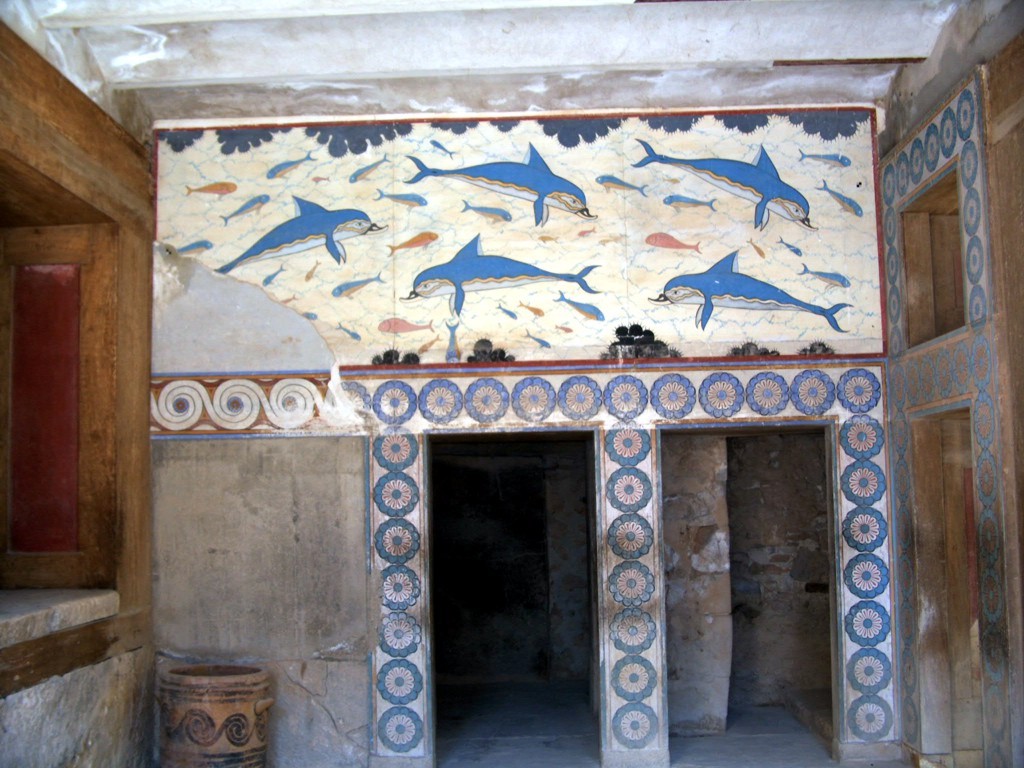
Phase 3: Piet De Jong
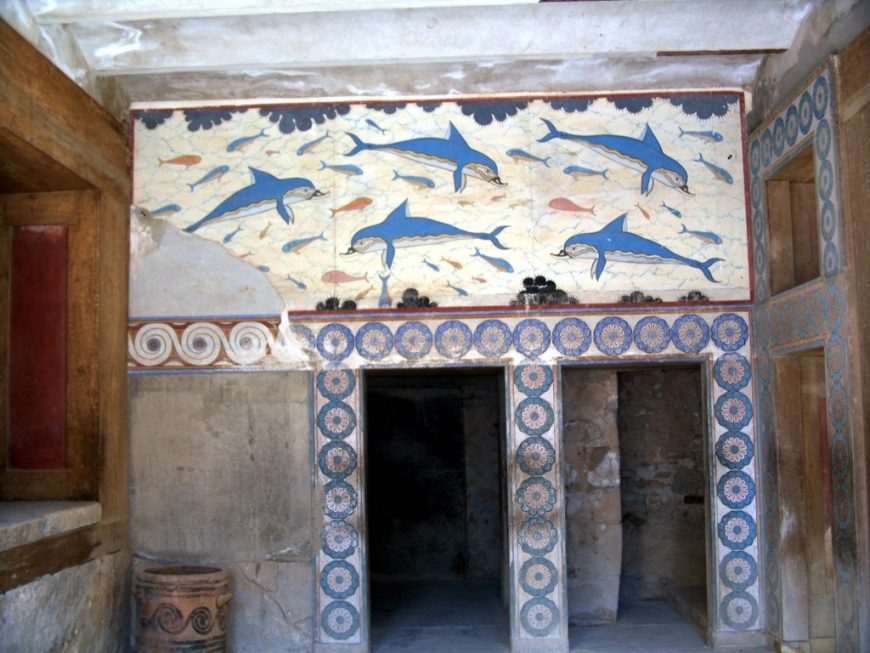
Piet de Jongm reconstruction of the "dolphin fresco," Knossos
Piet de Jong, reconstruction of the “Dolphin Fresco,” Queen’s Megaron, Knossos (public domain)

The third phase of conservation work was executed over a longer period of time, from 1922 to 1952, by Piet De Jong. The vast majority of what Knossos looks like today, with large passages of reconstructed walls and rooms, is his work.

Three main elements characterize De Jong’s work at Knossos. The most prominent was his use of iron reinforced concrete. In the twelve years between Doll’s and De Jong’s work, the use of reinforced concrete had grown in popularity because of its speedy construction, its relative cheapness, and its ability to be molded into nearly any shape. It was also thought to be nearly indestructible.

Another essential characteristic of De Jong’s work at Knossos was his use of reinforced concrete to construct parts of the palace beyond what had been found—some passages were based on archaeological evidence, some were not (the bases of these reconstructions came from Evans himself).

De Jong often did not merely end walls at the height of their discovery but would either finish them off with a flat roof and cornice, often decorated with double white horns (what some contemporary wall paintings of Bronze Age houses looked like), or would leave the top edge of walls with irregular stones, evoking a picturesque, antique view. When a complete vision of ancient Knossos could not be reconstituted, a romantic one was built instead.
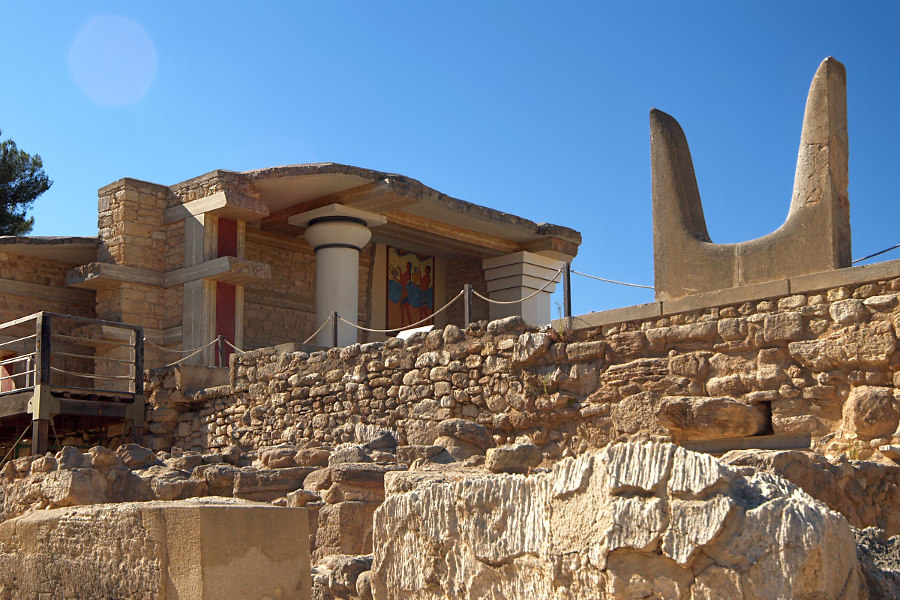
South Propylaeum, Knossos (photo: Stegop, CC BY-SA 4.0)
South Propylaeum, Knossos (photo: Stegop, CC BY-SA 4.0)

The reconstruction of the interior decoration of the throne room was executed during this period and similarly exhibits a combination of the truthful reflection of archaeological remains and Evans’s creativity.

Lastly, an important characteristic of De Jong’s restorations was the placement of reproductions of wall paintings around his newly built spaces. Some paintings were placed very close to their findspots and therefore aimed at a more authentic reconstruction, while other paintings were reconstructed at some distance from where they had been discovered.

The question remains: why did Evans encourage De Jong’s radical approach to conservation, especially after two more conservative predecessors? Several reasons are at play, no doubt. The first, and possibly the most important, is the condition of Knossos after almost eight years of abandonment during the First World War. Aside from the wild overgrowth of weeds, there was much weather-related and other damage. However, the parts of the site that had been roofed (such as the Throne Room and the Shrine of the Double Axes) and sections that were more intact (such as the Grand Staircase), were in excellent shape and this no doubt convinced Evans of the importance of aggressive conservation work. Second, the iron-reinforced concrete which De Jong proposed to use was inexpensive and could be employed quickly. Third, Evans, in a masterful anticipation of the desires of future tourism, aimed to make a site that would vividly conjure the culture he had discovered, as much evocative and picturesque as historically accurate.

Conservation at Knossos after Evans

It is only fair to reflect upon the restorations of Knossos within their historical framework. The aims, methods, and materials used in restoration at the site over a period of some sixty years changed, reflecting a long list of crises, constraints, theories, and desires. Perhaps most significant, however, was Evans’s overriding conviction that the conservation of Knossos was an obligation born out of its great antiquity and unique importance. He knew this from his own Edwardian education, British colonial outlook, and his twenty-four year directorship of the Ashmolean Museum at the University of Oxford. Evans was keenly aware of how intimately connected the teaching of Knossos’s history was with how it was presented on site. He made Knossos into a museum and a showcase for the newly discovered Aegean Bronze Age chapter of ancient history and the earliest example of cultural tourism, today a mainstay of public historical education—not to mention local economies. Evans did it first at Knossos.

Conservation at Knossos has continued since De Jong’s work, although with new challenges. The most recent conservation work on the site has been focused largely on repairing Evans’s reconstructions. Despite a belief that reinforced concrete would last indefinitely, it has proven to be susceptible to the wet Cretan winters, crumbling and allowing for rust on the interior ironwork. In other areas the reinforced concrete proved to be structurally unsound.
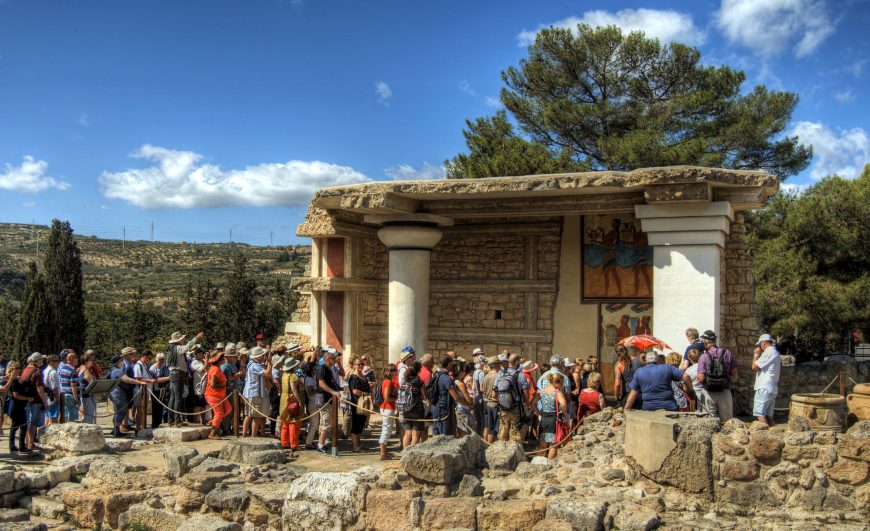
Visitors to Knossos, 2016, photo: Neil Howard, CC BY-NC 2.0
Visitors to Knossos, 2016, photo: Neil Howard, CC BY-NC 2.0

In addition, the steady increase of tourist traffic since the 1950s has meant growing stress on both the original architecture of Knossos as well as its reconstructions. Sustained foot fall, increasing weight load as well as touching and sitting, is increasingly destructive. To combat this, the Greek Archaeological Service, under the Greek Ministry of Culture and Sports, has closed off large sections of Knossos and generally restricted circulation on the site. In the 1990s it conducted extensive conservation of both ancient and modern structures as well as building new corrugated plastic roofing. At present the Service is working on a visitor management plan for the site and the Greek government has applied to UNESCO for World Heritage Status for Knossos as well as four other Minoan palatial sites which would afford much needed support for ongoing conservation efforts.

See also:

Knossos at UNESCO

Minoan Crete from The Metropolitan Museum of Art’s Heilbrunn Timeline of Art History

Arthur Evans archive (Oxford University)

Source: Dr. Senta German, “Restoration versus conservation: the Palace at Knossos (Crete),” in Smarthistory, July 11, 2018, accessed September 9, 2024, https://smarthistory.org/ancient-mediterranean/the-palace-at-knossos-crete/.

Bull-leaping fresco from the palace of Knossos

Bull-leaping fresco from the palace of Knossos
Bull-leaping fresco from the east wing of the palace of Knossos (reconstructed), c. 1400 B.C.E., fresco, 78 cm high (Archaeological Museum of Heraklion, photo: Jebulon, CC0)

Court of the Stone Spout
The Court of the Stone Spout, where the pieces of the fresco were found, from Sir Arthur Evans, The Palace of Minos (London, 1930), p. 270 (Universitäts-Bibliothek Heidelberg)

Taking the bull by the horns

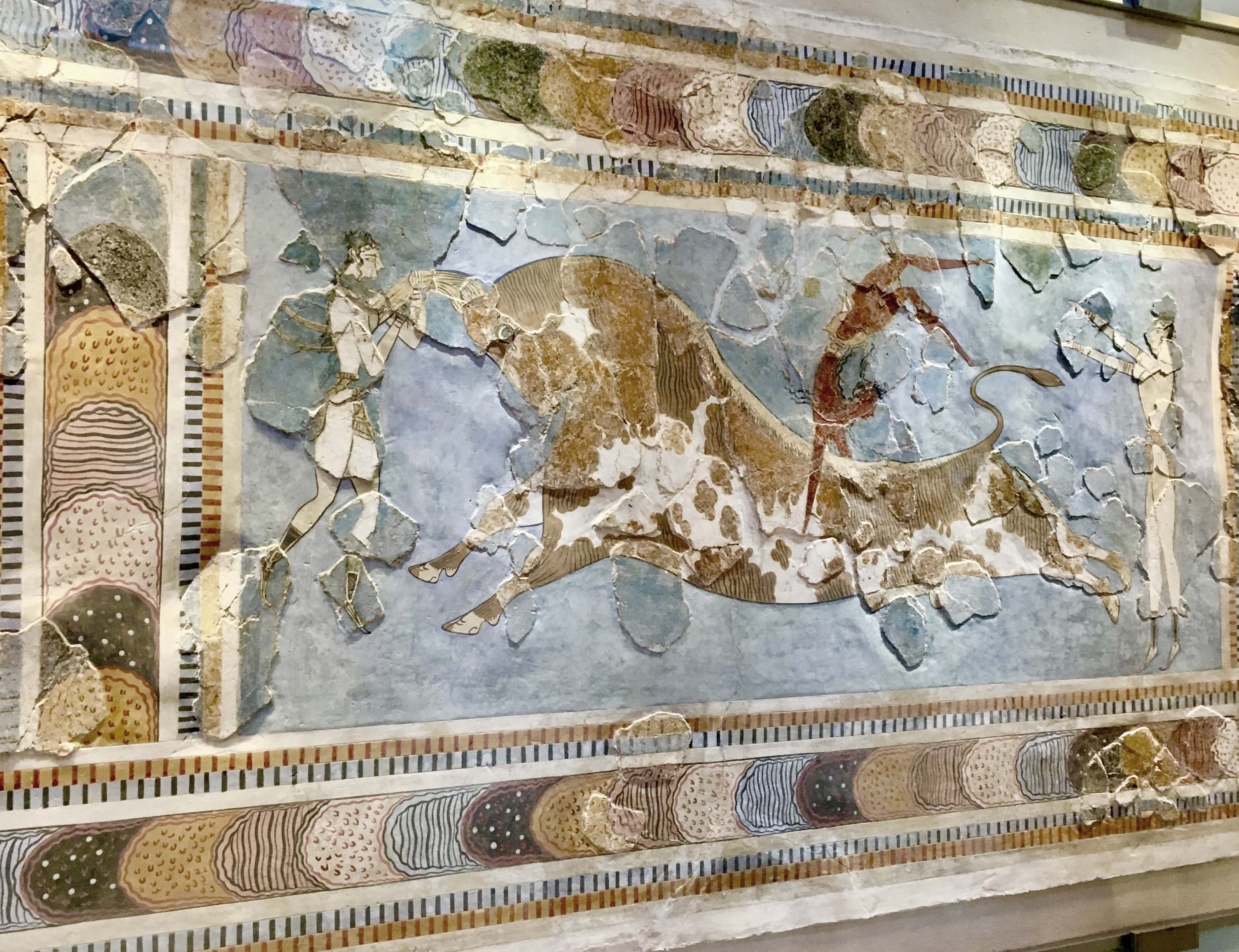
Bull sports—including leaping over them, fighting them, running from them, or riding them—have been practiced all around the globe for millennia. Perhaps the best-loved ancient illustration of this, called the bull-leaping or Toreador fresco, comes from the site of Knossos on the island of Crete. The wall painting, as it is now reconstructed, shows three people leaping over a bull: one person at its front, another over its back, and a third at its rear.

The image is a composite of at least seven panels, each .78 meters (about 2.5 feet) high. Fragments of this extensive wall painting were found very badly damaged in the fill above the walls in the Court of the Stone Spout, on the east side of the Central Court at Knossos. The fact that the paintings were found in fill indicates that this wall painting was destroyed as part of a renovation. The pottery which was found together with the fragments gives us its date, likely LM II (around 1400 B.C.E.).

Reconstructed but still incomplete

When Sir Arthur Evans, the first archaeologist to work at Knossos, found the fragments, he recognized them as illustrating an early example of bull sports, and he was eager to create a complete image that he could share with the world.  He hired a well-known archaeological restorer, Émile Gilliéron, to create the image we know today from the largest bits of the seven panels. Unfortunately, it is impossible to reconstruct all of the original panels and to get a sense of the painting at all, we are left with Gilliéron’s reconstruction.

Bull-leaping fresco from the east wing of the palace of Knossos (reconstructed), c. 1400 B.C.E.
Bull-leaping fresco from the east wing of the palace of Knossos (reconstructed), c. 1400 B.C.E., fresco, 78 cm high (Archaeological Museum of Heraklion, photo: Andy Montgomery, CC BY-SA 2.0)

Visual gymnastics

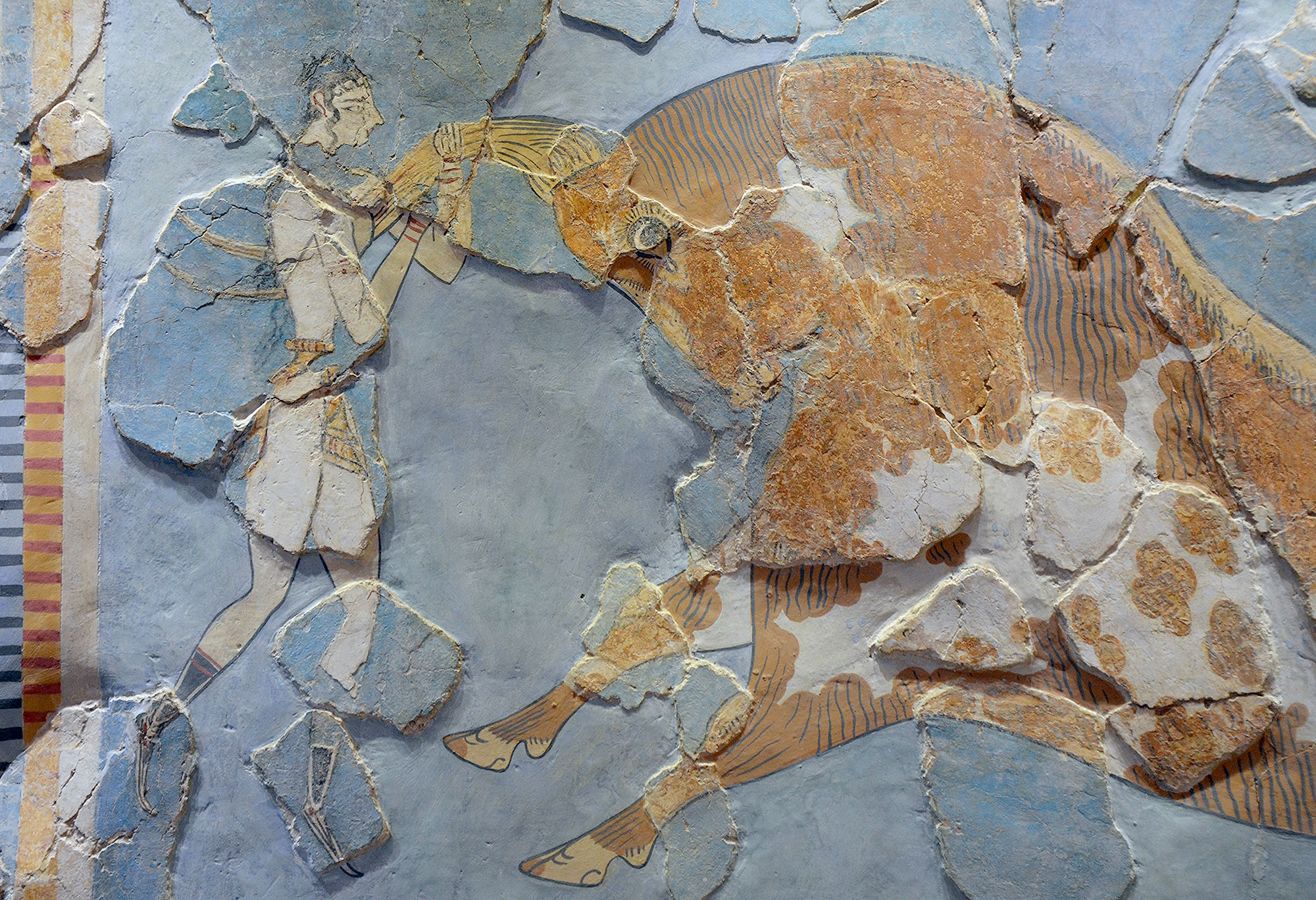
What we see is a freeze-frame of a very fast moving scene. The central image of the fresco as reconstructed is a bull charging with such force that its front and back legs are in midair. In front of the bull is a person grasping its horns, seemingly about to vault over it. The next person is in mid-vault, upside down, over the back of the bull, and the final person is facing the rear of the animal, arms out, apparently just having dismounted—“sticking the landing,” as they say in gymnastics.

Bull-leaping fresco from the east wing of the palace of Knossos (reconstructed), c. 1400 B.C.E.
Bull-leaping fresco (detail) from the east wing of the palace of Knossos (reconstructed), c. 1400 B.C.E., fresco, 78 cm high (Archaeological Museum of Heraklion, photo: Carole Raddato, CC BY-SA 2.0)

Bull-leaping fresco (detail) from the east wing of the palace of Knossos (reconstructed), c. 1400 B.C.E.
Bull-leaping fresco (detail) from the east wing of the palace of Knossos (reconstructed), c. 1400 B.C.E., fresco, 78 cm high (Archaeological Museum of Heraklion, photo: Carole Raddato, CC BY-SA 2.0)

The people on either side of the bull, as reconstructed, bear markers of both male and female gender: they are painted white, which indicates a female figure according to ancient Egyptian gender-color conventions, which we know the Minoans also used. But both characters wear merely a loincloth, which is male dress. The hairstyle (curls at the top with locks falling down the back) is not uncommon in representations of both youthful males and females. Many interpretations of this gender crossing are possible, but there is little evidence to support one over another, unfortunately. At the very least, we can say that the representation of gender in the Late Aegean Bronze Age was fluid.

The person at the center of the action, vaulting over the bull’s back, is painted brown, which indicates male gender according to ancient Egyptian gender-color conventions, and this makes sense considering his loincloth. It is interesting to note that the muscles of all three of the bull leapers, at their thighs and chests, have been very delicately articulated, accentuating their athletic build.

ull-leaping fresco (detail) from the east wing of the palace of Knossos (reconstructed), c. 1400 B.C.E.
Bull-leaping fresco (detail) from the east wing of the palace of Knossos (reconstructed), c. 1400 B.C.E., fresco, 78 cm high (Archaeological Museum of Heraklion, photo: Carole Raddato, CC BY-SA 2.0)

The background of the scene is blue, white, or yellow monochrome, and indicate no architectural context for the activity. Moreover, the seven panels and Gilliéron’s composite reconstruction all show a border of painted richly variegated stones overlapping in patches. So, it seems we are meant to see these scenes as abstracted action within frames, not part of a wider visual field or narrative.

Bull-leaping fresco, detail of border
Bull-leaping fresco (detail) from the east wing of the palace of Knossos (reconstructed), c. 1400 B.C.E., fresco, 78 cm high (Archaeological Museum of Heraklion, photo: Jebulon, CC0)

A rite of passage?

The most interesting question about the bull leaping paintings from Knossos is what they might mean. We cannot understand the whole bull-leaping cycle in detail as it is so fragmentary, but we know that it covered a lot of wall space and a considerable amount of resources must have been expended to create it.

As mentioned above, many cultures across space and time have engaged in bull sports, and they all have a few things in common. First, these sports are life-threatening. To race, dance with, leap over, or kill a bull might very well get you killed. Second, these activities are usually performed before a crowd: they are a civic event, publicly presented and recorded in memory. Third, those who participate in these bull activities are often youths at an age when they are passing from childhood into adulthood and the achievement of the bull sport contributes to that passage. Anthropologists refer this sort of activity as a “rite of passage,” which, when witnessed by one’s community, establishes the participant as an adult.

Therefore, we might surmise that the bull leaping scenes from Knossos refer to such a rite of passage ceremony. Many have identified the Central Court (Theatral area) just beyond the west façade of the palace at Knossos as locations where bull-leaping ceremonies might have taken place. We may never know the exact meaning of these paintings, but they continue to resonate with us today—not only because of their beauty and dynamism, but because they represent an activity that is still an important part of many cultures around the world.

Additional resources:

This work at the Archaeological Museum of Heraklion

Bulls and Bull-leaping in the Minoan World

Source:  Dr. Senta German, “Bull-leaping fresco from the palace of Knossos,” in Smarthistory, August 15, 2018, accessed September 9, 2024, https://smarthistory.org/bull-leaping-fresco/.

Minoan woman or goddess from the palace of Knossos (“La Parisienne”)

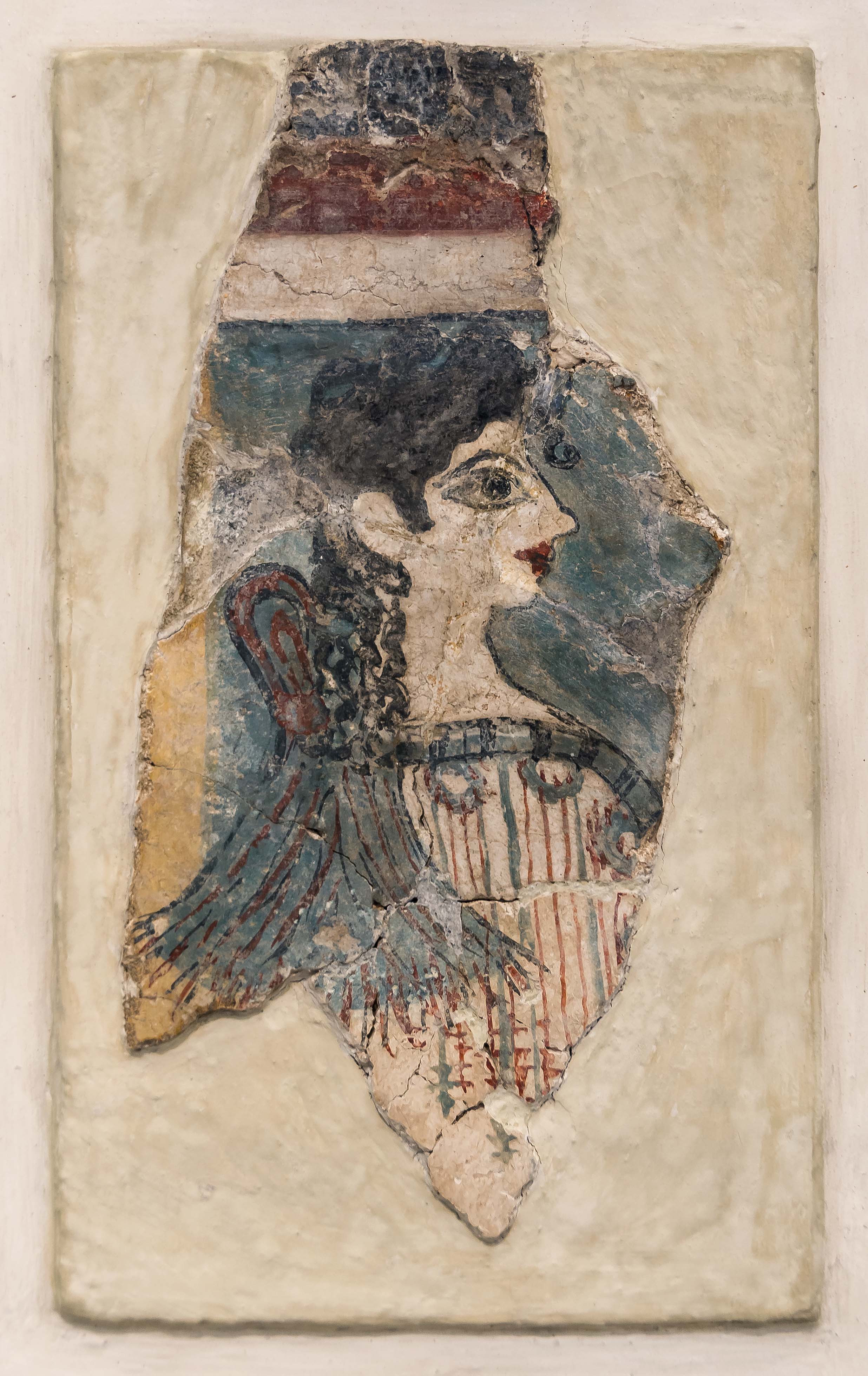
Woman or goddess ("La Parisienne") from the Camp-Stool fresco, western wing of the palace at Knossos,
Woman or goddess (“La Parisienne”) from the Camp-Stool fresco, c.1350 B.C.E., western wing of the palace at Knossos, buon fresco, 20 cm high (Archaeological Museum of Heraklion)

 “Parisian” from ancient Crete

This image of a young woman with a bright dress and curly hair is among the best known images in Minoan art. It is also one of the few representations of Minoan people rendered in color and detail, and it is a beautiful example of Minoan wall painting. Shortly after it was first discovered by Sir Arthur Evans at Knossos, it was seen by Edmond Pottier, a famous art historian of Greek pottery, who likened her charming look to the contemporary women of Paris. She has been known as “La Parisienne” ever since.

Woman or priestess ("La Parisienne") from the Camp-Stool fresco, western wing of the palace at Knossos,
Woman or goddess (“La Parisienne”) from the Camp-Stool fresco, c.1350 B.C.E., western wing of the palace at Knossos, buon fresco, 20 cm high (Archaeological Museum of Heraklion)

The sacred knot

Only La Parisienne’s head and upper body are preserved. Her hair is black and curly, with one curl springing down onto her forehead and others cascading down her neck and upper back. Her skin is white, which is in imitation of the ancient Egyptian color convention (women painted white, men brown), and her large, darkly outlined eye also reminds us of Egyptian style, but her bright red lips are unique. She wears an elaborately woven blue and red striped dress, with a blue banded edge attached with red flecked loops. Tied to the back of the dress is a “sacred knot,” as Evans first called it. This is a loop of long cloth tied with another loop at the nape of the neck, leaving a length of the cloth trailing down the back.

This is one of only two representations of a woman actually wearing a sacred knot, although the knots themselves are found on seals, painted on pottery, in other frescos, and rendered in ivory or faience. This knot is thought to designate the wearer as a holy person, so this Minoan woman may be a priestess.

The west wing of the palace at Knossos (photo: tedbassman, CC BY 2.0)
The western wing of the palace at Knossos (photo: tedbassman, CC BY 2.0)

Sir Arthur Evans, Arthur J., upper plan the northwest palace area, Knossos, from The Palace of Minos (London, 1935)
Sir Arthur J. Evans. Upper plan, northwest palace area, Knossos, from The Palace of Minos (London, 1935), p. 380 (Universitäts-Bibliothek Heidelberg)

Found in fragments

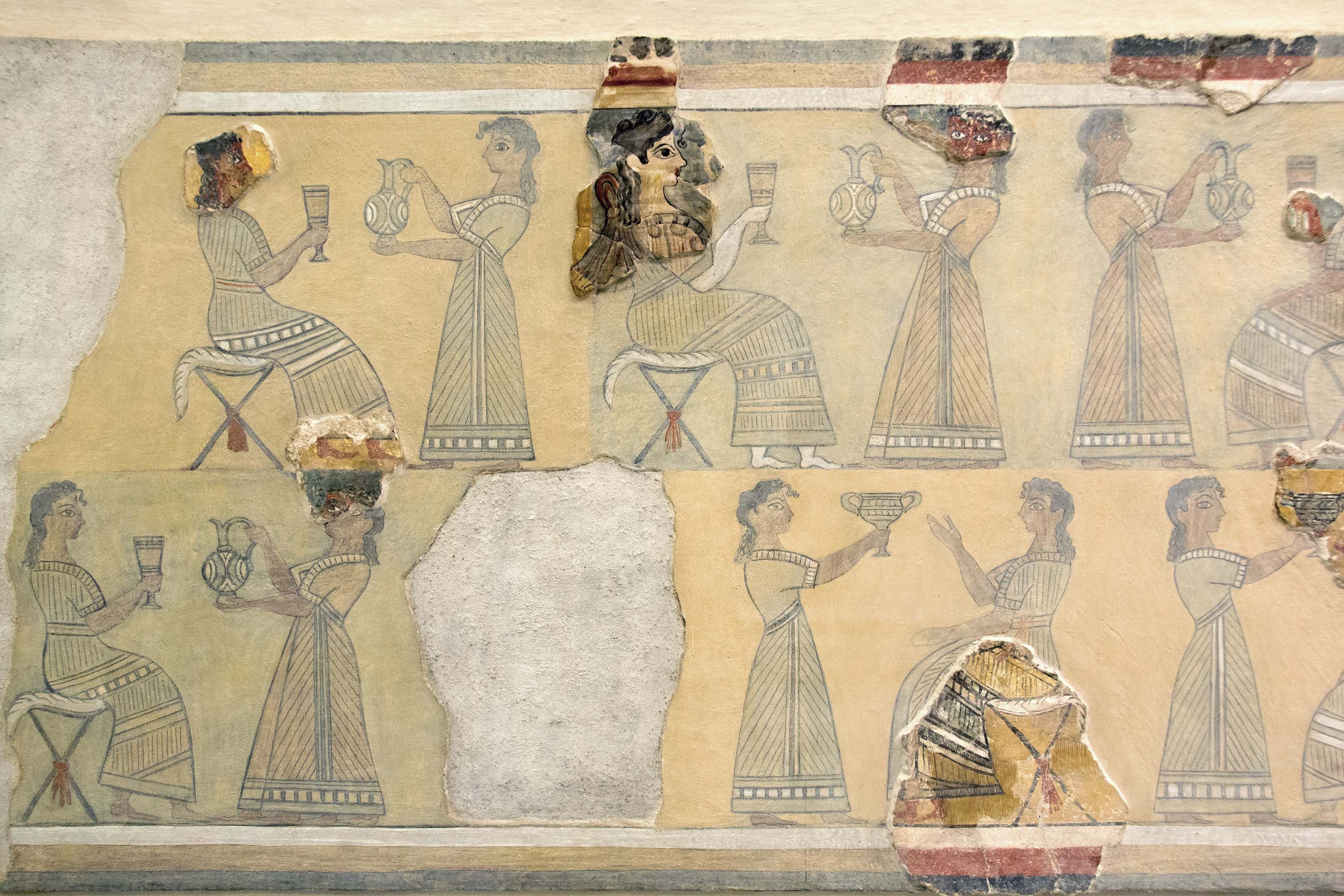
The wall painting of which La Parisienne is a part was discovered heavily damaged and fallen from an upper story in the western wing of Knossos. It was painted in buon fresco (on wet plaster) as most Minoan wall paintings were, and given its archaeological context is likely one of the last painted works of the palace, dating to LM III(around 1350 B.C.E.). Specifically, this fragment was part of a two tiered scene that is about a half-meter (about 1.5 feet) wide, called the Camp Stool fresco (shown below as a reconstruction). Featured on both the top and bottom panels are pairs of men and women in profile sitting and standing and holding up elegant vessels. La Parisienne comes from one of the female pairs.

It has been suggested that the part of the palace of Knossos from which this painted scene fell was used for ceremonies and feasting; if this is true, subject matter depicting toasts being made would fit in nicely. Whatever her original meaning, La Parisienne is an enduring testament to the skill of Minoan fresco painters.

The Camp Stool fresco (reconstruction), c. 1350 B.C.E., 
The Camp Stool fresco (reconstruction), c. 1350 B.C.E., from west wing of the palace of Knossos (Archaeological Museum of Heraklion, Crete)

Additional resources:

This object at the Archaeological Museum of Heraklion

Sir Arthur Evans, The Palace of Minos (London, 1935)

Source: Dr. Senta German, “Minoan woman or goddess from the palace of Knossos (“La Parisienne”),” in Smarthistory, August 14, 2018, accessed September 9, 2024, https://smarthistory.org/la-parisienne/.
Source: Dr. Steven Zucker and Dr. Beth Harris, “Lion Gate,” in Smarthistory, December 13, 2015, accessed September 9, 2024, https://smarthistory.org/lion-gate-mycenae/.
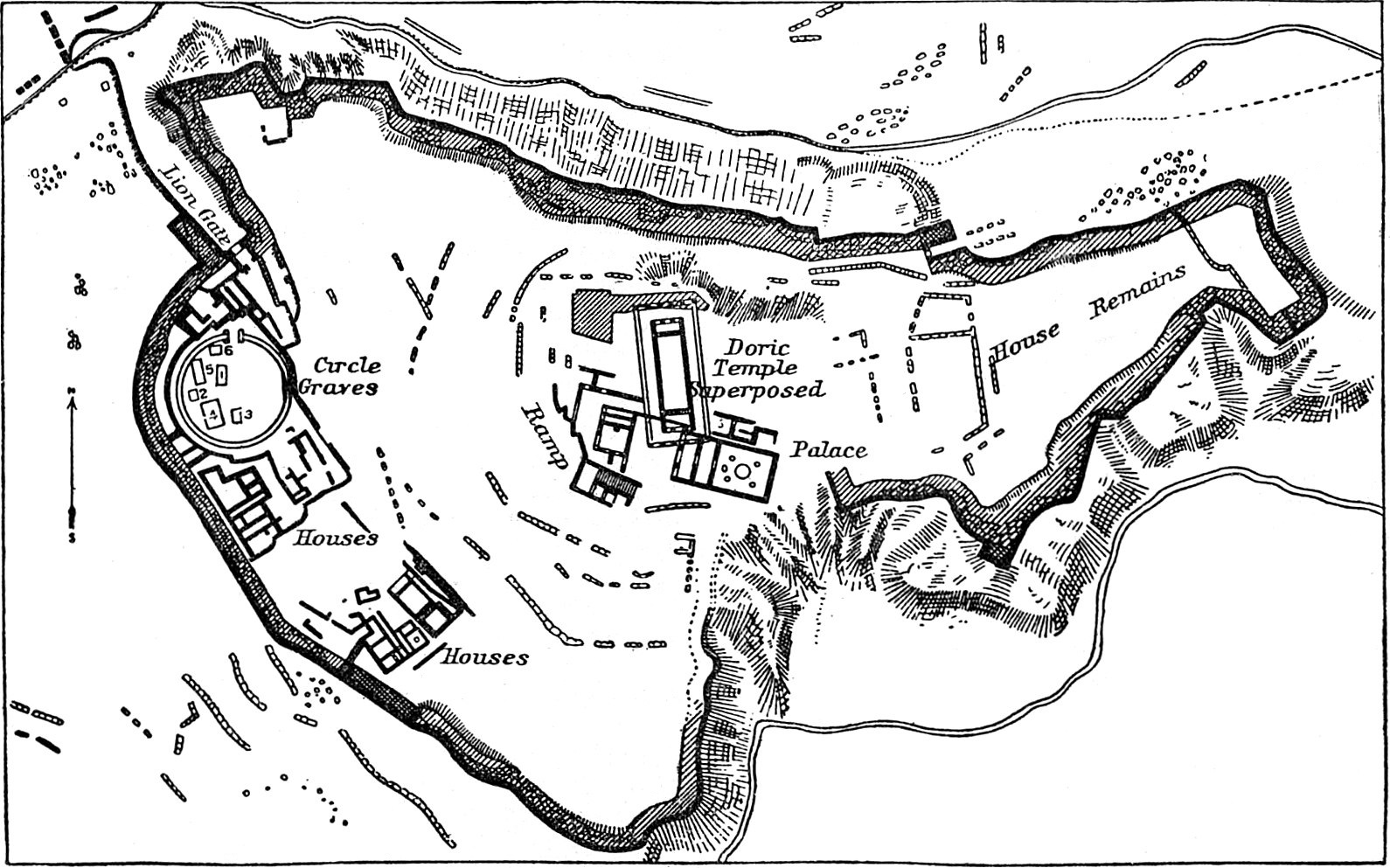
The “Palace” and Grave Circle A

The “Palace” and Grave Circle A, Mycenae, c. 1600-1100 B.C.E.
Seeking the mythic cities of Homer, Heinrich Schliemann identified Mycenae in the 19th century.

Video URL: https://youtu.be/S7HJB0PtiW0

For video transcript go to https://smarthistory.org/the-palace-and-grave-circle-a-mycenae/

Source: Dr. Steven Zucker and Dr. Beth Harris, “The “Palace” and Grave Circle A,” in Smarthistory, December 14, 2015, accessed September 11, 2024, https://smarthistory.org/the-palace-and-grave-circle-a-mycenae/.
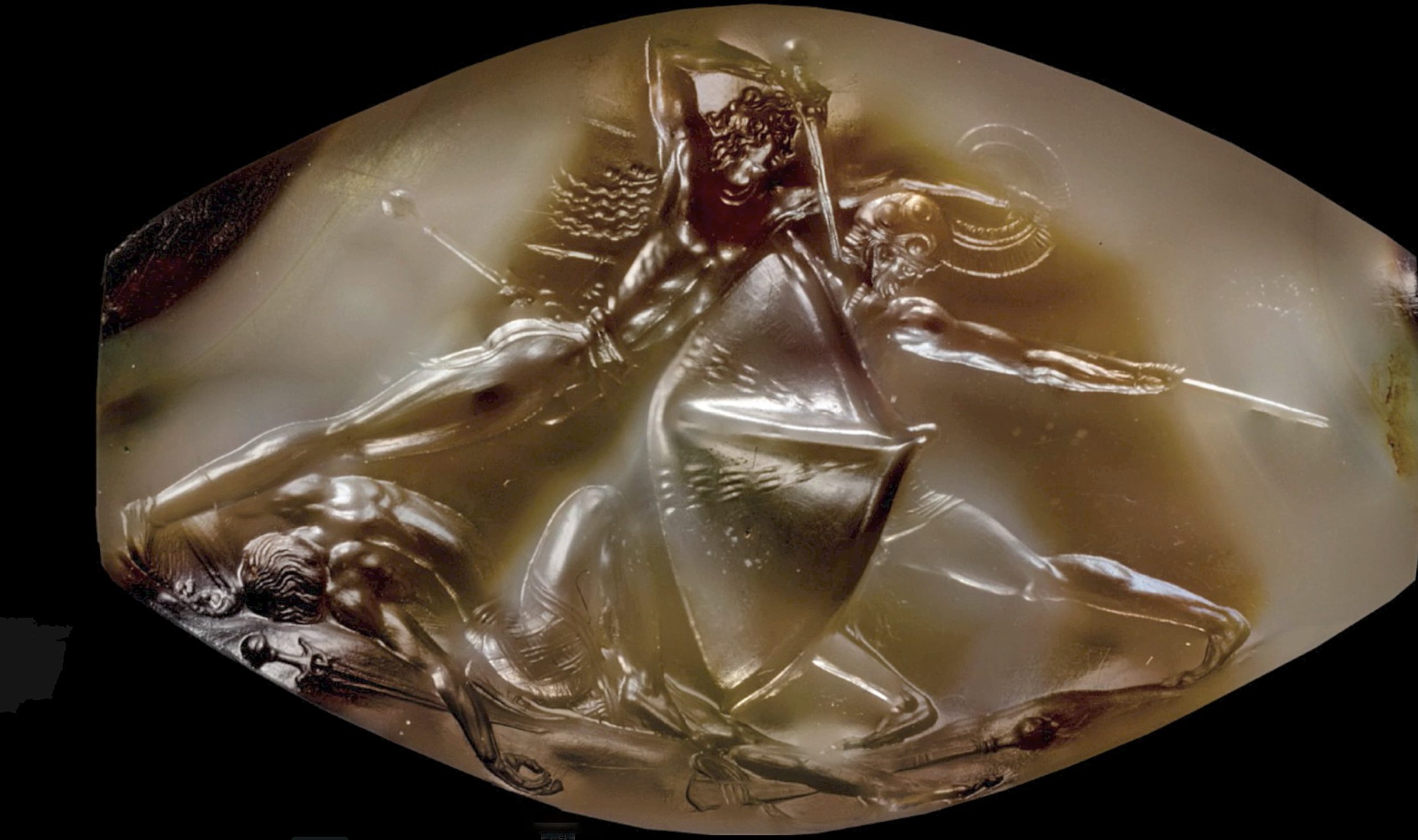
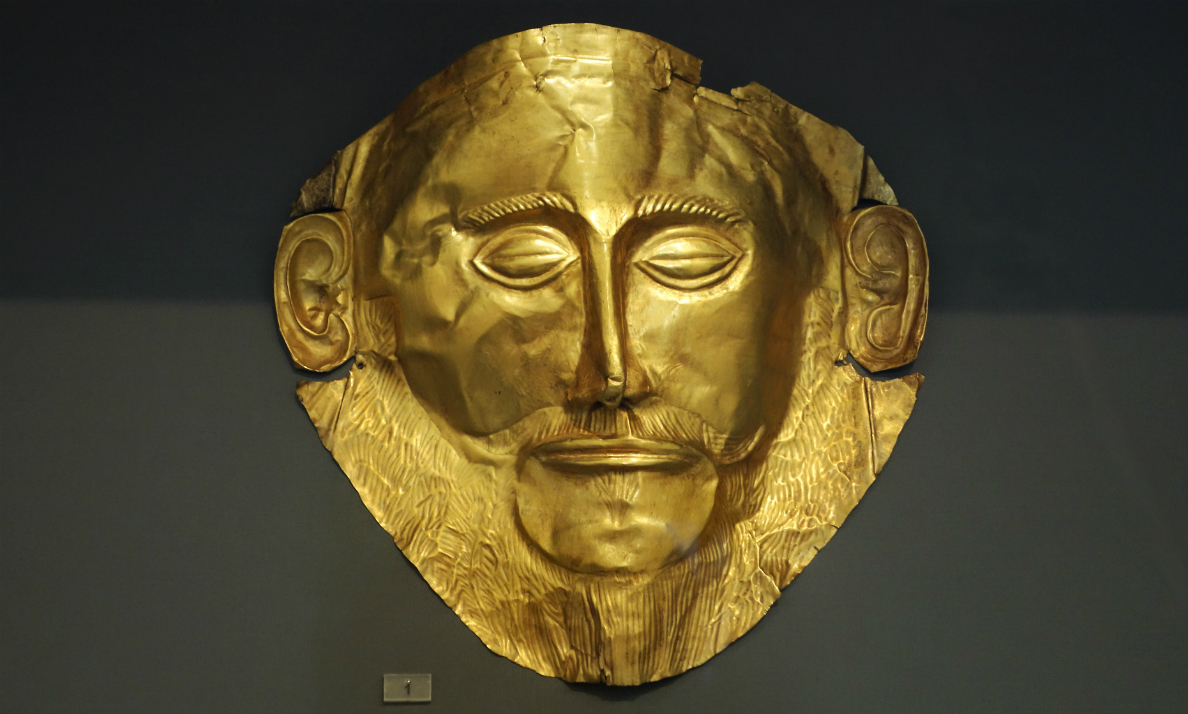
Mask of Agamemnon

Mask of Agamemnon, from shaft grave V, grave circle A, Mycenae c.1550-1500 B.C.E., gold, 12″ / 35 cm (National Archaeological Museum, Athens)

“I have gazed into the face of Agamemnon,” boasted the man who discovered it—but is it really the Homeric hero?


Video URL: https://youtu.be/1PKOiYY9SPA

For video transcript go to https://smarthistory.org/mask-of-agamemnon/.

Source: Dr. Steven Zucker and Dr. Beth Harris, “Mask of Agamemnon,” in Smarthistory, December 14, 2015, accessed September 9, 2024, https://smarthistory.org/mask-of-agamemnon/.
The Treasury of Atreus, Mycenae, c. 1300-1250 B.C.E.

Below the great citadel of Mycenae, a passage into a hillside leads to a massive beehive-shaped tomb.

Video URL: https://youtu.be/Cc9cLmgXp_A

View on Google Maps

Video transcript:   https://smarthistory.org/the-treasury-of-atreus-mycenae/.

Source:  Dr. Steven Zucker and Dr. Beth Harris, “The Treasury of Atreus,” in Smarthistory, December 14, 2015, accessed September 9, 2024, https://smarthistory.org/the-treasury-of-atreus-mycenae/.

Warrior Krater

by Dr. Monica Bulger
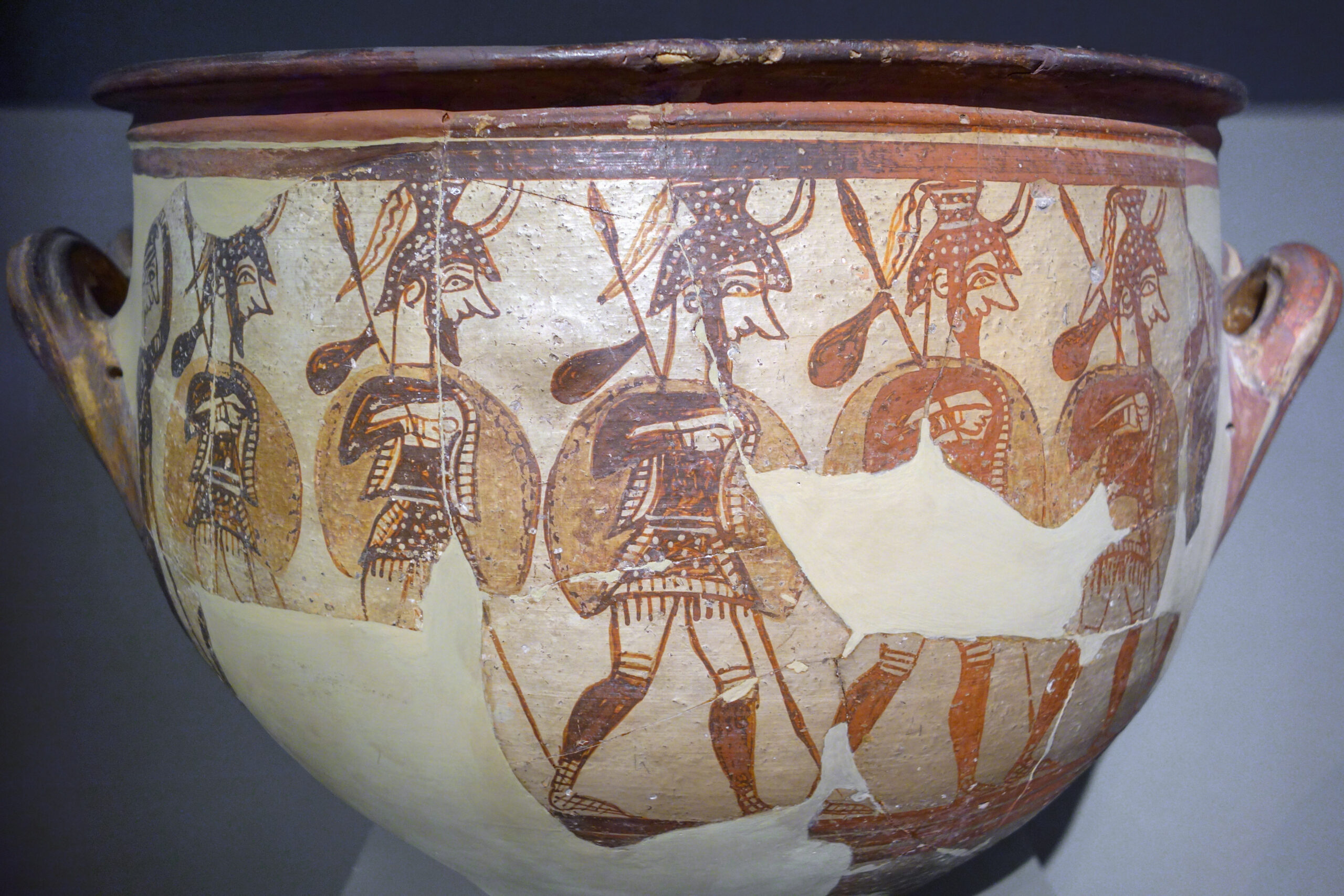
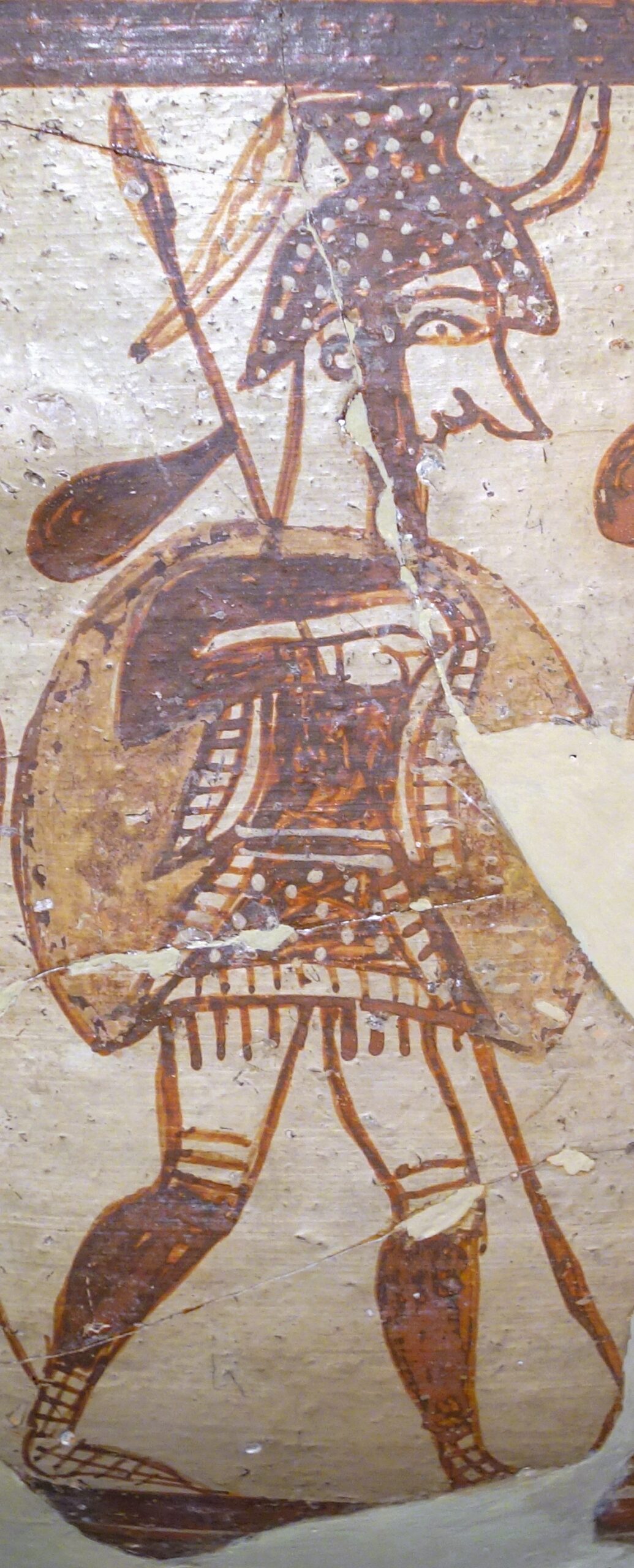
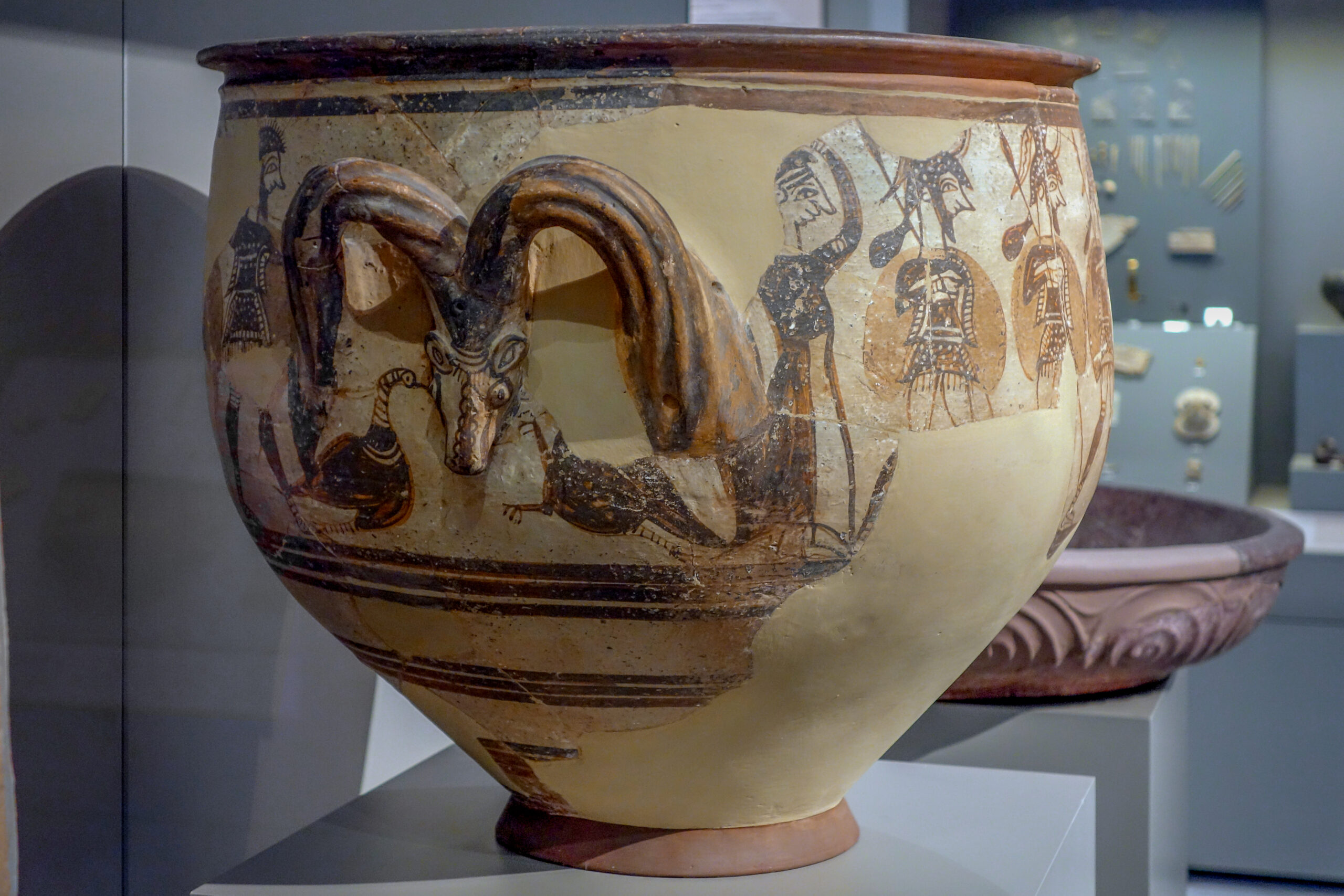
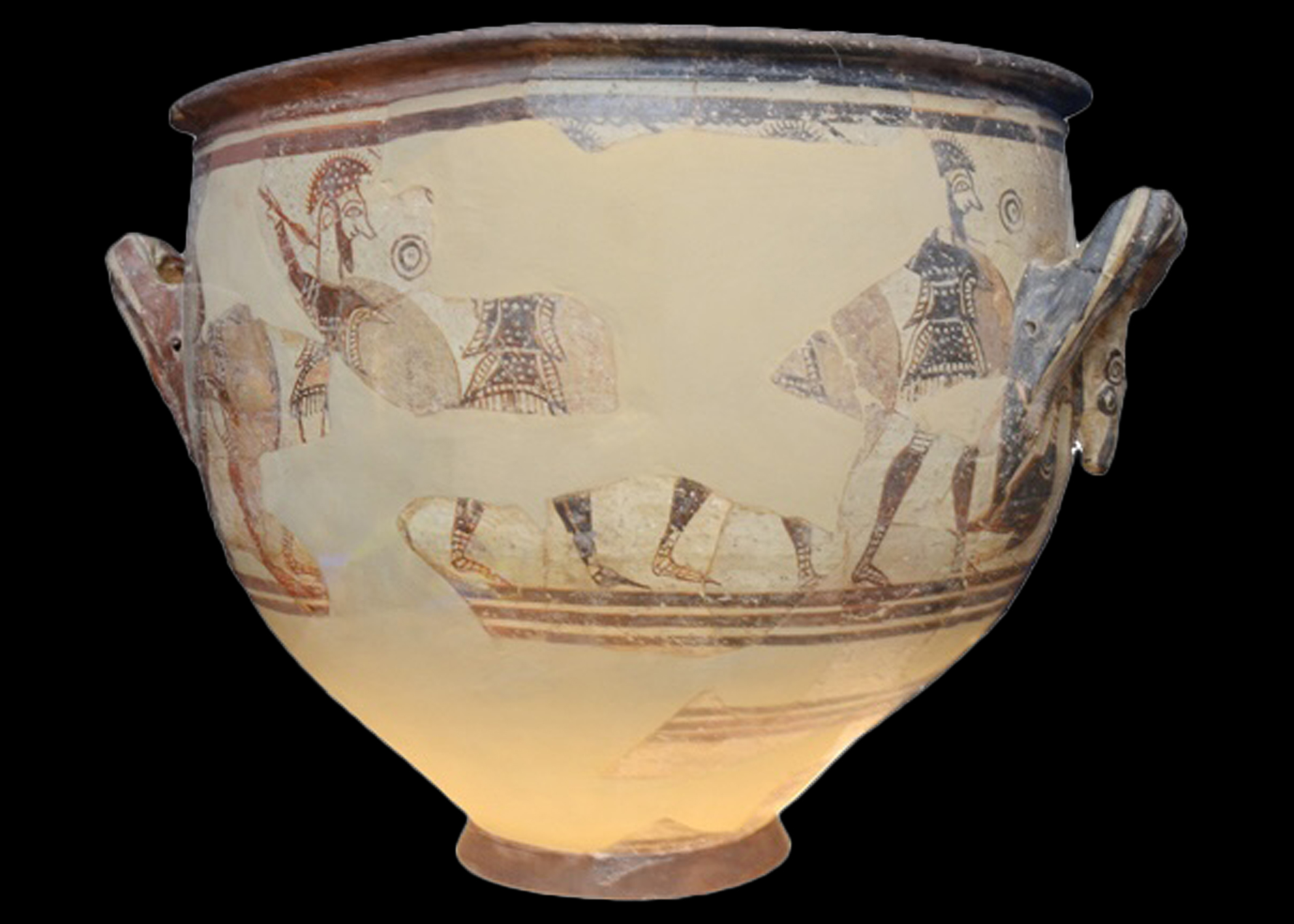
Front of Warrior Krater, c. 1200–1100 B.C.E.
Front of Warrior Krater, c. 1200–1100 B.C.E., ceramic, 42 cm high (National Archaeological Museum, Athens; photo: Steven Zucker, CC BY-NC-SA 2.0)

One of the most famous vases from the ancient Mediterranean is decorated with a row of soldiers who march confidently across its surface. The vessel was made by a talented artist working in the city of Mycenae, in Greece, sometime between 1200 and 1100 B.C.E. Although Mycenaean civilization was in turmoil during this century, the artist who created this functional vessel decorated it elaborately with a militaristic theme that would have carried significance for its original owners. In the following paragraphs, we will explore the form, function, and find spot of the so-called Warrior Krater to better understand what it tells us about the Mycenaeans who used it three millennia ago.

Form and function

This vase is now known as the Warrior Krater because of its decoration and shape. Warriors are painted on both sides of the vessel. The specific shape of the vase makes it a krater. It has a wide opening at its top, low handles on both of its sides, and a narrow, ring-shaped base. In the ancient Greek world, people used kraters to mix wine and water. They believed it was appropriate to dilute their wine before drinking it. The Warrior Krater was discovered in a house in the ancient city of Mycenae. [1] The residents of this house might have used the vase to mix wine and water at banquets they hosted in their home, setting it out so that their guests could admire its decoration. [2]

Soldiers on front of Warrior Krater (detail), c. 1200–1100 B.C.E
Soldiers on front of Warrior Krater (detail), c. 1200–1100 B.C.E., ceramic, 42 cm high (National Archaeological Museum, Athens; photo: Steven Zucker, CC BY-NC-SA 2.0)

Soldier on front of Warrior Krater (detail), c. 1200–1100 B.C.E
Soldier on front of Warrior Krater (detail), c. 1200–1100 B.C.E., ceramic (National Archaeological Museum, Athens; photo: Steven Zucker, CC BY-NC-SA 2.0)

Technique

Although the Warrior Krater was found in fragments, we can still see much of what the Mycenaean banqueters saw on its front side. The artist has used a polychrome technique to paint the ceramic vessel. This means that its figures are rendered in several different colors, including dark reddish-brown, yellow, and white. [3] The figures’ skin is left unpainted, and so is the same grayish color as the clay surface of the vessel. The warriors are evenly spaced and all walk across the same groundline. Although we might first see these warriors as being almost cartoonish in their simplicity, this simplicity is intentional: it allows them to be easily recognized as soldiers, even today, long after they were first painted. [4] Moreover, looking more closely at these warriors reveals that the artist has actually painted them with meticulous detail.

A story about soldiers

Each of the six soldiers on the front of the vessel wears a similar costume. The best preserved of the soldiers is the third from the left. On his head, he wears an elaborate helmet with a central protrusion at the top. A feather extends from the back of the helmet, while a horn protrudes from its front. The soldier’s face is simple yet easily understandable. He has a clearly delineated ear, an eye with a pupil, an arching eyebrow, a prominent nose, and a small mouth. The brown pigment that decorates his chin represents his beard. [5] Like his companions, he wears a protective long-sleeve shirt, a short fringed skirt, lower-leg protectors (known as greaves), and boots indicated by cross-hatching on his feet. He carries additional battle equipment. In his right hand, which is positioned in front of his chest, he holds a tall spear pointing upwards. The small brown bag that hangs from his spear might contain his rations. [6] Although the soldier’s left arm is not clearly visible, we see the outline of the object he holds behind him. The round, yellowish shape that appears behind his torso represents the metal shield he carries in his left hand. [7]

Left side with handle and woman (detail), Warrior Krater, c. 1200–1100 B.C.E.
Left side with handle and woman (detail), Warrior Krater, c. 1200–1100 B.C.E., ceramic, 42 cm high (National Archaeological Museum, Athens; photo: Steven Zucker, CC BY-NC-SA 2.0)

The soldiers appear to walk in sync towards the other side of the vessel, each extending their left leg. The repetition of the soldiers adds a sense of rhythm to the image, recalling the synchronized march of a procession of real soldiers. Behind these warriors, just in front of one of the vessel’s handles, stands a woman. Although her face closely resembles the faces of the soldiers in front of her, her costume distinguishes her as female. She wears a long dress and a cap (which we see only part of because of the incomplete preservation of the krater). She raises her left hand to her head in a gesture that indicates mourning or farewell. [8] This woman may be waving goodbye to the soldiers who are marching away from her, and perhaps simultaneously grieving the potentially deadly fate they will face on the battlefield.

Just behind this female figure, we can see one of the Warrior Krater’s elaborate handles. The handle has two twisting arches that meet in the center. The central portion of the handle is decorated with a bull’s head: it is almost as if we are meant to understand the twisting handles as exaggerated horns that emerge from the bull’s head. [9] Bulls were highly valued, both as animals that could assist with everyday tasks required of farming, and as particularly rich gifts that could be sacrificed to the gods. Beneath each of the handle’s arches is a goose-like bird with a striped neck. Neither the birds nor the bull seem to be part of the military scene on the vase. Instead, they may have been included simply to add more decoration.

Back of Warrior Krater, c. 1200–1100 B.C.E., ceramic, 42 cm high (National Archaeological Museum, Athens)

The back of the Warrior Krater is much more poorly preserved than the front. It is decorated with five soldiers marching towards the right, in the same direction as the soldiers on the front of the vase. In many ways these soldiers closely resemble those on the front of the vase, but a few key details distinguish them. The soldiers on the back of the vase wear a different kind of helmet, characterized by a series of pointy protrusions. They also hold their spears and shields differently. Their shields are lowered in front of them, and their spears are pointing forwards. These soldiers are ready to attack. [10]

Interpreting the narrative

It is possible that ancient viewers understood the front and back of the Warrior Krater to represent a single narrative. Perhaps the same group of soldiers is shown at two different stages of their deployment. On the front, they are leaving home as a woman watches their departure. On the back, they have reached the battlefield and are preparing to attack their enemies. [11] Perhaps we are meant to see two different groups of soldiers who are approaching one another and will soon meet to battle each other. [12] The exact interpretation of the vase’s story remains somewhat unclear. However, there is little doubt that the elaborate decoration would appeal to its Mycenaean viewers. Mycenae and its neighbors were often at war with one another. The level of strife in the Mycenaean civilization increased after 1200 B.C.E., as economic collapse and warfare spread throughout the region. [13] While enjoying a feast at a house in the city, Mycenaeans may have gazed upon this vase and been reminded of their many friends and relatives who had departed for battle, similarly dressed and similarly eager to defend their territory.

Map with the towns of Mycenae and Athens in Greece (underlying map © Google)

Pictorial style

We may be left wondering how it is possible that a Mycenaean artist was able to create such an elaborate vessel despite his tumultuous historical circumstances. The Warrior Krater is not the only Mycenaean vase decorated with people. Instead, it is one of many examples in a long-standing Mycenaean tradition of decorated pottery. From about 1400 B.C.E. onwards, Mycenaean craftspeople decorated some of their vases with human and animal figures. Today, these vessels are sometimes called Pictorial style vases. Pictorial style vases were made in mainland Greece, and many were exported to customers in Cyprus and other regions to the east. [14] The Warrior Krater is an especially late (and especially well-preserved) Pictorial style vase, and was surely made by an artist who was familiar with other Pictorial style vases.

Painted Stele, painted decoration c. 1200–1100 B.C.E., stone covered in plaster and paint, 91 cm high (National Archaeological Museum, Athens; photo: CC0 1.0)
Painted Stele, painted decoration c. 1200–1100 B.C.E., stone covered in plaster and paint, 91 cm high (National Archaeological Museum, Athens; photo: CC0 1.0)

An adaptable artist

Although we do not know the name of the artist who made the Warrior Krater, we do have another example of his work. This artifact is a stele, or an upright carved stone slab. It was found in a tomb near Mycenae. [15] The middle register of the stele shows a row of five warriors that so closely resemble the warriors on the Warrior Krater that scholars have concluded they were made by the same person. [16] The warriors on the stele are now faded, but like their counterparts on the krater, they carry shields and spears. They wear stiff long-sleeve shirts, short skirts, leg protectors, and cross-hatched boots. They are much more vibrantly colored than the warriors on the krater, showing off a new aspect of the artist’s talent. It is possible that this artist—who is sometimes called the Stele Painter by modern scholars—was trained in both vase painting and fresco painting.

However, it is also possible that Mycenaean craftspeople working during the difficult period of 1200–1100 B.C.E. were adapting to make many different kinds of artworks. As resources in Mycenae dwindled, commissions for luxury items like large wall paintings and expensive metal goods would have decreased. [17] Artists like the one who made the Warrior Krater and the Painted Stele would have needed to craft smaller objects made of less expensive materials to make money. Despite its relatively inexpensive material, the Warrior Krater is an innovative work that reveals the talent of its creator and the interests of its original owners.

This work at the National Archaeological Museum in Athens

Read an essay about this vase by a curator at the National Archaeological Museum in Athens

Penelope A. Mountjoy, Mycenaean Pottery: an Introduction (Oxford: Oxford University Committee for Archaeology, 1993).

Source: Dr. Monica Bulger, “Warrior Krater,” in Smarthistory, March 14, 2024, accessed September 9, 2024, https://smarthistory.org/warrior-krater/.

Conclusion

When you study this chapter think about

  • The interrelationships between these three regions of the Aegean and the relationships they had with the outside world (the ANE and Egypt)
  • The characteristic styles of these regions
  • What we can learn about the cultures from their architecture and arts
  • The connection they have with the later Greek world (in the next chapter).   How has much of this culture been interpreted through the lens of the Greeks (think about Evans and Schliemann)?  

What other examples of colossal or hybrid animal imagery have we seen in this Unit (Chapters 2-4)?